Gold strengthens in November as Dollar softens on rate cut bets

Gold is entering the final stretch of November with renewed strength as global markets reposition around a softer dollar and rising expectations of Federal Reserve rate cuts in early 2026. The metal has climbed decisively above the 4140 dollars area, extending the rebound that began after the mid month consolidation and now approaching the upper boundaries of the November range.
The macro backdrop is shifting in ways that are unusually supportive for precious metals. US economic data continues to soften at the margins, inflation expectations have stabilized, and several large institutions have revised their policy forecasts, anticipating at least one Fed cut during the first half of 2026. Combined with persistent geopolitical friction and uneven global growth, this environment has revived demand for safe-haven assets and created a favourable context for gold to retain upward momentum.
The chart structure reinforces this narrative. The Renko pattern on XAUUSD shows a clean sequence of higher bricks, multiple defended lows and strong participation near key psychological levels. While momentum indicators display short-term divergences, the broader technical alignment remains constructive.
Dollar softness and shifting rate expectations support Gold
The dollar has lost some of the defensive bid that dominated much of the autumn. As Treasury yields retreated and traders began to price in a more accommodative Fed path, the dollar index pulled back from recent highs. For gold, this combination is particularly supportive. The metal tends to benefit when real yields decline and when the currency environment becomes less hostile to non yielding assets.
Behind this shift lies a gradual but meaningful change in economic data. Job growth moderated, leading indicators weakened, and several inflation components decelerated. None of these signals point to recession, but they collectively justify a more cautious policy stance. Markets are now comfortable assigning a non trivial probability to a mid 2026 rate cut, a scenario that enhances the appeal of gold as a hedge against monetary adjustment.
This macro support does not guarantee linear upside, but it does establish a favourable bias for precious metals into December.
Geopolitics and global uncertainty keep safe haven demand elevated
The geopolitical environment remains complex. Tensions in several regions persist, energy markets continue to rebalance unevenly, and supply chain fragmentation remains a strategic concern for policymakers. In this context, gold plays a dual role. It offers protection against financial volatility and serves as a hedge against geopolitical surprise.
Central bank activity reinforces this dynamic. Multiple institutions, especially in emerging markets, have maintained steady gold purchasing programs. Their interest is structural rather than tactical, driven by diversification goals and long term reserve management strategies. This baseline demand adds depth to the market and strengthens the floor beneath the metal.
The Renko structure reveals the strength of the November move
The Renko chart of XAUUSD provides a high resolution view of the recent price action. The latest sequence shows the metal pushing through multiple resistance zones, validating the momentum that began after the mid-month retracement.
Price rejected the 4170 area earlier in the month, producing a local top that initiated a corrective phase. This pullback carried gold down toward the 4130 region, where buyers stepped in consistently across several bricks, generating a visible support band. The market respected this zone with repeated touches and clear defence, a behaviour that often precedes a renewed directional move.
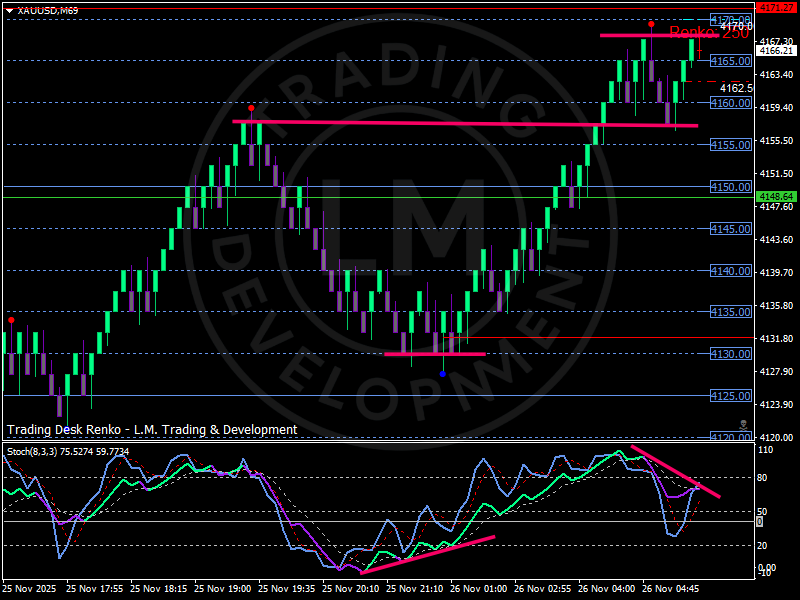
From the 4130 area, gold began rebuilding structure, forming higher lows and moving through intermediate levels with increasing conviction. The breakout above 4160 dollars is especially notable because it coincides with a cluster of horizontal levels derived from previous consolidations. Sustaining price above this boundary signals an underlying bid and reflects the improving macro backdrop.
Above the 4160 band, gold has been navigating the higher zone between 4165 and 4170 dollars. This area represents a short term inflection point. The chart shows two red markers near the upper boundary, indicating prior attempts to break higher. These attempts were followed by moderate pullbacks, but each time the metal refused to retrace deeply, suggesting absorption of supply.
Momentum divergence appears but has not invalidated the uptrend
The oscillator at the bottom of the chart shows a clear divergence. While price pressed higher into the 4170 zone, the momentum lines produced lower highs. This divergence warns of a possible deceleration in trend strength and may foreshadow a shallow corrective move.
However, divergences in strong macro contexts often generate pauses rather than trend reversals. As long as the metal remains above the 4155 dollars level and continues to print defended lows on Renko, the overall trend remains constructive.
The key is to distinguish between momentum loss and structural weakness. Currently, the divergence signals a need for consolidation more than a reversal. A break below 4150 dollars could change that interpretation, but this level has not been challenged yet.
Technical levels that matter in the coming sessions
The chart highlights several important price zones that will shape the near term outlook.
- 4170 dollars area: This is the local ceiling. A clean breakout through this region would signal renewed bullish pressure and could open the path toward 4180 and higher targets.
- 4165 dollars area: A dynamic threshold that often serves as a short term pivot. Sustained movement above it supports continuation.
- 4160 dollars: This is the key support in the upper structure. Holding above it preserves the bullish bias.
- 4155 dollars: First meaningful support and a natural reference for risk control. A break beneath it risks a deeper pullback.
- 4150 dollars: Structural support. Losing it would challenge the medium term bullish sequence.
- 4130 dollars: The base of the November rebound. Only a move back toward this zone would indicate a broader shift in sentiment.
The distribution of levels suggests that gold has room to explore the upper band as long as macro conditions remain supportive and the dollar continues to soften.
Why Gold remains well positioned for December
The final month of the year often delivers distinct patterns in precious metals as liquidity thins and macro themes dominate. This year, gold enters December with a compelling combination of stabilizing inflation, easing yields, currency softness and persistent geopolitical uncertainty.
These ingredients create a favourable environment for demand to remain steady even if momentum fluctuates. The Renko structure adds a layer of confirmation, showing healthy transitions between impulses and consolidations, efficient support defence and the absence of disorderly selling.
The risks are present but manageable. If yields rebound sharply or if US data strengthens enough to delay expectations of policy easing, gold may retest lower supports. Conversely, if macro conditions maintain their current tone, the metal could extend the November advance into early December.
The tactical picture remains dependent on short term data, but the structural picture remains resilient.
Conclusion
Gold continues to show constructive behaviour in both macro and technical dimensions. The interplay of softer yields, a weakening dollar, geopolitical uncertainty and steady central bank buying has reinforced the metal’s upward bias. The Renko chart adds clarity to this narrative, revealing well supported structures, consistent rebounds and the potential for continued exploration of upper resistance.
As long as XAUUSD holds above the 4160 and 4155 levels, the trend remains constructive into December. A breakout above 4170 dollars would confirm renewed strength and validate the bullish case. For traders and analysts, the focus shifts to how incoming macro data interacts with this structure and whether the conditions that lifted gold in November persist into the final month of the year.
Author

Luca Mattei
LM Trading & Development
Luca Mattei is a market analyst focusing on FX, metals, and macroeconomic trends. He develops trading tools for retail and professional traders, coding indicators and EAs for MT4/MT5 and strategies in Pine Script for TradingView.