|

Gold re-enters 2,000 zone; outlook bullish [Video]

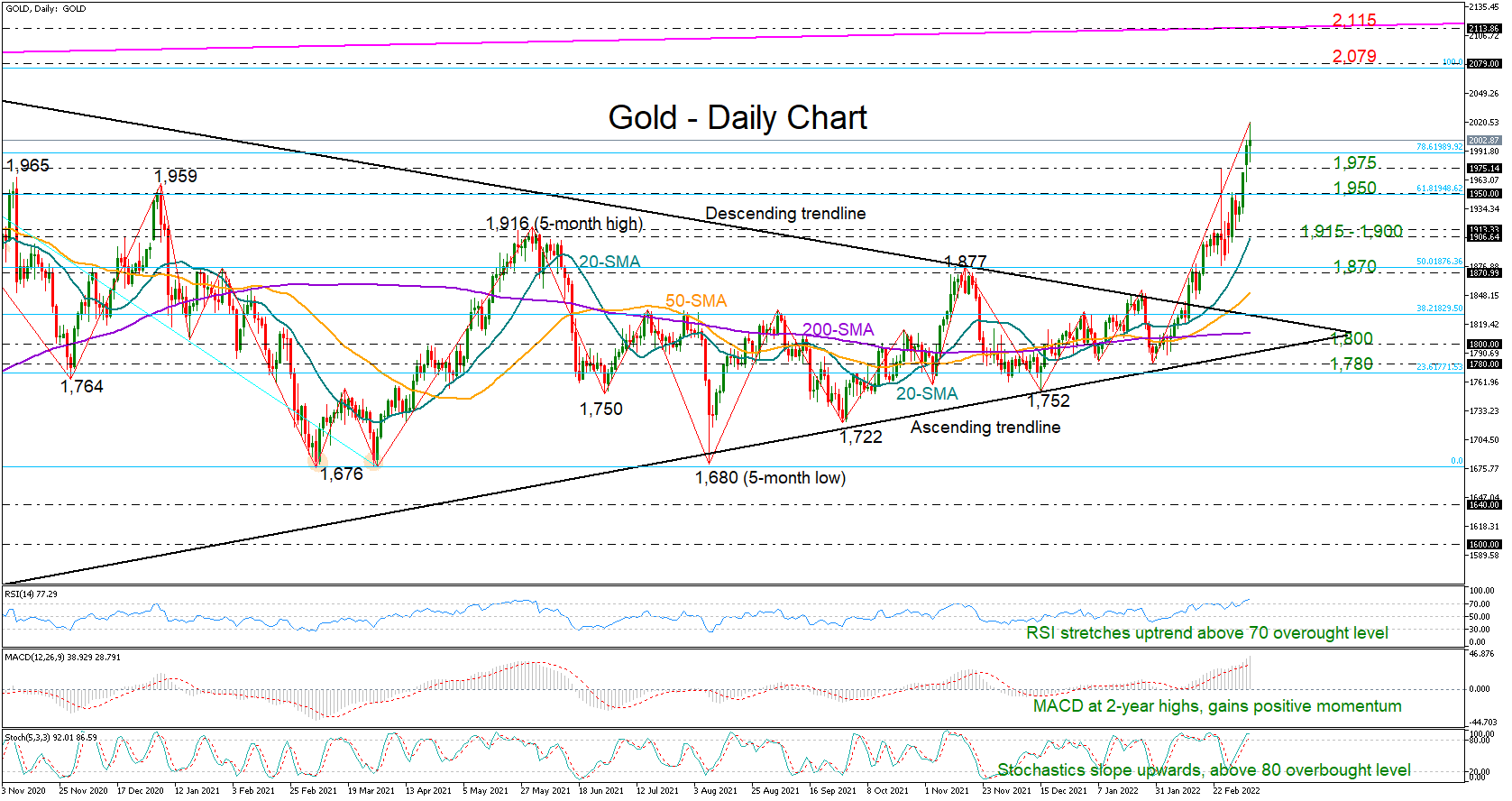
Gold staged another exciting bullish run early on Tuesday to finally re-enter the 2,000 level after almost two years since its pandemic peak. 

Particularly, the price is currently testing the resistance zone of 2,020 from August 2020, making any downside corrections or some consolidation likely at this point as the RSI and the Stochastics flash overbought conditions. That said, neither of those indicators is showing signs of abating, while the MACD continues to gain momentum at two-year highs, reflecting persisting buying forces.

Meanwhile in trend indicators, the shorter-term simple moving averages (SMAs) keep pointing upwards with a steeper positive slope than the longer-term SMAs, endorsing the improving broad outlook in the market.

On the upside, the biggest challenge will be the 2,079 record high and potentially the 2,115 region, where the tentative ascending line that joins the 2011 and 2020 peaks is passing through. A sustainable extension above that boundary may hit a new wall around the 2,300 level taken from the 161.8% Fibonacci retracement of the 2,079 – 1,676 downleg.

Should selling pressures resurface, initial support could commence around the 1,975 zone, while a sharper decline below 1,950 could squeeze the price towards the 1,915 – 1,900 area and the 20-day SMA. Lower, the bears could take a rest somewhere near 1,870.

Summarizing, gold has opened the gates towards the 2,079 record high after restoring its bullish outlook in the long-term picture. While some stabilization could be normal after the impressive three-day rally, the technical picture suggests buyers may not easily lose their interest in the market.
Gold

Author

Christina Parthenidou

Christina joined Trading Point in May 2017. She holds a master degree in Economics and Business from the Erasmus University Rotterdam with a specialization in International economics.


More from Christina Parthenidou
Share:

Editor's Picks

AUD/USD sits at three-week highs above 0.7000 on hawkish RBA-speak

AUD/USD holds a positive bias for the fourth straight day, trading above 0.7000 in the Asian session on Wednesday and at three-week highs. RBA Deputy Governor Andrew Hauser's hawkish remarks and inflation concerns underpin the pair. However, the upside appears capped as the US Dollar attracts some buyers amid looming US-Iran uncertainty.

USD/JPY remains confined in a familiar range below 158.50

USD/JPY sees some dip-buying in the Asian session on Wednesday, though it remains confined within a multi-week range near 158.50 as the uncertainty over the timing of the next BoJ rate hike keeps Japanese Yen bulls on the defensive. Meanwhile, hawkish Fed expectations, bolstered by inflation risks stemming from volatile oil prices, underpin the US Dollar. However, looming intervention fears could limit JPY losses and cap the currency pair.

Gold extends losing spree as US bond yields hold ground

Gold extends its losing streak for the fourth trading day on Wednesday, trading 0.2% lower to near $4,115 in the Asian session. The precious metal is under pressure as United States Treasury Yields on the back of significant gains in oil prices in past few weeks.

Bitcoin gains strength as Ethereum and Ripple selling eases

Top three cryptocurrencies, Bitcoin, Ethereum, and Ripple, are holding steady on Wednesday after a bullish close the previous day. The mild recovery hints at an extended rally as the prevailing bearish pressure eases. Bitcoin trades at $82,930 on Wednesday, holding a bullish near-term bias following a mild rebound the previous day.

US – Midterm update: Pre-election tail risk scenarios
With two weeks until the US midterm elections on 3 November, early voting has already opened in more than 40 states. Prediction markets are broadly unchanged since we published our Midterm update, 13 October. The prediction market Polymarket continues to see Democrats winning both chambers as the most likely outcome, with a 62.5% probability.
The US Dollar fell. Gold didn't rally. That tells you everything
Gold (XAU/USD) is struggling to capitalize on a weaker US Dollar (USD), after repeatedly failing to establish itself above the $4,200 level. The precious metal remains confined to a relatively narrow trading range despite a combination of developments that would normally support higher prices.