Gold Price Weekly Forecast: XAU/USD holds above key support ahead of NFP
- Gold price dropped to a fresh multi-month low this week.
- XAU/USD technical outlook suggests that sellers retain control despite latest rebound.
- June jobs data from the US could trigger the next big reaction in the pair.

Gold price extended its downtrend this week and touched $1,893, its lowest level since March, before erasing a portion of its weekly losses on Friday. ISM PMI surveys and June jobs report from the US could drive XAU/USD’s action next week but the technical outlook suggests that the bearish bias is likely to stay intact in the near term.
What happened last week?
In the absence of high-impact macroeconomic data releases, financial markets remained relatively quiet on Monday, allowing XAU/USD to consolidate the prior week’s losses.
During the Asian trading hours on Tuesday, Chinese Premier Li Qiang said that China was still on track to reach its annual growth target of around 5.0% for the year. "China will introduce more pragmatic measures to expand domestic demand and stimulate market vitality," Li added, noting that the economy is expected to grow at a stronger pace in the second quarter than in the first one. Risk mood improved on these comments, but gold struggled to find demand as the 10-year US Treasury bond yield pushed higher after US data showed that consumer sentiment improved noticeably in June and New Home Sales rose at a much stronger pace than expected in May.
Federal Reserve Chairman Jerome Powell stuck to his hawkish rhetoric while speaking at the European Central Bank’s (ECB) annual Forum on Central Banking on Wednesday, prompting XAU/USD to continue to stretch lower. "We believe there's more restriction coming, driven by the labor market,” Powell said. He added that a strong majority of policymakers forecasted two more interest-rate hikes in the dot plot. Meanwhile, results of the Fed’s Bank Stress Test showed that large US banks were “well-positioned to weather a severe recession and continue to lend to households and businesses even during a severe recession.”
Gold moved sideways during the European trading hours on Thursday, but came under heavy bearish pressure on upbeat US macroeconomic data. The US Bureau of Economic Analysis (BEA) announced that it revised the annualized Gross Domestic Product (GDP) growth for the first quarter higher to 2% from the previous estimate of 1.3%. Additionally, the number of first-time applications for unemployment benefits declined by 26,000 to 239,000 in the week ending June 24. The 10-year US yield surged past 3.8% on hawkish Fed bets after these data, dragging XAU/USD below $1,900 for the first time in over three months. Later in the session, the National Association of Realtors reported a 2.7% decline in Pending Home Sales in May, which limited the USD’s gains. In turn, XAU/USD managed to return back above $1,900. However, this rebound could also be a sign of stop losses getting triggered below $1,900.
The BEA reported on Friday that the Personal Consumption Expenditures (PCE) Price Index declined to 3.8% on a yearly basis in May from 4.3%. The Core PCE Price Index, the Fed's preferred gauge of inflation, edged lower to 4.6% from 4.7% in the same period. These readings made it difficult for the USD to hold its ground and allowed XAU/USD to edge higher ahead of the weekend.
Next week
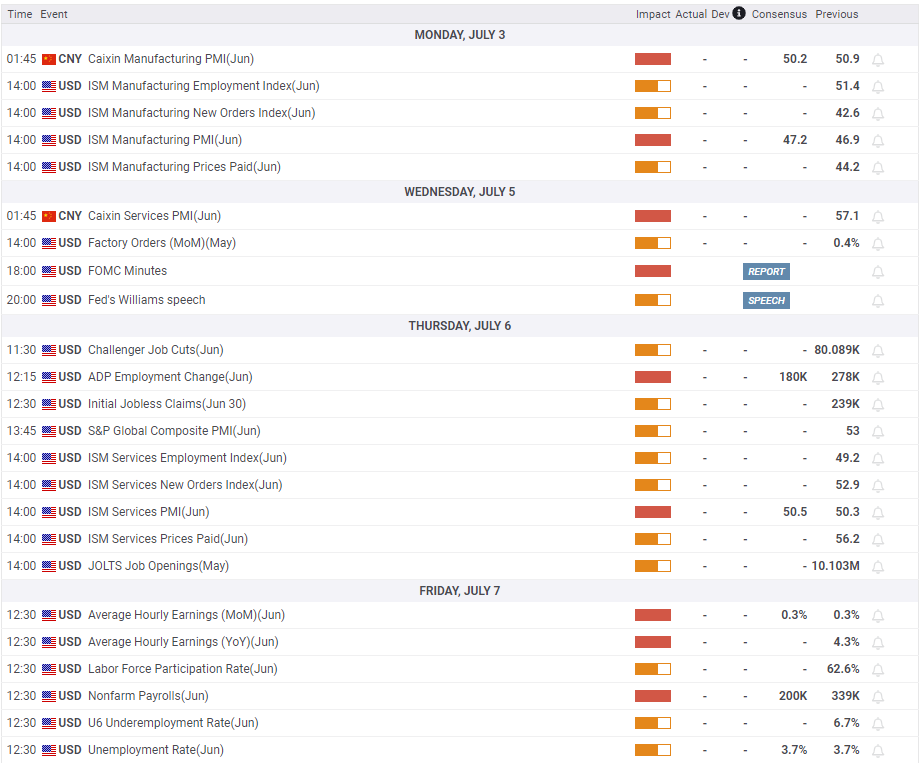
The ISM will release the Manufacturing PMI report for June on Monday. In case the headline recovers into the expansion territory above 50, the USD is likely to continue to stay resilient against its rivals. Investors will also pay attention to the employment component of the survey. An unexpected decline below 50 in this index could limit the USD’s gains even if the report signals growth in the sector’s overall business activity. Ahead of the July 4 holiday on Tuesday, however, trading conditions could thin out on Monday, paving the way for a quiet American session.
On Wednesday, the Fed will release the minutes of the June policy meeting. At this point, it should not be surprising if the publication shows that some policymakers didn’t rule out a return to rate hikes as early as July. An optimistic tone regarding the inflation outlook could hurt the USD but investors are likely to hesitate to take large positions ahead of the key employment data later in the week.
Private sector employment report published by Automatic Data Processing (ADP) and ISM Services PMI will be featured in the US economic docket on Thursday. On Friday, the US Bureau of Labor Statistics (BLS) will release the June jobs report, which is forecast to show an increase of 200,000 in Nonfarm Payrolls. This consensus forecast is subject to change once the data release comes closer.
Fed policymakers acknowledged recently that there is some softening in the labor market. Powell, however, noted at the ECB event that there are still around 1.7 job openings for every unemployed person in the US, highlighting a persisting imbalance between labor supply and demand.
The CME Group FedWatch Tool shows that markets have already nearly fully priced in another 25 bps rate hike in July. Hence, investors will try to figure out whether the jobs data will be good enough to open the door for one more rate hike later in the year. Currently, the probability of the Fed raising its policy rate by a total of 50 bps before year-end stands at around 40%. Market positioning suggests that the USD has more room on the upside in case NFP increase more than expected. A stronger-than-foreacast employment increase could help the Fed convince investors about its willingness to lift the policy rate to the 5.5%-5.75% range from the current 5%-5.25%. On the other hand, a disappointing jobs report, with a NFP print close to 100,000, could revive expectations for a less aggressive Fed tightening and cause US yields to turn south. In that scenario, XAU/USD could gather recovery momentum.
In summary, Gold’s valuation next week will likely be impacted by the market pricing of the Fed’s rate outlook. Although XAU/USD could rebound in case US data go against the Fed view of two more rate hikes, the pair’s upside is likely to remain capped, with investors refraining from betting on a Fed policy pivot before seeing inflation and jobs data in the third quarter of the year.
Gold technical outlook
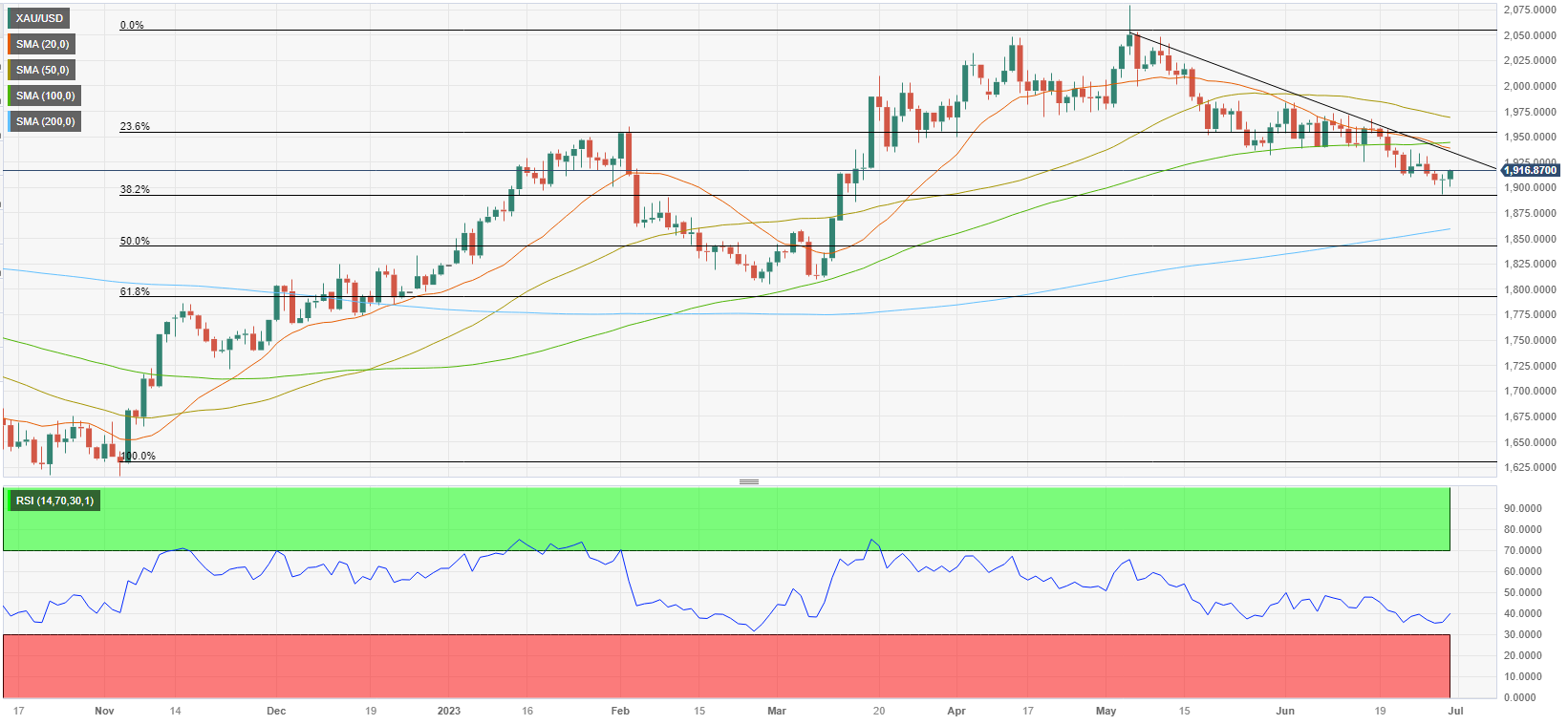
Despite Friday's rebound, the Relative Strength Index (RSI) indicator on the daily chart stays well below 50. Additionally, the 20-day Simple Moving Average (SMA) completed a bearish cross with the 100-day SMA, highlighting the bearish bias.
Thursday's volatile action confirmed $1,900 (Fibonacci 38.2% retracement of the latest uptrend, psychological level) as strong support for XAU/USD. In case the pair falls below that level and starts using it as resistance, $1,860 (200-day SMA) and $1,845 (Fibonacci 50% retracement) could be seen as next targets on the downside.
$1,940 (descending trend line, 100-day SMA) aligns as stiff resistance before. A daily close above that level could attract buyers and open the door for another leg higher toward $1,960 (Fibonacci 23.6% retracement) and $1,970 (50-day SMA).
Gold forecast poll
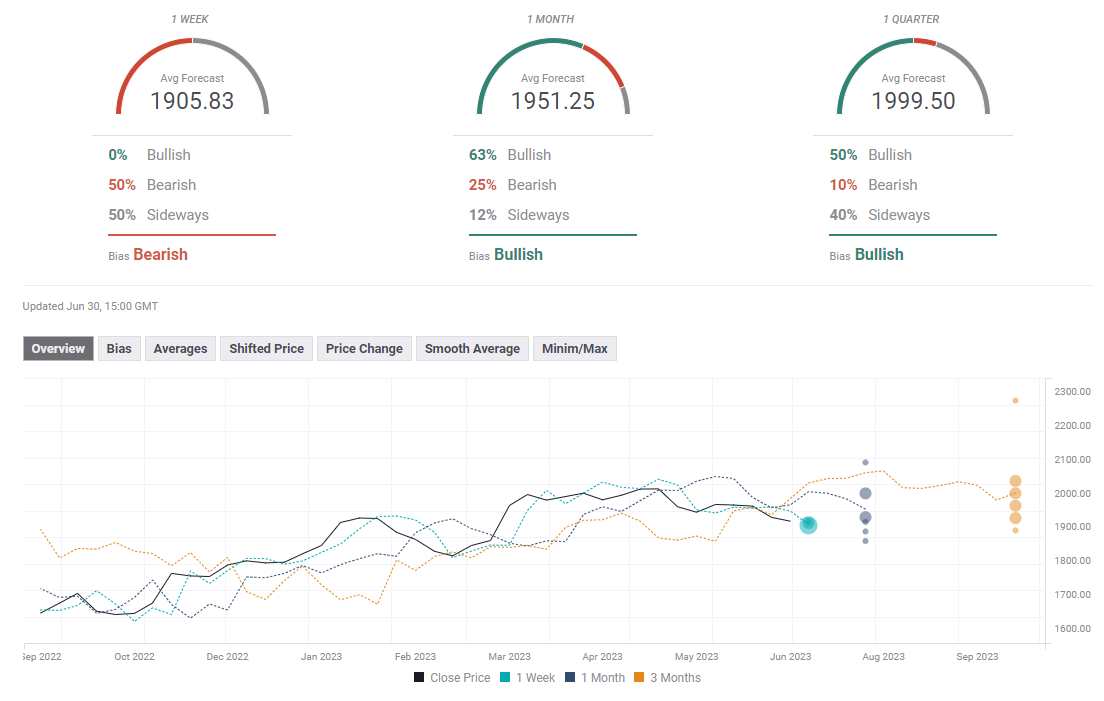
FXStreet Forecast Poll shows that experts expect XAU/USD to either edge lower or remain neutral next week, with the average target aligning at $1,905. The one-month and one-quarter outlooks both remain bullish.
Author

Eren Sengezer
FXStreet
As an economist at heart, Eren Sengezer specializes in the assessment of the short-term and long-term impacts of macroeconomic data, central bank policies and political developments on financial assets.

















