Gold Price Weekly Forecast: Bulls struggle to keep XAU/USD above $2,000
- Gold price snapped a two-week winning streak following Friday's sharp decline.
- Key short-term support level for XAU/USD is located at $1,940.
- First-quarter GDP data from the US will be watched closely by market participants next week.

Gold price fluctuated in a relatively tight channel for the majority of the week but edged lower on Friday after buyers failed to reclaim $2,000. High-tier macroeconomic data releases from the US could drive XAU/USD’s action next week with the Federal Reserve’s blackout period starting on April 22.
What happened last week?
The recovery seen in the US Treasury bond yields that started toward the end of the previous week continued on Monday as markets leaned toward one more Federal Reserve (Fed) rate hike in May. With the benchmark 10-year US Treasury bond yield rising to its highest level in over two weeks at 3.6%, Gold price turned south and closed the first day of the week below the key $2,000 level.
On Tuesday, the data from China, the world’s biggest gold consumer, revealed that the economy expanded at an annualized rate of 4.5% in the first quarter, much stronger than the 2.9% growth recorded in the last quarter of 2022. This reading also surpassed the market expectation for an expansion of 4%. Additionally, Retail Sales rose by 10.6% on a yearly basis, compared to analysts' estimate of 7.4%. In turn, XAU/USD regained its traction and climbed above $2,000. Moreover, the improving risk mood made it difficult for the US Dollar (USD) to build on its recent gains and helped the pair snap a two-day losing streak.
The stronger-than-expected Consumer Price Index (CPI) data from the UK reminded investors about the possibility that major central banks could stick to tight policies for longer than expected amid sticky global inflation. In turn, global bond yields climbed higher led by a strong upsurge seen in the UK gilt yields mid-week. As a result, XAU/USD came under heavy bearish pressure and dropped below $1,970 for the first time since early April. With the USD struggling to preserve its strength in the second half of the day, however, the pair erased a portion of its daily losses.
The disappointing macroeconomic data releases from the US didn’t allow the USD to find demand on Thursday and Gold price advanced beyond $2,000 once again. The Initial Weekly Jobless Claims in the US rose to 245,000 from 240,000 and the Federal Reserve Bank of Philadelphia’s Manufacturing Index dropped to -31.3 in April from -23.2. Finally, Existing Home Sales declined by 2.4% in March, missing the market expectation for an increase of 1.5% by a wide margin.
Gold price reversed its direction on Friday and the technical selling pressure increased after it broke below $2,000. With the S&P Global PMI data from the US showing that the business activity expanded at a stronger pace than expected in early April, the USD kept its footing heading into the weekend, causing XAU/USD to end the week in negative territory.
Next week
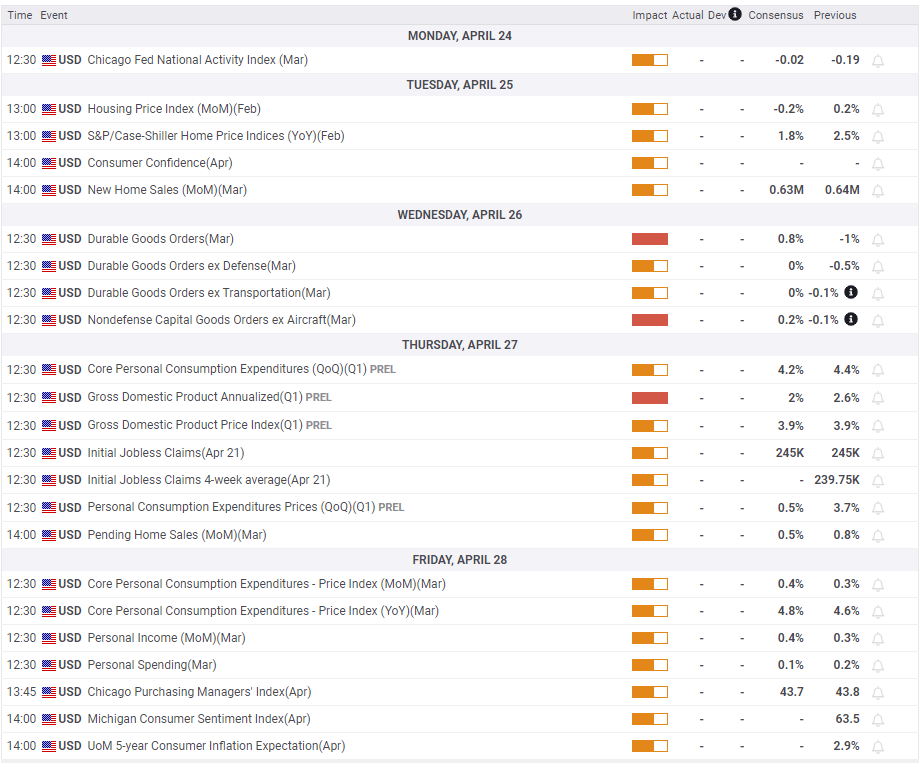
The Conference Board’s (CB) Consumer Confidence Index for April on Tuesday will be the first important data release from the US next week. Last week, the sharp increase in the one-year inflation expectation component of the University of Michigan’s Consumer Sentiment Survey helped the USD gather strength and forced XAU/USD to fall sharply. Hence, a similar reaction to the CB’s consumer survey could be witnessed.
On Wednesday, the US Census Bureau will publish the Durable Goods Orders data for March. In the past couple of weeks, markets have been reacting to high-tier data releases from the US in a straightforward way with disappointing figures weighing on the USD and vice versa. Before the US Bureau of Economic Analysis unveils the first estimate of the first quarter Gross Domestic Product (GDP) on Thursday, however, the market impact of the Durable Goods Orders report could remain short-lived.
The US economy is forecast to expand at an annual rate of 2.7% in Q1, slightly above the 2.6% growth recorded in the last quarter of 2022. Investors have been growing increasingly concerned about the US economy tipping into recession later in the year, especially after the banking crisis unveiled tightening financial conditions. Hence, a GDP reading at or below 2% could bring back expectations of Fed rate cuts toward the end of the year and cause the USD to come under heavy selling pressure. On the other hand, the positive impact of a stronger-than-expected GDP growth should have the opposite effect, lifting USD higher and weighing on XAU/USD.
Gold price technical outlook
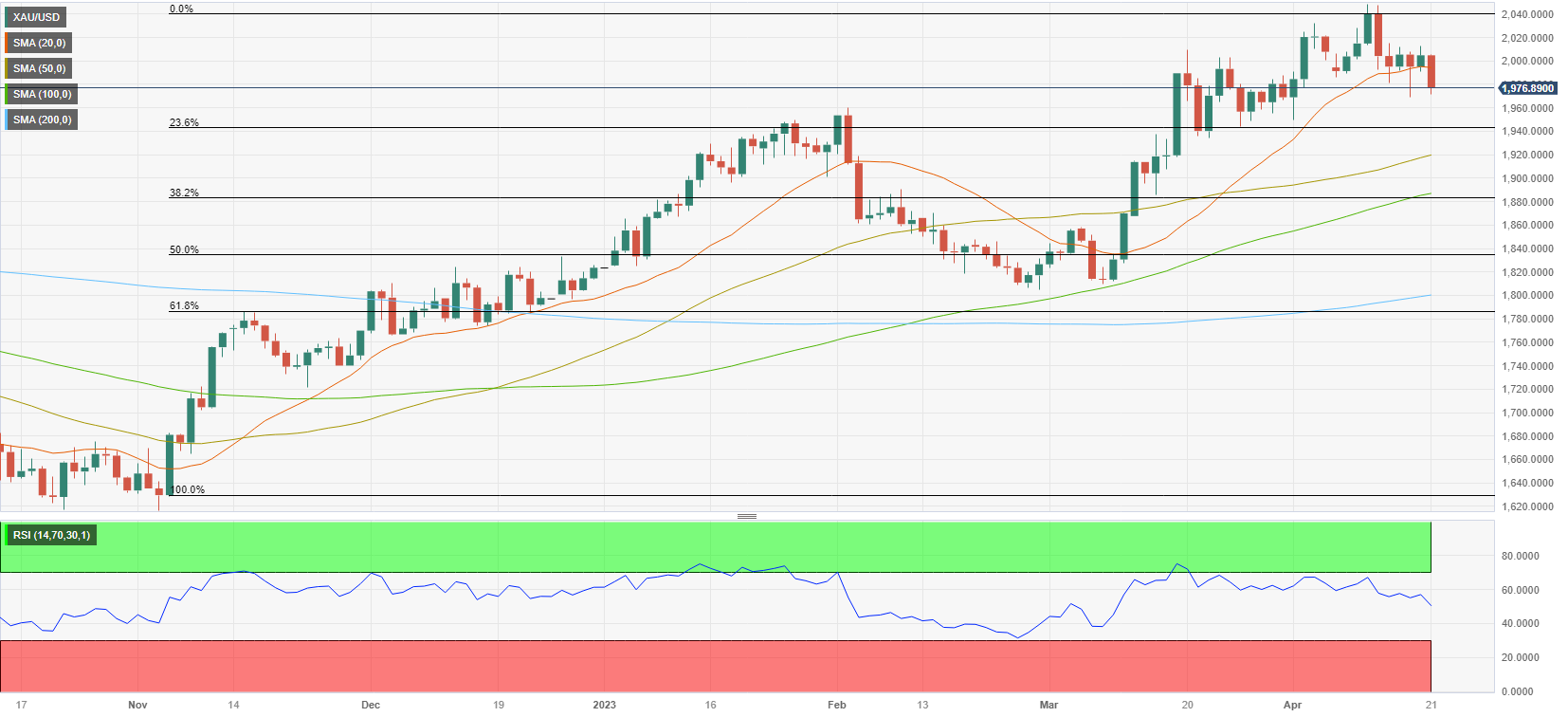
With Friday's decline, XAU/USD closed below the 20-day Simple Moving Average (SMA) for the first time since early March. Additionally, the Relative Strength Index declined slightly below 50, reflecting the bearish shift in the short term outlook.
On the downside, $1,940 (Fibonacci 23.6% retracement of the latest uptrend) aligns as key support. If XAU/USD makes a daily close below that level, additional losses toward $1,920 (50-day SMA) and $1,900 (psychological level, static level) could be witnessed.
This week's price action, once again, proved that $2,000 is a tough resistance to crack. In case Gold price rises above that level and starts using it as support, it could face interim resistance at $2,020 (static level) before testing $2,040 (end-point of the latest uptrend).
Gold price forecast poll
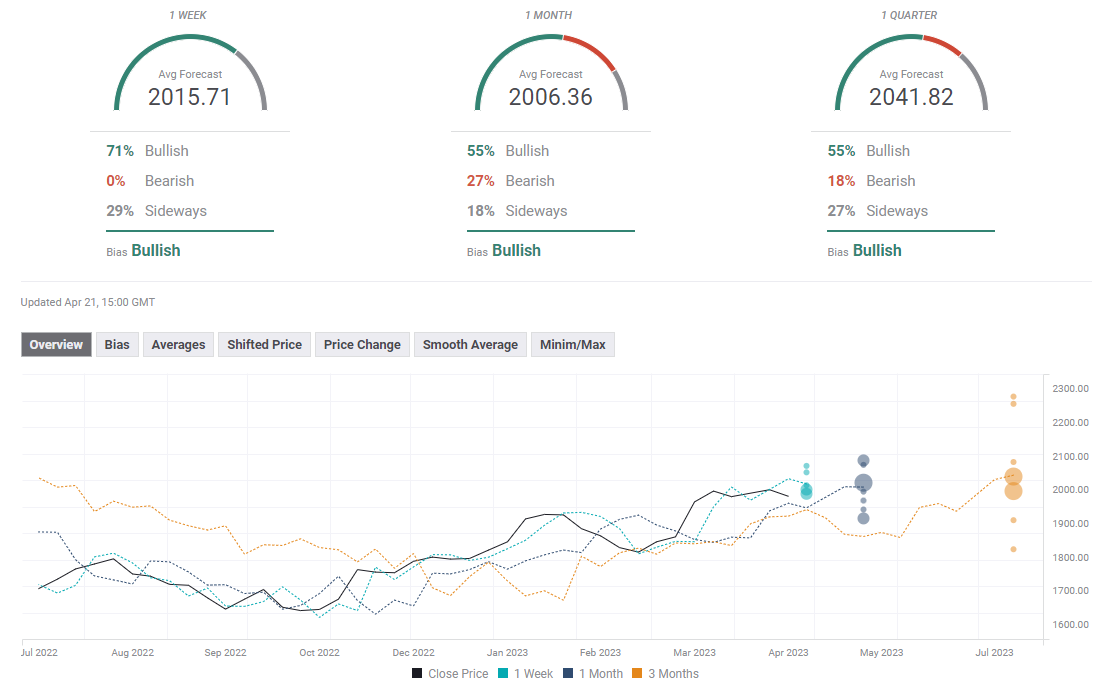
Despite XAU/USD's uninspiring performance, the FXStreet Forecast poll points to an overwhelmingly bullish bias in the short term. The one-week average target of polled experts is located at $2,015.
Author

Eren Sengezer
FXStreet
As an economist at heart, Eren Sengezer specializes in the assessment of the short-term and long-term impacts of macroeconomic data, central bank policies and political developments on financial assets.

















