Gold price today: One analyst sees a slide to $3,500, two are watching friday's jobs report

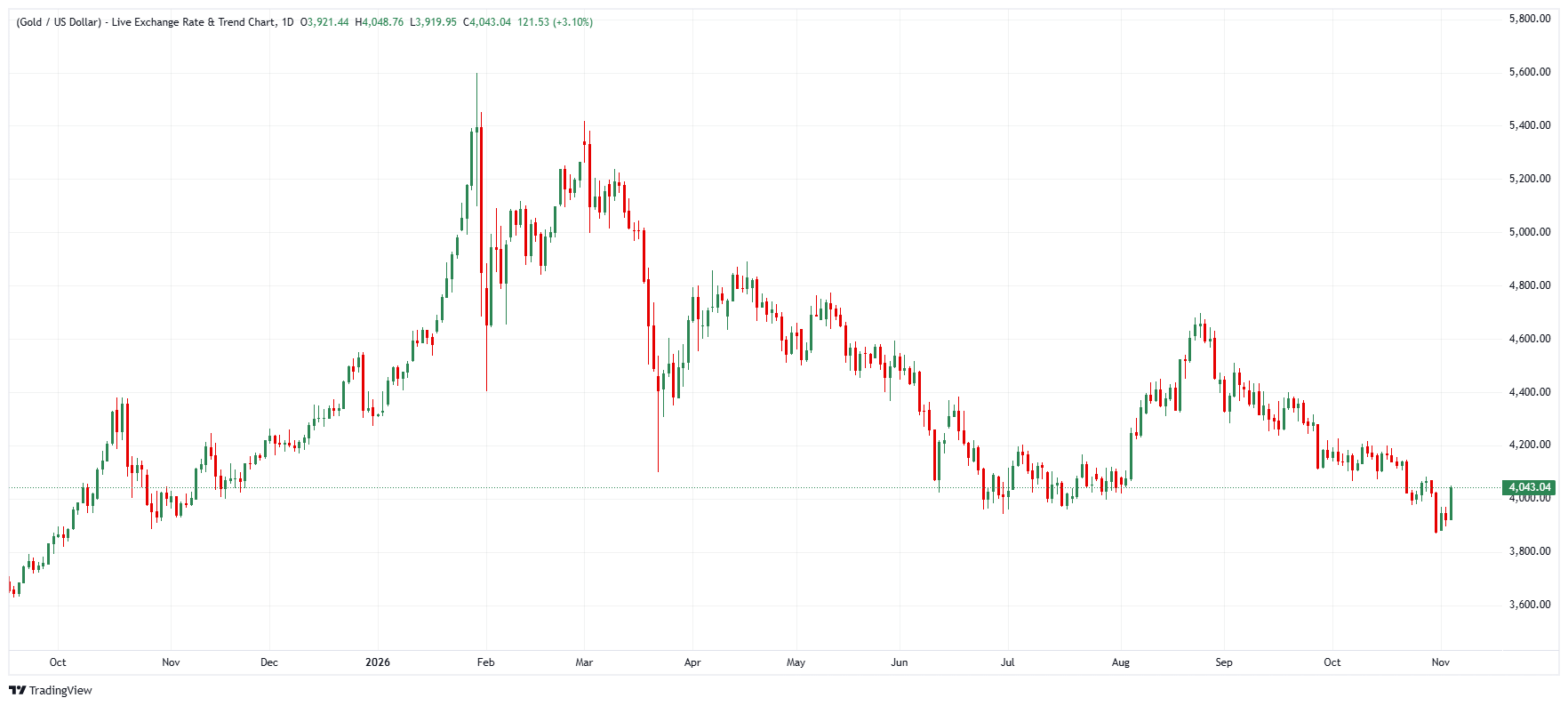
Gold (XAU/USD) edges higher and recovers above the $4,000 mark at the time of writing on Wednesday after clinching an uncomfortable milestone: the drop from its final top to this year's breakdown now measures 17.5% - exactly what Gold fell in 2013 before collapsing much further. The three latest takes split cleanly on what comes next: one analyst says the 2013 replay sends Gold to $3,500, while the other two point to record central-bank and ETF buying - and a clearly defined technical floor ahead of Friday's US Nonfarm Payrolls (NFP) - as reasons the slide may not run that far.
Gold Price Forecast’s Przemyslaw Radomski: The numbers say 2013 all over again
Przemyslaw Radomski is the bear of the trio, and his case is statistical: Gold topped at $4,696 on August 25, closed below its 2026 lows on October 30, and the fall from its final top to the breakdown matches 2013 to the decimal. "With the first target reached, the next one is about $3,500," he wrote in his November forecast, adding that once Gold tests $3,500 he expects a rebound "to more or less the current levels, with gold verifying $4,000 as resistance," before a final slide to the low $3,000s - about $3,090 on the full 2013 mapping. The tape backs his read: "The head-and-shoulders top on the above chart was completed, and its downside target is about $3,920." Gold hit it the next day, and Monday's $70.70 rally faded in a single session. — Read the full report
FXStreet’s Sagar Dua: The US jobs report is the next catalyst
The FXStreet analyst is technically cautious - Gold sits below the 20-day EMA at $4,050 with the RSI at 37 on the daily chart and the one-year low at $3,870.23 as key support - but his argument now runs through data, not price. Friday's Nonfarm Payrolls for October, he notes, "is expected to have a significant impact on Fed's interest rate expectations." Before that, ADP is seen showing 69K private jobs versus 90K in September, while September's JOLTS already surprised to the upside at 7.523 million openings - a mix that leaves rate expectations, and the US Dollar's pull on Gold, hanging on Friday's print. — Read the full report
Money Metals Exchange’s Mike Maharrey: Demand didn't crack - it changed hands
Mike Maharrey brings the physical-market check from the World Gold Council's Q3 data: total demand of 1,369 tonnes was down just 1% year-on-year, with year-to-date demand of 3,881 tonnes virtually matching last year's record pace. Central banks bought an estimated 321 tonnes - roughly 100 more than the five-year quarterly average - ETFs added 211 tonnes of inflows to a record 4,256 tonnes of holdings, and the WGC does not attribute the buying to dip-chasing: "prices remained historically elevated, suggesting that longer-term strategic considerations, such as diversification and risk management, have remained the primary driver of demand." The flip side: jewelry and bar-and-coin demand hit multi-year lows as consumers balked at elevated prices. — Read the full report
The takeaway
The divergence is about timeframe: Radomski's 2013 template warns the breakdown phase has further to go - $3,500 next, and no consolidation until the low $3,000s - while Dua and Maharrey frame the drop as a market still absorbing record structural buying, with Friday's NFP the datapoint that decides which camp wins. Watch the one-year low at $3,870 to see whether the 2013 analog plays out, and the employment report for the confirmation either side needs.
(This article was created with the help of an Artificial Intelligence tool and reviewed by an editor. Know more.)
Author

FXStreet Insights Team
FXStreet
The FXStreet Insights Team is a group of journalists that handpicks selected market observations published by renowned experts. The content includes notes by commercial as well as additional insights by internal and external analysts.