Gold Price Forecast: XAU/USD ticks lower while early trend points to Democrats victory in House
- Gold trades cautiously around $3,930 ahead of the outcome of us Midterm Elections.
- Early trends show Democrats winning both the House and the Senate.
- The next key trigger for the Gold price will be the US NFP data.

Gold trades with caution at around $3,930 in the Asian trading session on Wednesday. The precious metal struggles to gain direction as investors shift their focus to United States (US) Midterm elections where early trend shows that Democrats would have a clear majority in House of Representatives.
What do early trends show and their likely impact?
According to BBC, 179/435 seats in the House of Representatives are counted and Democrats are leading with 114 seats. For a clear majority, any party needs to win 218 seats.
Several market experts had anticipated a significant chance of Democrats winning both House and the Senate.
Strategists at Brown Brothers Harriman (BBH) highlighted that betting markets “favor a Democratic sweep,” with Polymarket and Kalshi “putting the odds around 70%.”
ING argued that such an outcome “could make the case that the Dollar should come lower,” as a Democrat clean sweep would likely “lead to gridlock on the debt ceiling, a prolonged government shutdown next year and could encourage President Trump to pursue an even more activist foreign policy agenda.” Against that backdrop, Turner suggests investors will be weighing these political risks against the still-supportive mix of strong US growth, above-target inflation and ongoing Federal Reserve (Fed) tightening for the Dollar.
Lower US Dollar would make the Gold price a favorable risk-reward bet for investors.
NFP data – next key major trigger
Going forward, the next major trigger for Gold will be the US Nonfarm Payrolls (NFP) data for October, which is scheduled for Friday. The official employment data is expected to have a significant impact on Fed’s interest rate expectations.
Before that, investors will pay attention to the US ADP Employment Change data for October, which will be published at 13:15 GMT. The data is expected to show that the private sector created 69K fresh jobs lower than 90K in September.
Meanwhile, the US JOLTS Job Openings data for September has come in stronger than expected. The Bureau of Labor Statistics (BLS) reported that employers posted 7.523 million fresh jobs, higher than 7.13 million estimates and the prior reading of 7.19 million.
Gold Technical Analysis
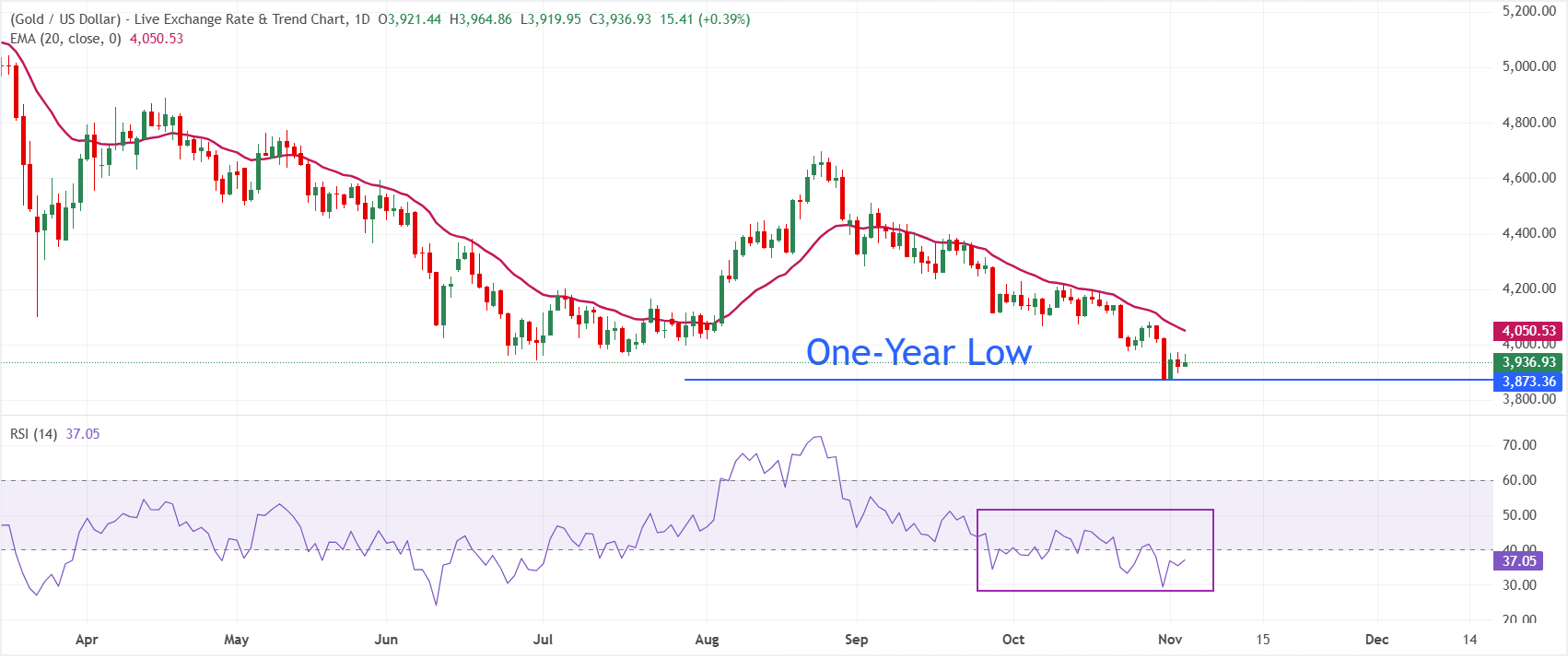
In the daily chart, XAU/USD trades at $3,937.90, maintaining a bearish near-term tone as spot remains below the 20-day exponential moving average (EMA) at $4,050.63. The metal’s inability to reclaim this short-term trend benchmark suggests rallies are still capped, while the Relative Strength Index (RSI) at 37 keeps pressure tilted to the downside without yet signaling extreme oversold conditions.
On the topside, initial resistance is located at the 20-day EMA around $4,050, which gold would need to overcome to ease immediate selling pressure and open the way for a more sustained recovery. Looking down, the one-year low at $3,870.23 is the key support level.
(The technical analysis of this story was written with the help of an AI tool. Know more.)
Gold FAQs
Gold has played a key role in human’s history as it has been widely used as a store of value and medium of exchange. Currently, apart from its shine and usage for jewelry, the precious metal is widely seen as a safe-haven asset, meaning that it is considered a good investment during turbulent times. Gold is also widely seen as a hedge against inflation and against depreciating currencies as it doesn’t rely on any specific issuer or government.
Central banks are the biggest Gold holders. In their aim to support their currencies in turbulent times, central banks tend to diversify their reserves and buy Gold to improve the perceived strength of the economy and the currency. High Gold reserves can be a source of trust for a country’s solvency. Central banks added 1,136 tonnes of Gold worth around $70 billion to their reserves in 2022, according to data from the World Gold Council. This is the highest yearly purchase since records began. Central banks from emerging economies such as China, India and Turkey are quickly increasing their Gold reserves.
Gold has an inverse correlation with the US Dollar and US Treasuries, which are both major reserve and safe-haven assets. When the Dollar depreciates, Gold tends to rise, enabling investors and central banks to diversify their assets in turbulent times. Gold is also inversely correlated with risk assets. A rally in the stock market tends to weaken Gold price, while sell-offs in riskier markets tend to favor the precious metal.
The price can move due to a wide range of factors. Geopolitical instability or fears of a deep recession can quickly make Gold price escalate due to its safe-haven status. As a yield-less asset, Gold tends to rise with lower interest rates, while higher cost of money usually weighs down on the yellow metal. Still, most moves depend on how the US Dollar (USD) behaves as the asset is priced in dollars (XAU/USD). A strong Dollar tends to keep the price of Gold controlled, whereas a weaker Dollar is likely to push Gold prices up.
Author

Sagar Dua
FXStreet
Sagar Dua is associated with the financial markets from his college days. Along with pursuing post-graduation in Commerce in 2014, he started his markets training with chart analysis.