Gold price today: One analyst sees a rebound, one sees further weakness

Gold (XAU/USD) has slipped below $4,000 into the weekend, and the two most recent FXStreet analyses read the move in opposite directions. One argues the sub-$4,000 liquidation is terminal exhaustion — aggressive selling colliding with a massive institutional demand floor — and sets up a long mean-reversion trade; the other reads the same break as a bearish continuation, with strong US Q3 Gross Domestic Product (GDP) and September's hot Personal Consumption Expenditures (PCE) data reinforcing the case for a December rate hike by the Federal Reserve (Fed), keeping non-yielding Gold under pressure.
SMAS Quantum Research’s Andrey Shvedov: The kinetic energy of the multi-day decline is reaching terminal exhaustion
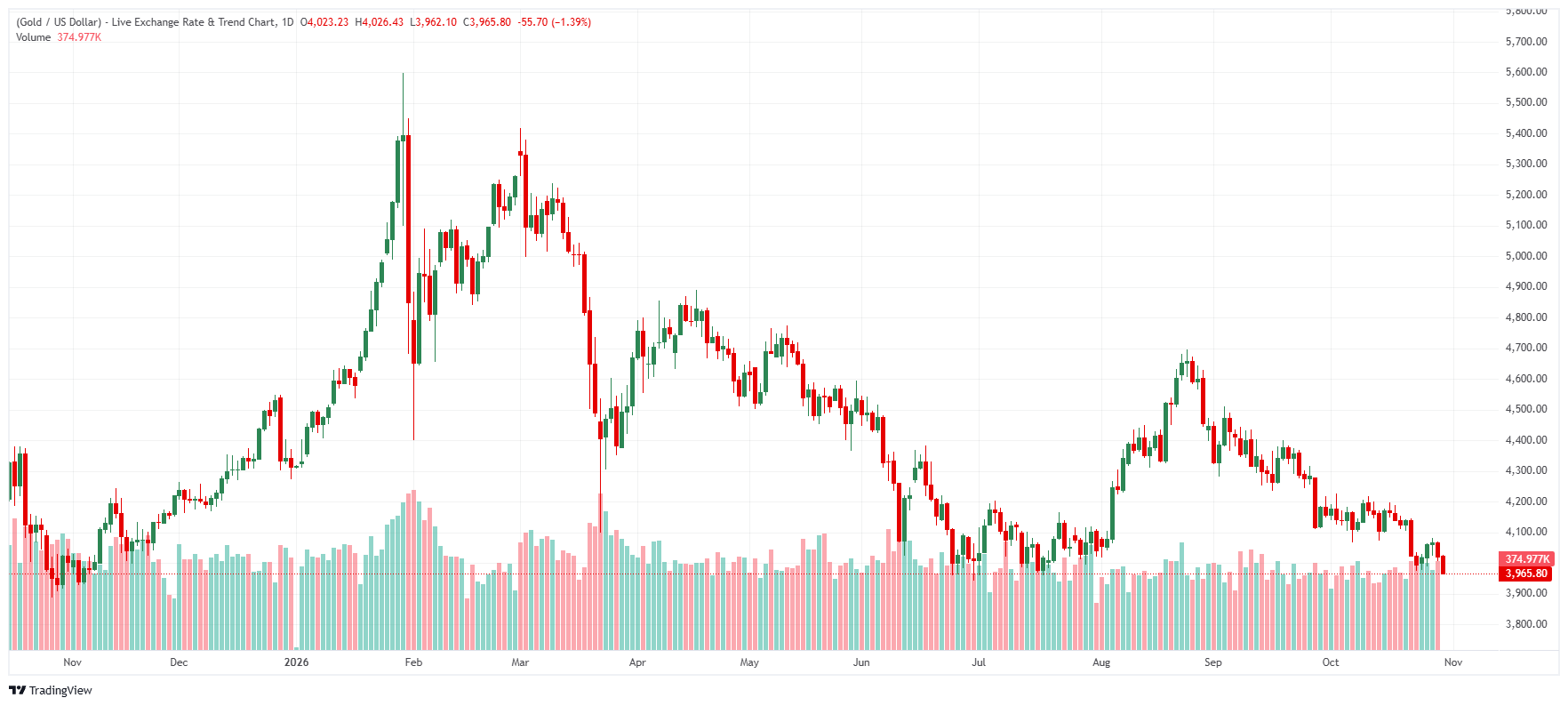
Shvedov is the contrarian voice, reading the break below $4,000 as absorption rather than breakdown. "The psychological penetration below the $4,000 threshold represents a high-velocity liquidity search," he wrote, "but this downward impulse has decelerated sharply upon colliding with the macro institutional accumulation basin established across the $3,920 to $3,960 corridor." His telemetry shows "selling velocity exhibits dramatic deceleration from -42 degrees on H1 down to -8 degrees on H4," while "the supreme macro horizon W1 stands resolutely bullish at +26 degrees." His conclusion is a buy-the-dip setup: "a high-convexity Long Mean-Reversion Scenario is deployed," with a buy limit between $3,940 and $3,965, a stop below $3,895, and targets at $4,065 and $4,175. A "confirmed H4 candle close firmly above $4,035.00 confirms the completion of sell-volume absorption." — Read the full report
FXStreet’s Sagar Dua: Strong growth and hot inflation pave the way for monetary tightening
Dua reads the same sub-$4,000 break as fundamentally driven and still in force. "Gold extends its decline below the psychological level of $4,000 while entering into the weekend," he wrote, after US preliminary Q3 GDP expanded at 3.4% annualized — "faster than estimates of 3.2% and the prior release of 2.2%" — and core PCE rose 3.1% year-over-year in September. "The combination of strong growth and hot inflation paves the way for monetary tightening by the Fed in the near term. Such a case bodes poorly for non-yielding assets, like Gold." On the technicals, Gold "trades at $3,992.40, retaining a bearish near-term bias as it holds below the 20-day EMA at $4,102.31," with the RSI at 35.87. He flags the 20-day EMA near $4,102 as the first recovery hurdle, and notes "with no clearly defined indicator-based supports just below the market," the structure "continues to favor further weakness as long as XAU/USD trades beneath its short-term EMA." — Read the full report
The takeaway
Two analysts reach opposite conclusions at the $4,000 line. Shvedov sees the sub-$4,000 liquidation as terminal exhaustion into a 7th-order demand floor spanning $3,920-$3,960, and positions for a rebound to $4,065 and $4,175. Dua sees the same break as a bearish continuation, driven by 3.4% Q3 GDP growth and 3.1% YoY core PCE in September that keep a December Fed hike alive, with no clear support until recent lows. The deciding signal is a daily close above or below the $4,035-$4,102 zone – a break above it validates Shvedov's rebound, while a failure to reclaim the 20-day EMA near $4,102 keeps Dua's downside in play.
(This article was created with the help of an Artificial Intelligence tool and reviewed by an editor. Know more.)
Author

FXStreet Insights Team
FXStreet
The FXStreet Insights Team is a group of journalists that handpicks selected market observations published by renowned experts. The content includes notes by commercial as well as additional insights by internal and external analysts.