Gold Price Forecast: XAU/USD falls below $4,000 as strong US data strengthen case for Fed rate hike
- Gold price declines further below $4,000 due to strong US economic releases.
- The US Q3 GDP growth was stronger-than-expected at 3.4%.
- Investors brace high volatility ahead of US mid-term elections.
Gold extends its decline below the psychological level of $4,000 while entering into the weekend. The precious metal faces selling pressure as better-than-projected United States (US) preliminary Q3 Gross Domestic Product (GDP) and hot Personal Consumption Expenditure (PCE) Price Index data for September have strengthen the case for an interest rate hike by the Federal Reserve (Fed) in the December policy meeting.
A look at how key US economic indicators performed on Thursday
On Thursday, the Bureau of Economic Analysis (BEA) reported that the economy expanded at an annualized pace of 3.4%, faster than estimates of 3.2% and the prior release of 2.2%. The US economic outperformance came on the back of strong consumer spending and a historic capital expenditure by hyperscalers.
Strong GDP numbers have come at a time when financial markets are shifting their focus to Mid-term elections, which will take place on November 4.
Meanwhile, the US core PCE Inflation, which strips of volatile food and energy items, and is a Fed’s preferred inflation gauge, grew by 3.1% Year-on-Year (YoY), in line with expectations, and faster than the August reading of 3%. On a monthly basis, the growth was similar to estimates and the prior release of 0.3%.
The combination of strong growth and hot inflation paves way for monetary tightening by the Fed in the near term. Such a case bodes poorly for non-yielding assets, like Gold.
What are near-term triggers for Gold?
Going forward, key triggers for Gold will be US mid-term elections and various US employment-related indicators, notably the Nonfarm Payrolls (NFP) data for October.
Analysts at Commerzbank argue that the US is “heading towards what is known as a ‘divided government’,” with a likely split between the White House and Congress. They note that in key areas for President Trump, “such as foreign and trade policy, he has in any case relied primarily on executive orders recently,” meaning much of his agenda can continue even if legislative progress slows.
However, Commerzbank cautions that “the Democrats would probably at least try to constrain the administration’s room for manoeuvre on issues of particular importance to the public, such as the current Iran conflict, which has pushed up the cost of living significantly.” Looking beyond the current term, the bank highlights that “a Congress politically opposed to the next president would increase the risk of legislative gridlock,” whereas “if the president and Congress are politically aligned, the scope for more far-reaching changes in fiscal and economic policy would increase.”
Gold Technical Analysis
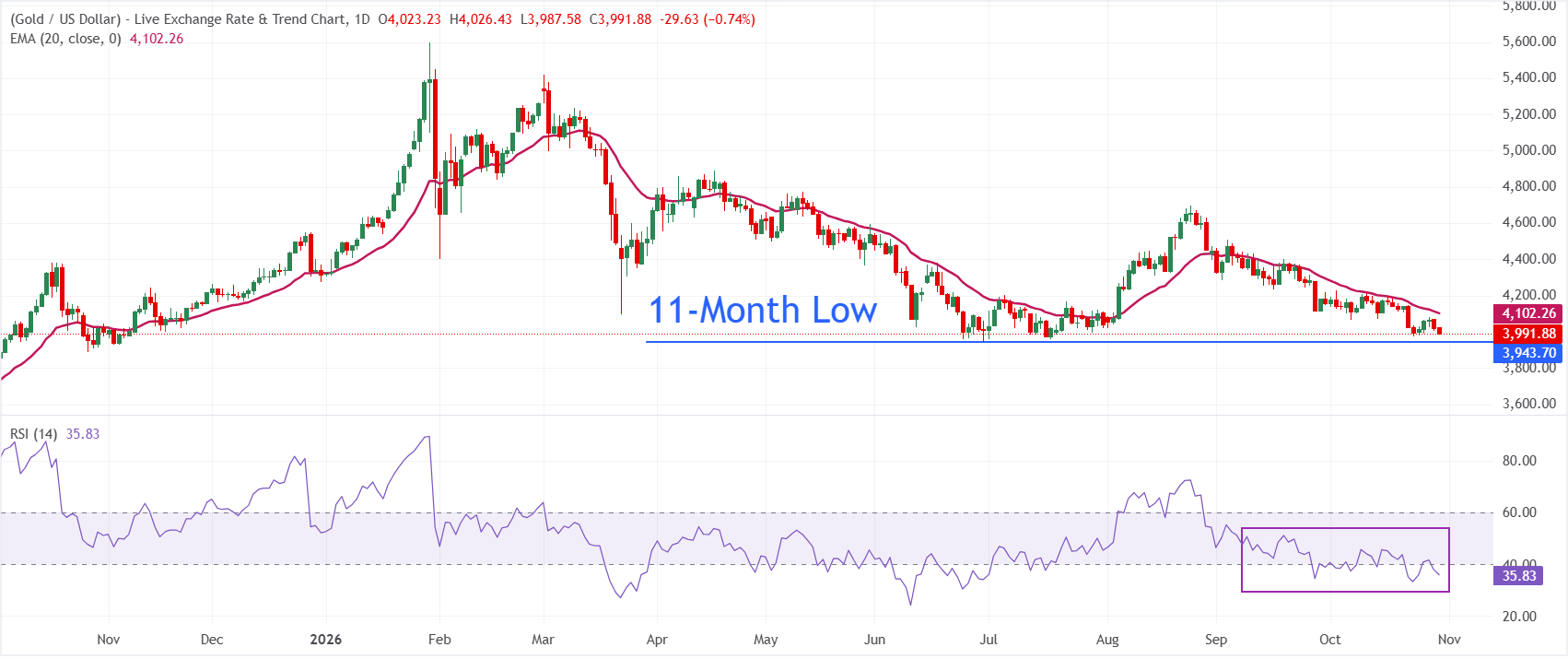
In the daily chart, XAU/USD trades at $3,992.40, retaining a bearish near-term bias as it holds below the 20-day exponential moving average (EMA) at $4,102.31. The metal has been retreating from the recent $4,300+ region, and the proximity of price to the descending EMA suggests rallies are likely to be capped while the broader trend remains under pressure. The Relative Strength Index (RSI) at 35.87 hovers just above oversold territory, hinting at persistent selling interest but without a clear exhaustion signal yet.
On the topside, immediate resistance is located at the 20-day EMA around $4,102, which acts as the first hurdle for any recovery attempt. A daily close above this level would be needed to ease the current bearish tone and open the way for a more sustained rebound toward higher levels. On the downside, with no clearly defined indicator-based supports just below the market, traders will likely look to recent price lows as provisional floors, while the overall structure continues to favor further weakness as long as XAU/USD trades beneath its short-term EMA.
(The technical analysis of this story was written with the help of an AI tool. Know more.)
Gold FAQs
Gold has played a key role in human’s history as it has been widely used as a store of value and medium of exchange. Currently, apart from its shine and usage for jewelry, the precious metal is widely seen as a safe-haven asset, meaning that it is considered a good investment during turbulent times. Gold is also widely seen as a hedge against inflation and against depreciating currencies as it doesn’t rely on any specific issuer or government.
Central banks are the biggest Gold holders. In their aim to support their currencies in turbulent times, central banks tend to diversify their reserves and buy Gold to improve the perceived strength of the economy and the currency. High Gold reserves can be a source of trust for a country’s solvency. Central banks added 1,136 tonnes of Gold worth around $70 billion to their reserves in 2022, according to data from the World Gold Council. This is the highest yearly purchase since records began. Central banks from emerging economies such as China, India and Turkey are quickly increasing their Gold reserves.
Gold has an inverse correlation with the US Dollar and US Treasuries, which are both major reserve and safe-haven assets. When the Dollar depreciates, Gold tends to rise, enabling investors and central banks to diversify their assets in turbulent times. Gold is also inversely correlated with risk assets. A rally in the stock market tends to weaken Gold price, while sell-offs in riskier markets tend to favor the precious metal.
The price can move due to a wide range of factors. Geopolitical instability or fears of a deep recession can quickly make Gold price escalate due to its safe-haven status. As a yield-less asset, Gold tends to rise with lower interest rates, while higher cost of money usually weighs down on the yellow metal. Still, most moves depend on how the US Dollar (USD) behaves as the asset is priced in dollars (XAU/USD). A strong Dollar tends to keep the price of Gold controlled, whereas a weaker Dollar is likely to push Gold prices up.
Author

Sagar Dua
FXStreet
Sagar Dua is associated with the financial markets from his college days. Along with pursuing post-graduation in Commerce in 2014, he started his markets training with chart analysis.