Gold price holds above support amid geopolitical tensions and dovish Fed outlook

Gold (XAU/USD) prices are under mild pressure but remain supported by broader market factors. Although the pullback from a three-week high is modest, the yellow metal remains supported by several broader factors. A rebound in US Dollar and improved risk sentiment have triggered some intraday profit-taking. However, market uncertainty and expectations of lower interest rates are helping limit deeper losses.
Gold corrects as US Dollar bounces back and risk appetite improves
The US Dollar bounced off a six-week low, triggering a minor correction in gold prices. This came as equity markets responded to Wall Street's positive overnight performance. The improved risk tone encouraged traders to move away from safe-haven assets like gold. Still, the overall sentiment remains cautious as broader uncertainties persist.
Geopolitical tensions continue to weigh heavily on market outlook. Former US President Donald Trump’s renewed accusations against China have sparked fears of another trade war. His decision to double steel tariffs added to the uncertainty. In addition, he is pressuring trade partners to submit proposals quickly before new tariffs are implemented. Meanwhile, instability in Eastern Europe shows no signs of easing. Ukraine-Russia peace talks remain inconclusive, and ongoing drone strikes suggest further escalation. These developments could support safe-haven flows into gold.
On the monetary policy front, expectations for US interest rate cuts in 2025 are rising. Fed Governor Christopher Waller stated that rate cuts are still possible even if tariffs cause temporary inflation. Chicago Fed’s Austan Goolsbee also sees room for easing over the next 12–18 months. In contrast, Dallas Fed’s Lorie Logan remains cautious, emphasising patience. Despite differing views, investors expect the Fed to maintain a dovish bias. Easing inflation and concerns over US fiscal health continue to limit the Dollar’s upside and provide a supportive backdrop for gold in the medium term.
Gold price breaks key resistance as bullish pattern signals move toward $3,400
The gold chart below shows a bullish technical structure on the 4-hour timeframe. A descending trend line, which had capped gold prices since mid-April, has now been broken to the upside. This breakout occurred with a strong bullish candle closing above the trend line.
The chart also reveals an inverse head-and-shoulders pattern. This pattern is typically a bullish reversal setup. The neckline around $3,360 has been breached, confirming the pattern and adding to bullish momentum.
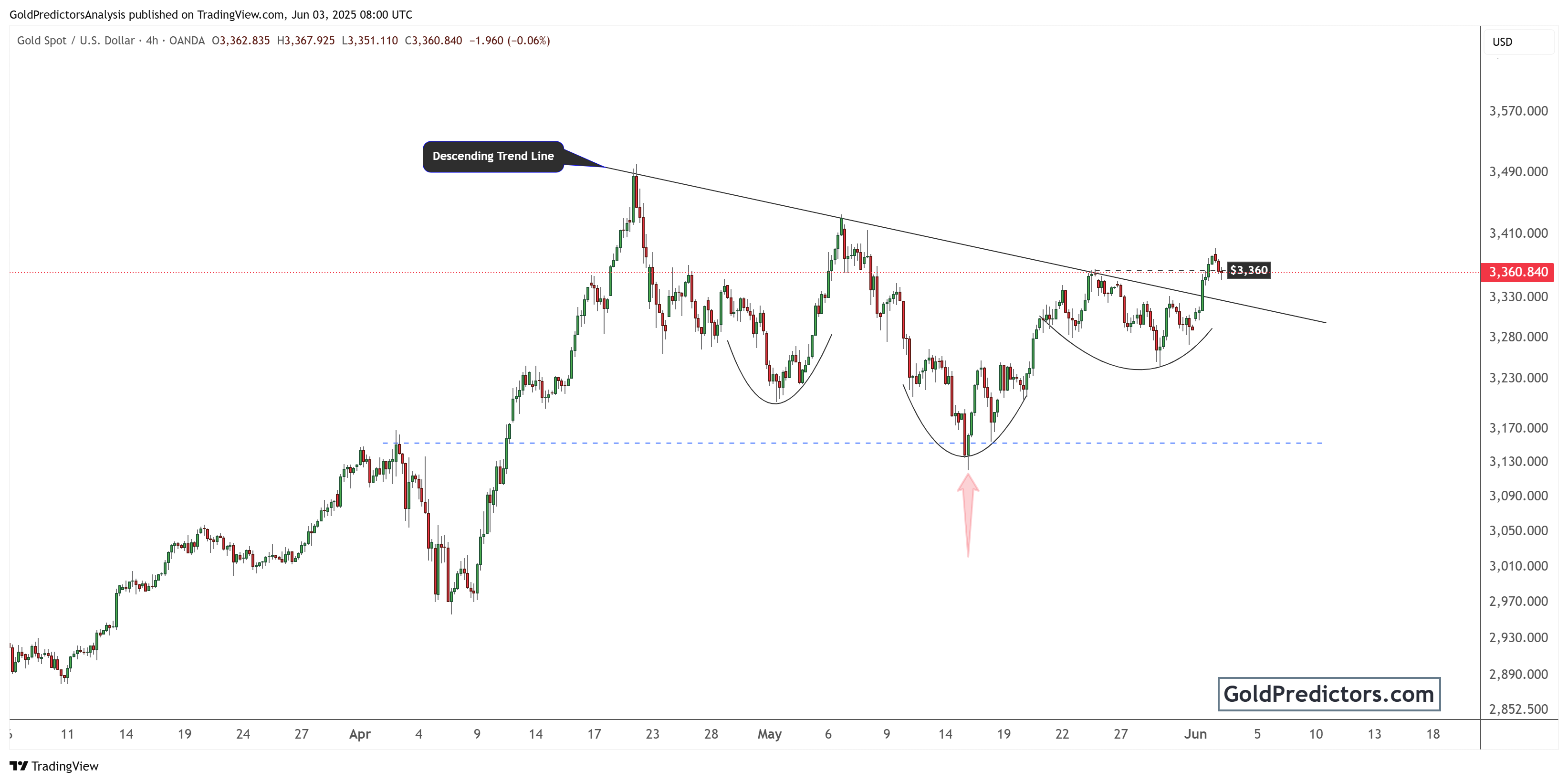
Volume and price action suggest that this breakout is significant. The price currently corrects lower to find support. If bulls can hold this level, a further move higher toward $3,400 and beyond is possible.
However, traders should be cautious. A retest of the broken trend line and the $3,360 support is likely. If this area holds, it would strengthen the bullish case. A failure to maintain this level could drag prices back into the previous range, invalidating the bullish setup.
Conclusion
Gold prices remain resilient despite recent intraday weakness. Fundamental support from geopolitical tensions and dovish Fed expectations continues to offset pressure from a stronger US Dollar and improved risk appetite. A breakout above key resistance indicates bullish potential, with the $3,360 level now serving as a critical support area. If this level holds, the technical outlook supports the prospect of further upside. Conversely, a failure to maintain support at this zone could signal a potential trend reversal. Traders should stay alert as volatility remains high.
Unlock exclusive gold and silver trading signals and updates that most investors don’t see. Join our free newsletter now!
Unlock exclusive gold and silver trading signals and updates that most investors don’t see. Join our free newsletter now!
Author

Muhammad Umair, PhD
Gold Predictors
Muhammad Umair is a financial markets analyst and investor who focuses on the forex and precious metals markets.














