Gold Price Forecast: XAU/USD threatens key $2,630 support ahead of more Fedspeak
- Gold price extends a five-day losing streak early Tuesday, despite risk aversion.
- The US Dollar pulls back with Treasury yields following dovish Fedspeak.
- Gold price threatens key $2,630 support; will it defend it amid bullish daily RSI?

Gold price maintains its corrective decline early Tuesday, looking to threaten the lower boundary of the recent range at $2,630. The focus now remains on the Middle East tensions, additional Chinese stimulus rollout and speeches from US Federal Reserve (Fed) policymakers for fresh directives.
Gold price reels from China’s economic pain
Gold price is struggling to find a foothold, as sellers remain in control amid the re-emergence of worries surrounding China’s economic prospects, as Chinese traders return after a week-long holiday break.
Even though Chinese stocks re-opened with a bang, no announcements on further stimulus so far and the National Development and Reform Commission’s (NDRC) gloomy outlook on China’s economy intensified risk aversion across Asia.
China’s state planner, the NDRC, said in its press conference that “the downward pressure on China's economy is increasing.” Gold price, therefore, remains undermined, as China is the world’s top Gold consumer.
The Gold price correction, however, appears cushioned by a broad pullback in the US Dollar (USD) alongside the US Treasury bond yields, following the dovish remarks from St. Louis Fed President Alberto Musalem. Musalem said late Monday that "further gradual reductions in the policy rate will likely be appropriate over time," adding that "I will not prejudge the size or timing of future adjustments to policy."
His comments fuelled a fresh leg down in the USD, despite markets ruling out a 50 basis points (bps) Fed rate cut next month. Markets are currently pricing in about an 86% chance that the Fed will opt for a 25 bps rate cut at its next meeting, the CME Group's FedWatch Tool shows.
Looking ahead, speeches from Atlanta Fed President Raphael Bostic and Fed Vice Chairman Philip Jefferson will be closely scrutinized in the absence of any top-tier economic data releases from the US later on Tuesday.
Traders will also pay attention to the escalating conflict between Israel and Iran, especially after the Iran-backed militant group, Hezbollah, fired dozens of rockets at Israel’s third-largest city, Haifa. Meanwhile, the Israeli military has described its recent ground operation in Lebanon as “localized, limited and targeted,” but it has steadily increased in scale beginning last week.
Gold price technical analysis: Daily chart
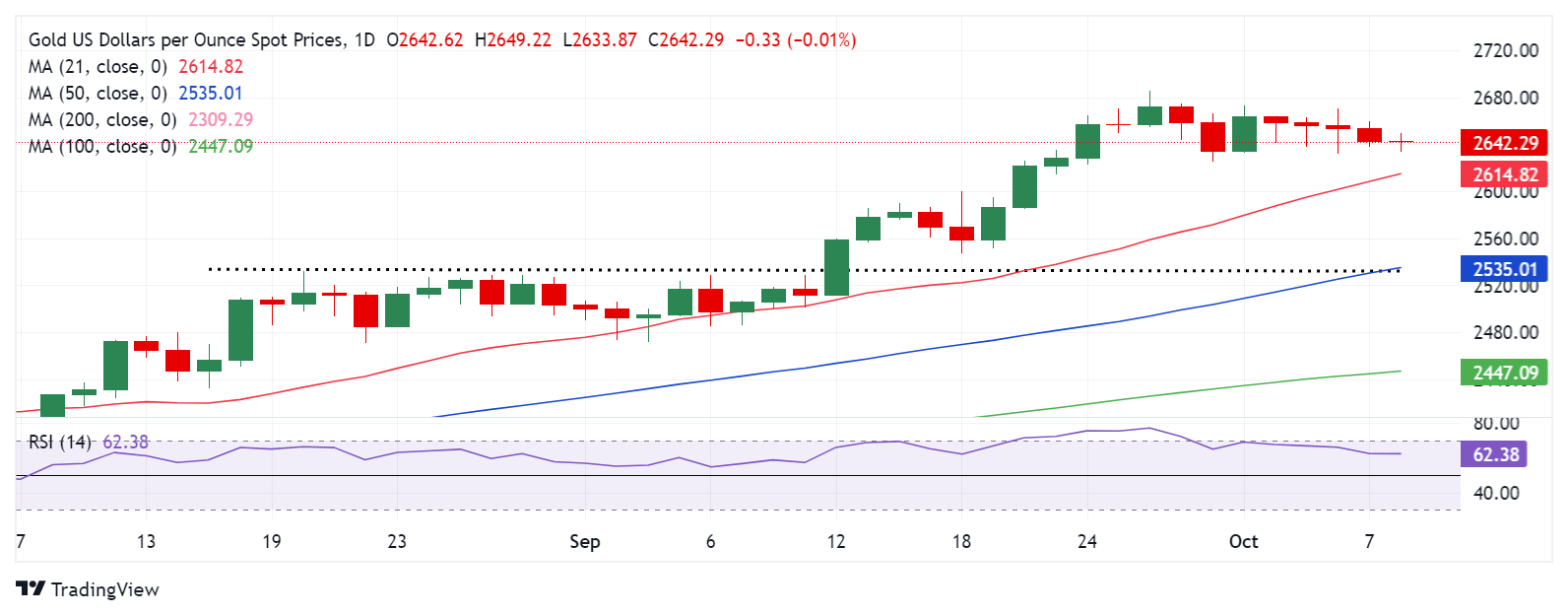
Following a gradual decline over the last four days, Gold buyers are seen challenging the key static support of $2,630.
The 14-day Relative Strength Index (RSI), however, stays well above the midline, currently near 62, suggesting that any decline in Gold price could be likely bought into.
Gold price needs a daily candlestick closing above the strong resistance near $2,670 to negate the near-term downside pressure.
The next resistance is aligned at the record high of $2,686. Further up, buyers will target the $2,700 round level.
On the flip side, Gold sellers must crack the intermittent low of $2,630 on a daily closing basis to unleash further correction toward the $2,600 threshold.
Ahead of that level, the 21-day Simple Moving Average (SMA) at $2,614 could offer a temporary relief to buyers.
Gold FAQs
Gold has played a key role in human’s history as it has been widely used as a store of value and medium of exchange. Currently, apart from its shine and usage for jewelry, the precious metal is widely seen as a safe-haven asset, meaning that it is considered a good investment during turbulent times. Gold is also widely seen as a hedge against inflation and against depreciating currencies as it doesn’t rely on any specific issuer or government.
Central banks are the biggest Gold holders. In their aim to support their currencies in turbulent times, central banks tend to diversify their reserves and buy Gold to improve the perceived strength of the economy and the currency. High Gold reserves can be a source of trust for a country’s solvency. Central banks added 1,136 tonnes of Gold worth around $70 billion to their reserves in 2022, according to data from the World Gold Council. This is the highest yearly purchase since records began. Central banks from emerging economies such as China, India and Turkey are quickly increasing their Gold reserves.
Gold has an inverse correlation with the US Dollar and US Treasuries, which are both major reserve and safe-haven assets. When the Dollar depreciates, Gold tends to rise, enabling investors and central banks to diversify their assets in turbulent times. Gold is also inversely correlated with risk assets. A rally in the stock market tends to weaken Gold price, while sell-offs in riskier markets tend to favor the precious metal.
The price can move due to a wide range of factors. Geopolitical instability or fears of a deep recession can quickly make Gold price escalate due to its safe-haven status. As a yield-less asset, Gold tends to rise with lower interest rates, while higher cost of money usually weighs down on the yellow metal. Still, most moves depend on how the US Dollar (USD) behaves as the asset is priced in dollars (XAU/USD). A strong Dollar tends to keep the price of Gold controlled, whereas a weaker Dollar is likely to push Gold prices up.
Author

Dhwani Mehta
FXStreet
Residing in Mumbai (India), Dhwani is a Senior Analyst and Manager of the Asian session at FXStreet. She has over 10 years of experience in analyzing and covering the global financial markets, with specialization in Forex and commodities markets.