Gold Price Forecast: XAU/USD surges as fears return

XAU/USD Current price: $3,374.30
- Fresh geopolitical and trade tensions undermined the market mood on Monday.
- Tepid United States data added to the broad weakness of the US Dollar.
- XAU/USD consolidates gains in the $3,370 region, aiming for higher highs.
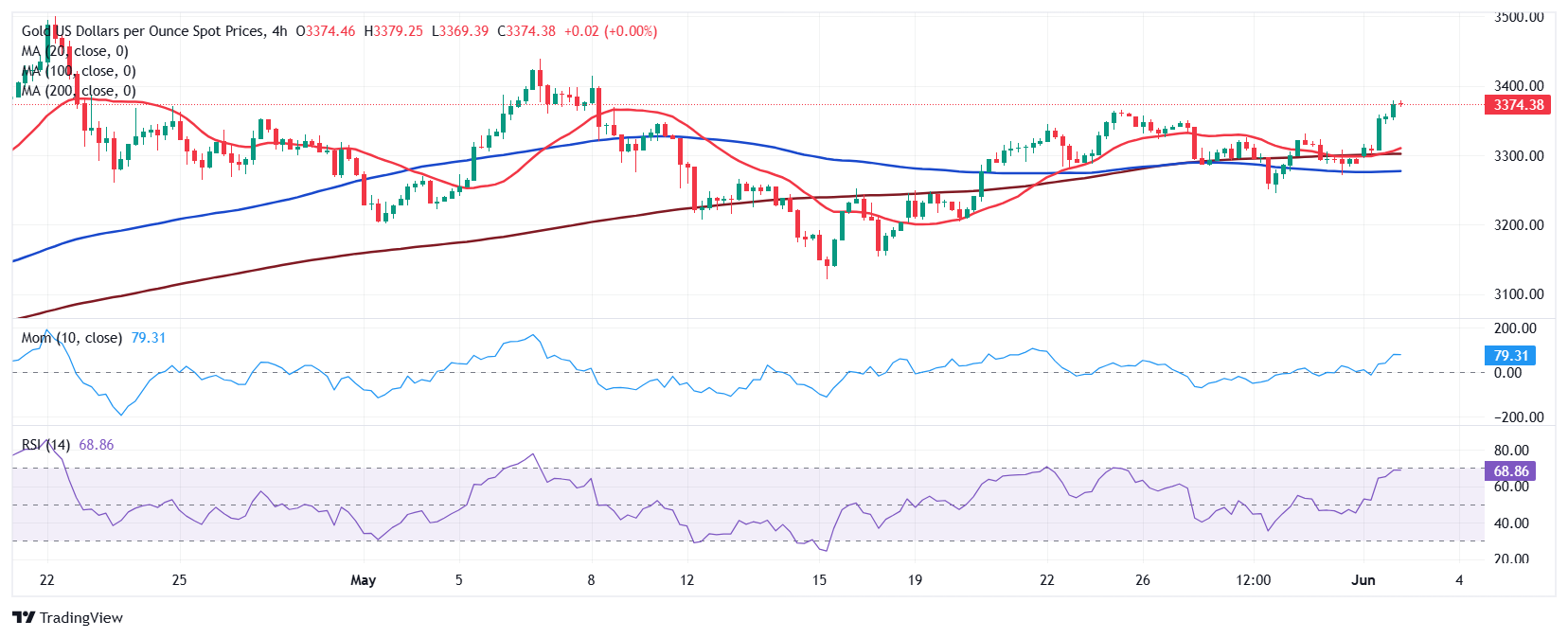
Spot is on the run at the beginning of the new week, with the bright metal trading in the $3,370 region, its highest in four weeks. A worsened market mood alongside broad US Dollar (USD) weakness boosted demand for the yellow metal. Speculative interest turned risk-averse amid United States (US) President Donald Trump to increase tariffs on steel and aluminium imports into the US from 25% to 50%, starting on Wednesday.
The unexpected announcement generated tensions with Beijing, which accused the US of violating the truce set a couple of weeks ago. Adding to the dismal mood, Ukraine conducted a massive drone attack on Russian strategic bombers' airfields during the weekend.
Meanwhile, “economic activity in the manufacturing sector contracted in May for the third consecutive month, following a two-month expansion preceded by 26 straight months of contraction,” according to the ISM report. The Manufacturing Purchasing Managers’ Index posted 48.5 in May, down from the 48.7 posted in April and missing expectations of 49.5. The imports sub-index plunged to 39.9, the weakest level since 2009.
The week will feature US employment-related data ahead of the Nonfarm Payrolls (NFP) report, scheduled for Friday. In the meantime, the Bank of Canada (BoC) and the European Central Bank (ECB) will announce their decisions on monetary policy.
XAU/USD short-term technical outlook
From a technical point of view, the daily chart for the XAU/USD pair shows that buyers defended the downside at around a directionless 20 Simple Moving Average (SMA) currently at $3,296.00. The 100 and 200 SMAs maintain their strong upward momentum far below the shorter one, as technical indicators head firmly north within positive levels, all of which supports another leg north.
In the near term, and according to the 4-hour chart, XAU/USD is poised to extend its advance. The pair is well above all its moving averages, with the 20 SMA gaining upward traction above the longer ones. Technical indicators, however, have lost their upward strength, holding on to higher ground but hinting at some consolidation before the next directional movement.
Support levels: 3,380.10 3,397.90 3,414.65
Resistance levels: 3,363.40 3,344.60 3,325.70
Tariffs FAQs
Tariffs are customs duties levied on certain merchandise imports or a category of products. Tariffs are designed to help local producers and manufacturers be more competitive in the market by providing a price advantage over similar goods that can be imported. Tariffs are widely used as tools of protectionism, along with trade barriers and import quotas.
Although tariffs and taxes both generate government revenue to fund public goods and services, they have several distinctions. Tariffs are prepaid at the port of entry, while taxes are paid at the time of purchase. Taxes are imposed on individual taxpayers and businesses, while tariffs are paid by importers.
There are two schools of thought among economists regarding the usage of tariffs. While some argue that tariffs are necessary to protect domestic industries and address trade imbalances, others see them as a harmful tool that could potentially drive prices higher over the long term and lead to a damaging trade war by encouraging tit-for-tat tariffs.
During the run-up to the presidential election in November 2024, Donald Trump made it clear that he intends to use tariffs to support the US economy and American producers. In 2024, Mexico, China and Canada accounted for 42% of total US imports. In this period, Mexico stood out as the top exporter with $466.6 billion, according to the US Census Bureau. Hence, Trump wants to focus on these three nations when imposing tariffs. He also plans to use the revenue generated through tariffs to lower personal income taxes.
Author

Valeria Bednarik
FXStreet
Valeria Bednarik was born and lives in Buenos Aires, Argentina. Her passion for math and numbers pushed her into studying economics in her younger years.

















