Gold Price Forecast: XAU/USD struggles above $2,900 but bullish bias remains intact
- Gold price treads water above $2,900 as the US CPI inflation week kicks off.
- The US Dollar stays weak amid tariff war-led economic concerns and falling US Treasury yields.
- Gold price flirts with 21-day SMA at $2,911 support whilst daily RSI stays bullish.

Gold price is extending its range-play above $2,900 starting a new week on Monday, looking to defend the critical support line near $2,910.
Gold price keeps eyes on Trump’s tariffs, geopolitics
Despite registering a weekly gain last week, Gold price struggles to gain upside traction early Monday. Gold buyers stay cautious amid looming US President Donald Trump’s tariffs on Canada and Mexico after the recent back-and-forth and ahead of this week’s US JOLTS Job Openings and Consumer Price Index (CPI) data.
President Trump issued a fresh tariff threat on Canadian lumber on Friday, noting that it may or may not come today, or on Monday, or on Tuesday. This statement came after the Trump administration temporarily waived tariffs on all USMCA-associated goods and reaffirmed that reciprocal tariffs will take effect in April.
On Sunday, Trump said that they are “looking at a lot of things with respect to tariffs on Russia.
Besides impending tariffs, geopolitical developments will also play a pivotal role this week, especially after the US President said that the administration has discussed lifting an intelligence pause on Ukraine. “Ukraine will sign the minerals deal, but I want them to want peace... they haven't shown it to the extent they should,” Trump added.
Heightened uncertainty around tariffs and the Ukraine peace deal intensifies concerns over a potential US stagflation, especially after Friday’s February labor market report. The US economy added 151,000 jobs in February, compared with an expected rise of 160,000 and a previous downward revision of 125,000. Meanwhile, the Unemployment Rate climbed to 4.1% versus expectations of 4%. The Labor Force Participation Rate ticked a tad lower to 62.4% in the same period from January’s 62.6%.
The US Dollar lost roughly 3% of its value against its major currency rivals last week amid economic slowdown fears. This lifted bets for more Federal Reserve (Fed) interest rate cuts this year and kept the Gold price downside cushioned. According to LSEG Fed interest rate probabilities, markets are currently pricing 76 basis points (bps) of Fed rate cuts by year-end, starting in June.
However, Gold buyers failed to find any fresh impetus for a sustained upside as Fed Chair Jerome Powell stated on Friday that the US central bank would take a cautious approach to monetary policy easing, adding that the economy currently "continues to be in a good place".
Looking ahead, Gold price remains a ‘buy-the-dips’ trade as it is the most sought-after store of value and a hedge against inflationary pressures. China continued its Gold purchases for the fourth consecutive month in February, according to the People's Bank of China data, lending support to yellow metal.
Meanwhile, traders digest the latest China’s inflation data showing that the February CPI fell into negative territory for the first time since January last year, declining by 0.7% year-over-year (YoY.) China’s CPI in February fell 0.2% on a monthly basis, compared to a rise of 0.7% in January.
It’s worth mentioning that Chinese tariffs, announced last week, of up to 15% on a raft of US farm products come into effect on Monday.
Gold price technical analysis: Daily chart
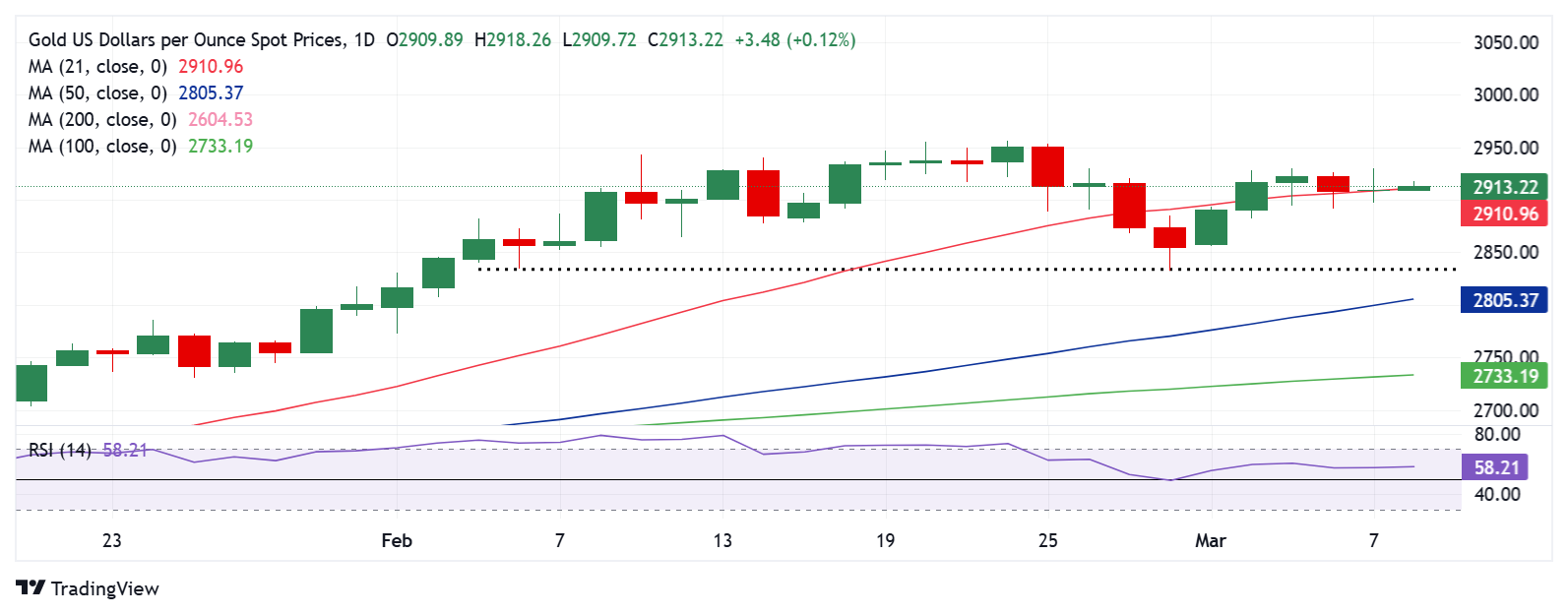
The short-term technical outlook for Gold price remains more or less the same as long as it defends the 21-day Simple Moving Average (SMA) of $2,911 on a daily candlestick closing basis.
The uptrend could gain further traction on acceptance above the $2,930 static resistance.
The Relative Strength Index (RSI) holds comfortably above the 50 level, suggesting buyers will likely retain control in the near term.
If the February 26 high of $2,930 is taken out sustainably, the next topside barriers are at an all-time high of $2,956 and the $2,970 round level.
If Gold price runs into offers, immediate support is seen at the $2,850 psychological barrier as the 21-day SMA at $2,911 gives way.
The demand area near $2,835 could be a tough nut to crack for sellers.
Tariffs FAQs
Tariffs are customs duties levied on certain merchandise imports or a category of products. Tariffs are designed to help local producers and manufacturers be more competitive in the market by providing a price advantage over similar goods that can be imported. Tariffs are widely used as tools of protectionism, along with trade barriers and import quotas.
Although tariffs and taxes both generate government revenue to fund public goods and services, they have several distinctions. Tariffs are prepaid at the port of entry, while taxes are paid at the time of purchase. Taxes are imposed on individual taxpayers and businesses, while tariffs are paid by importers.
There are two schools of thought among economists regarding the usage of tariffs. While some argue that tariffs are necessary to protect domestic industries and address trade imbalances, others see them as a harmful tool that could potentially drive prices higher over the long term and lead to a damaging trade war by encouraging tit-for-tat tariffs.
During the run-up to the presidential election in November 2024, Donald Trump made it clear that he intends to use tariffs to support the US economy and American producers. In 2024, Mexico, China and Canada accounted for 42% of total US imports. In this period, Mexico stood out as the top exporter with $466.6 billion, according to the US Census Bureau. Hence, Trump wants to focus on these three nations when imposing tariffs. He also plans to use the revenue generated through tariffs to lower personal income taxes.
Author

Dhwani Mehta
FXStreet
Residing in Mumbai (India), Dhwani is a Senior Analyst and Manager of the Asian session at FXStreet. She has over 10 years of experience in analyzing and covering the global financial markets, with specialization in Forex and commodities markets.

















