Gold Price Forecast: XAU/USD struggle with $2,900 extends despite escalating tariff war
- Gold price consolidates the previous rebound near $2,900 level early Tuesday.
- US economic growth woes outweigh global tariff war fears, weighing on the US Dollar, and US Treasury yields.
- Gold price battles 21-day SMA at $2,900 while the daily RSI still holds above the midline.

Gold price is treading water below $2,900 early Tuesday, consolidating the recent upswing before the next push higher.
Gold price stays supported by trade war fears
Markets remain risk-averse as a global tariff war seems inevitable, with US President Donald Trump affirming 25% tariffs on Canada and Mexico effective on Tuesday while he already signed the order to raise China tariffs to 20%.
In response, China’s Commerce Ministry and the Canadian prime minister’s office confirmed retaliatory tariffs on the US, triggering a tit-for-tat situation, which could translate into a full-fledged trade war.
Additionally, risks of the US economy tipping into recession have heightened amid increased expectations of Trump’s tariffs-led higher inflationary pressures and falling investors’ confidence. The Atlanta Fed GDP tracker now is at -2.8%, having reported a 5% collapse in two business days. Meanwhile, US ISM Manufacturing PMI declined to 50.3 in February, down from 50.9, missing expectations of 50.8. This was due to a sharp drop in new orders, which plunged from 55.1 to 48.6.
US recession fears fuelled a tech sell-off on Wall Street on Monday, prompting investors to run for cover in the traditional safe-haven Gold price as the US Dollar (USD) was sold off into the gloomy US economic outlook. US Treasury bond yields tumbled to the lowest level in five months, allowing Gold price to rebound toward the $2,900 threshold.
However, it remains to be seen if Gold price can regain that level as the USD could find fresh haven demand should risk aversion intensify in the sessions ahead. That said, geopolitical tensions will continue to play their part, cushioning any downside in the bright metal.
CNN News reported on Monday that US President Trump ordered military aid to Ukraine to be paused after his Friday Oval Office argument with Ukrainian President Volodymyr Zelensky. This put the US at crossfires with his European allies like Britain and France, who made clear their support for Zelensky at a summit in London on Sunday.
On Sunday, European leaders agreed to draft a peace plan on the Ukraine conflict to present to Washington.
Markets also remain wary as attention turns to the US employment data due later this week, which could significantly impact the US Federal Reserve’s (Fed) interest rate-cut outlook, influencing the value of the USD and the Gold price action in the near term.
Gold price technical analysis: Daily chart
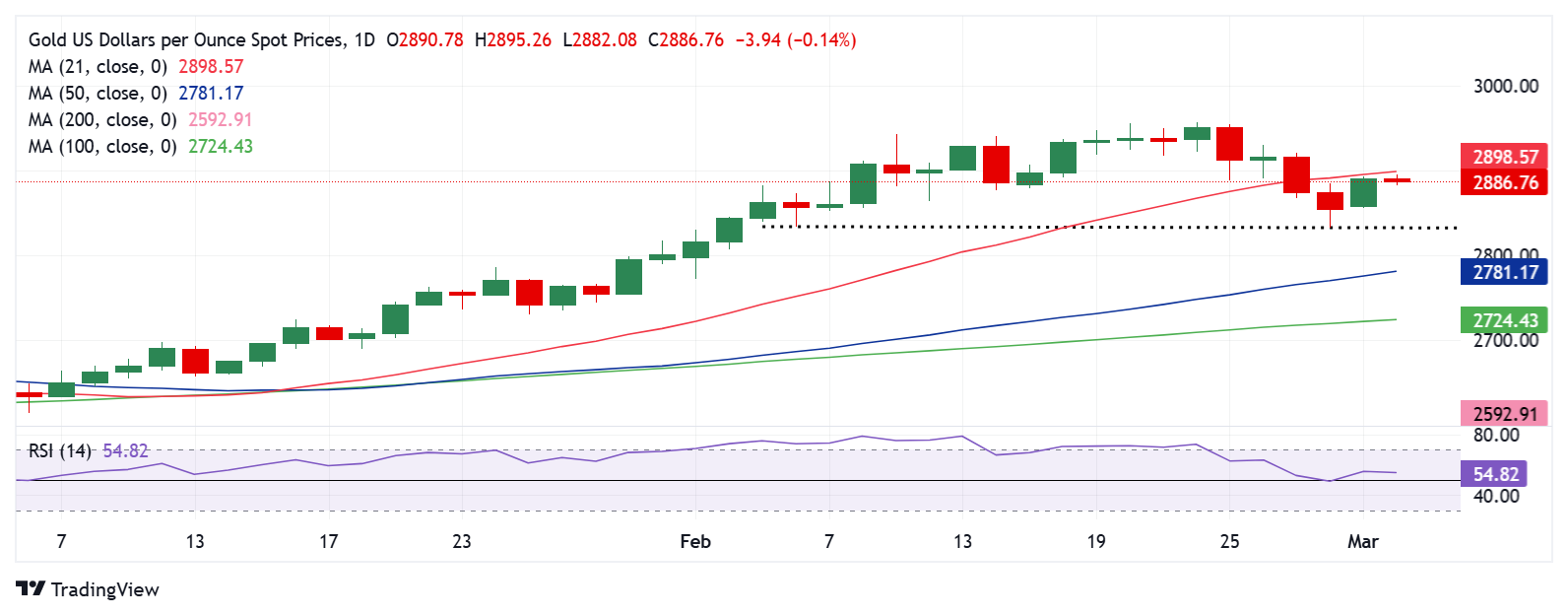
The daily chart shows that Gold price has stalled its latest move higher at the 21-day Simple Moving Average (SMA) of $2,900.
The recovery will likely gain traction only on acceptance above that level on a daily candlestick closing basis.
The Relative Strength Index (RSI) has turned slightly lower but holds well above the 50 level, suggesting that the upside bias remains intact.
The February 26 high of $2,930 will be on their radars if the 21-day SMA at $2,900 is taken out sustainably.
The next topside barrier is seen at an all-time high of $2,956.
If sellers refuse to step aside, the immediate support is seen at the $2,850 psychological barrier, below which the $2,835 demand area will be retested.
Additional declines will challenge the $2,800 round level.
Tariffs FAQs
Tariffs are customs duties levied on certain merchandise imports or a category of products. Tariffs are designed to help local producers and manufacturers be more competitive in the market by providing a price advantage over similar goods that can be imported. Tariffs are widely used as tools of protectionism, along with trade barriers and import quotas.
Although tariffs and taxes both generate government revenue to fund public goods and services, they have several distinctions. Tariffs are prepaid at the port of entry, while taxes are paid at the time of purchase. Taxes are imposed on individual taxpayers and businesses, while tariffs are paid by importers.
There are two schools of thought among economists regarding the usage of tariffs. While some argue that tariffs are necessary to protect domestic industries and address trade imbalances, others see them as a harmful tool that could potentially drive prices higher over the long term and lead to a damaging trade war by encouraging tit-for-tat tariffs.
During the run-up to the presidential election in November 2024, Donald Trump made it clear that he intends to use tariffs to support the US economy and American producers. In 2024, Mexico, China and Canada accounted for 42% of total US imports. In this period, Mexico stood out as the top exporter with $466.6 billion, according to the US Census Bureau. Hence, Trump wants to focus on these three nations when imposing tariffs. He also plans to use the revenue generated through tariffs to lower personal income taxes.
Author

Dhwani Mehta
FXStreet
Residing in Mumbai (India), Dhwani is a Senior Analyst and Manager of the Asian session at FXStreet. She has over 10 years of experience in analyzing and covering the global financial markets, with specialization in Forex and commodities markets.

















