Gold Price Forecast: XAU/USD set to rock on Fed verdict, Powell’s words
- Gold retraces further from record highs as a profit-taking spree grips the market.
- US Dollar awaits the Fed policy announcements, but not out of the woods yet.
- Gold eases within the overbought region on the daily chart; a pullback before the comeback?

Gold is in the red for the first time this week, correcting from record highs above $3,700 heading into the US Federal Reserve (Fed) showdown.
Gold keenly awaits the Fed verdict and Powell’s words
With a 25 basis points (bps) interest rate cut by the Fed fully baked, all eyes remain on the Summary of Economic Projections (SEP), the so-called Dot Plot chart, and Chairman Jerome Powell’s words for gauging whether the US central bank could deliver more than two rate cuts this year.
Calls for aggressive Fed easing have increased in the aftermath of weak August labor data and sticky inflation, stoking stagflation fears in the US economy.
Markets are pricing 67.9 bps of cuts by the end of the year, according to Refinitiv’s interest rate probabilities.
The non-interest-bearing Gold is set to experience intense volatility on the Fed policy announcements, with another lifetime high in the offing if the bank confirms the recent dovish expectations of three rate cuts by the year-end.
In case the Dot Plot shows that Fed officials maintained their outlook for two cuts or if Powell sounds less dovish, the US Dollar (USD) would breathe fresh signs of life, unfolding a fresh correction in Gold.
All in all, Gold’s fate hinges on the Fed verdict and its likely path forward on interest rates.
In the meantime, traders will continue cashing in on their Gold longs, but dip-buying could emerge at lower levels.
Gold price technical analysis: Daily chart
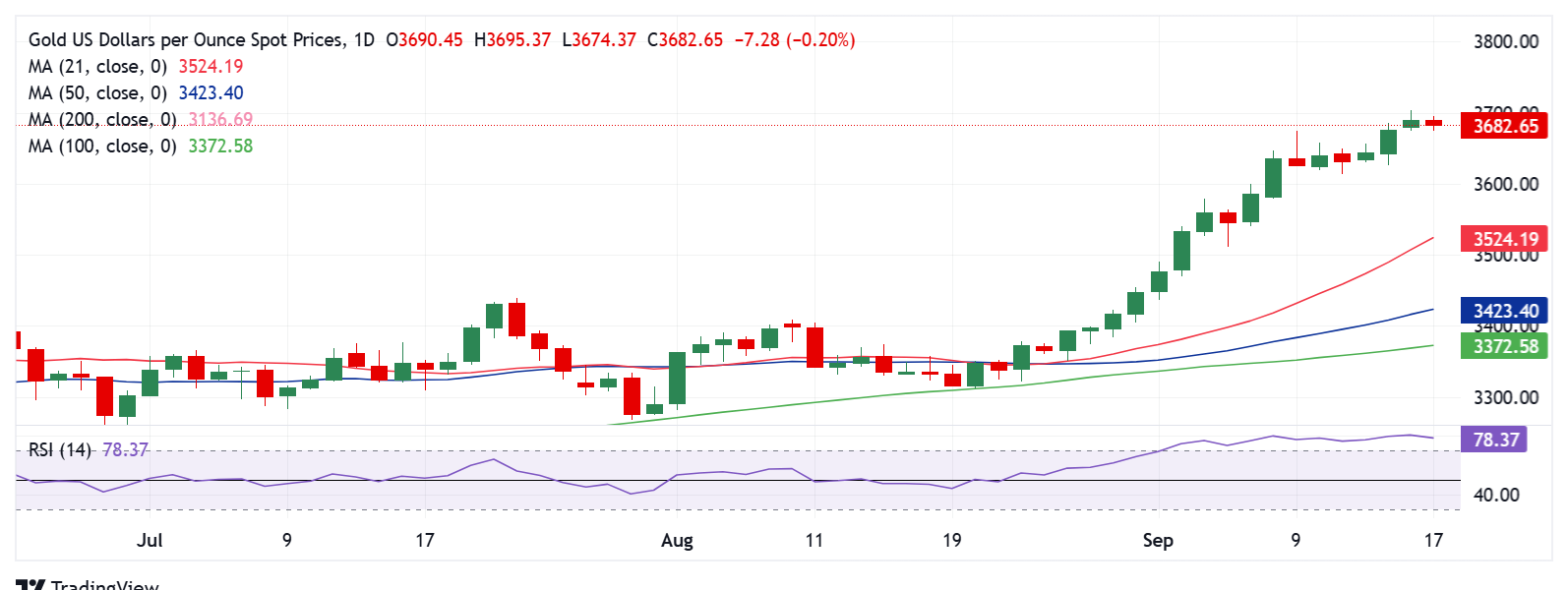
The daily chart shows that Gold buyers face exhaustion, reflective of the latest downtick in the 14-day Relative Strength Index (RSI) within the extreme overbought zone, from 80 to 77 levels.
On an outrightly dovish Fed outcome, Gold could retest the record high at $3,703, above which doors will open up toward the $3,750 region.
If the Fed turns out less dovish than expected, Gold could come under intense selling pressure, targeting this week’s low at $3,627 as the initial support.
Further down, the $3,600 round figure will be tested.
If selling pressure remains unabated, Gold could fall further toward the previous week’s low of $3,578.
Fed FAQs
Monetary policy in the US is shaped by the Federal Reserve (Fed). The Fed has two mandates: to achieve price stability and foster full employment. Its primary tool to achieve these goals is by adjusting interest rates. When prices are rising too quickly and inflation is above the Fed’s 2% target, it raises interest rates, increasing borrowing costs throughout the economy. This results in a stronger US Dollar (USD) as it makes the US a more attractive place for international investors to park their money. When inflation falls below 2% or the Unemployment Rate is too high, the Fed may lower interest rates to encourage borrowing, which weighs on the Greenback.
The Federal Reserve (Fed) holds eight policy meetings a year, where the Federal Open Market Committee (FOMC) assesses economic conditions and makes monetary policy decisions. The FOMC is attended by twelve Fed officials – the seven members of the Board of Governors, the president of the Federal Reserve Bank of New York, and four of the remaining eleven regional Reserve Bank presidents, who serve one-year terms on a rotating basis.
In extreme situations, the Federal Reserve may resort to a policy named Quantitative Easing (QE). QE is the process by which the Fed substantially increases the flow of credit in a stuck financial system. It is a non-standard policy measure used during crises or when inflation is extremely low. It was the Fed’s weapon of choice during the Great Financial Crisis in 2008. It involves the Fed printing more Dollars and using them to buy high grade bonds from financial institutions. QE usually weakens the US Dollar.
Quantitative tightening (QT) is the reverse process of QE, whereby the Federal Reserve stops buying bonds from financial institutions and does not reinvest the principal from the bonds it holds maturing, to purchase new bonds. It is usually positive for the value of the US Dollar.
Author

Dhwani Mehta
FXStreet
Residing in Mumbai (India), Dhwani is a Senior Analyst and Manager of the Asian session at FXStreet. She has over 10 years of experience in analyzing and covering the global financial markets, with specialization in Forex and commodities markets.