Gold Price Forecast: XAU/USD set to retake $2,000 on dovish Federal Reserve outlook
- Gold price is gathering pace for the next push higher as US Dollar stays offered.
- US Treasury bond yields got smashed on dovish US Federal Reserve policy guidance.
- Gold price is forming a bull pennant on the daily chart, with a bullish RSI.

Gold price is building on Wednesday’s upsurge this Thursday, as the United States Dollar (USD) continues to reel from the pain of a dovish US Federal Reserve policy announcement.
Dovish Federal Reserve dooms the United States Dollar
Gold price just needed that dovish outlook the Federal Reserve delivered on Wednesday, following the expected 25 basis points (bps) rate hike announcement. In its policy statement, the Federal Reserve dropped language about "ongoing increases" being needed in favor of "some additional" rises that could be appropriate, as they assess the impact of the banking sector crisis on the economy. Powell’s cautious remarks also collaborated with the dovish outlook and triggered a sharp sell-off in the US Treasury bond yields across the curve, eventually smashing the US Dollar while lifting the USD-denominated Gold price to daily highs of $1,979. The two-year US Treasury bond yields breached the 4.0% key level amidst the intense selling spiral.
US Treasury Secretary Janet Yellen, however, offered a temporary respite to the safe-haven US Dollar after she fuelled a fresh round of bank stock selling and jitters over stability by telling Congress she hasn't considered or discussed blanket insurance for deposits. Gold price, thereafter, retreated but managed to close the day above the $1,970 round level.
Markets have begun to wager that the Federal Reserve is close to ending its tightening cycle sooner than previously expected, in the face of the financial market turmoil. Therefore, the US Dollar has come under renewed selling pressure in Thursday’s Asian trading so far, sending the Gold price back toward the $2,000 mark.
Gold price now awaits the Bank of England's decision
With the Federal Reserve decision out of the way, traders now await the Bank of England’s (BoE) policy announcement to place fresh bullish bets on the Gold price. The United Kingdom central bank is set to hike policy rates by 25 bps on Thursday but Governor Andrew Bailey and Company could signal it as the last one before they adopt a wait-and-see approach in May.
In such a case, Gold price is likely to advance further, as most major central banks are nearing the end of their rate hike cycle. The Bank of Canada was the first central bank to halt its tightening cycle earlier this month, announcing it as a conditional pause.
If the BoE surprises with a hawkish 25 bps hike, noting that further tightening is needed, it could still render positive for Gold price. The hawkish BoE outlook will trigger a fresh rally in the GBP/USD pair, weighing further down on the US Dollar. Gold price could, therefore, capitalize on a sustained US Dollar weakness. The broader market sentiment will also hold the key for the Gold price action.
Gold price technical analysis: Daily chart
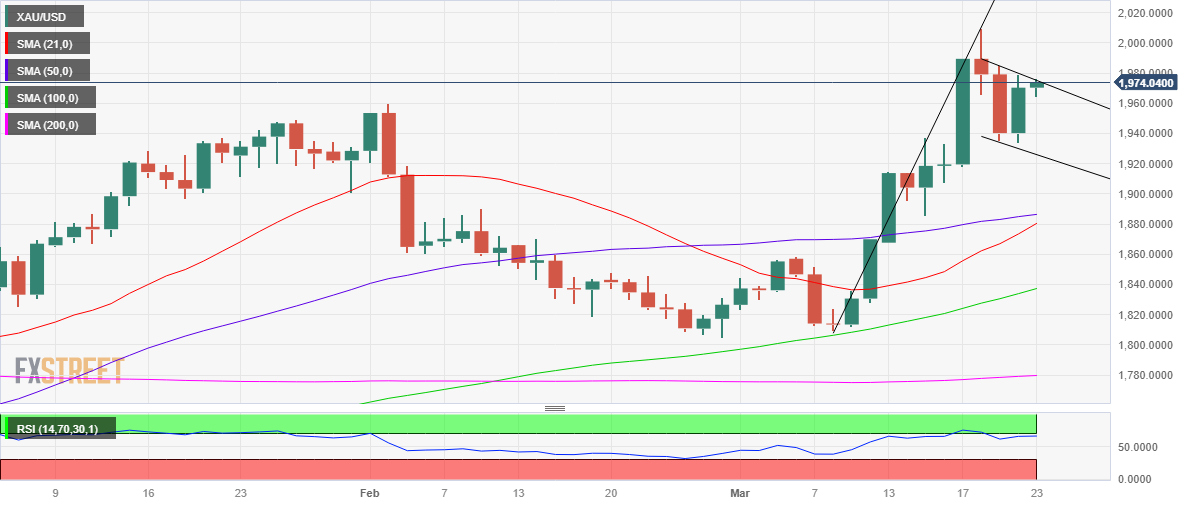
Following the Federal Reserve outcome-led massive upswing, Gold price is charting a potential bull pennant on the daily chart.
Gold buyers need a daily candle stick close above the falling trendline resistance at $1,975 to validate the bullish continuation pattern.
An upside break will call for a test of Tuesday’s high at $1,985, above which the $2,000 round figure will get challenged.
Further up, bulls will need a clear break of the yearly high at $2,010 to extend the ongoing bullish momentum toward the $2,050 psychological barrier.
On the other side, if Gold bulls fail to sustain at higher levels, any retracements could prod the intraday low at $1,965, below which the static support at $1,960 will be threatened.
Deeper declines will expose the $1,950 demand area, opening flloors for a test of the falling trendline support at $1,926.
Author

Dhwani Mehta
FXStreet
Residing in Mumbai (India), Dhwani is a Senior Analyst and Manager of the Asian session at FXStreet. She has over 10 years of experience in analyzing and covering the global financial markets, with specialization in Forex and commodities markets.
















