Gold Price Forecast: XAU/USD sellers lurk at $1,850, downside remains favored
- Gold price recovery fizzles, as US Dollar bulls fight back control on Tuesday.
- US Treasury bond yields rally after a long weekend amid hawkish Federal Reserve expectations.
- Gold price looks vulnerable below $1,850 but $1,825 support needs to fail.

Having failed to sustain the recovery near $1,850 on Monday, Gold price is resuming the downtrend toward the seven-week low of $1,819 this Tuesday. The return of full markets in the United States and the global Manufacturing and Services PMIs will be awaited for fresh trading impetus in the Gold price.
Gold price suffers from the US Treasury bond yields rally
Gold price is trading on the back foot after a flat start to the week, as the US Treasury market reopens after a long weekend, prompting the US Treasury bond yields to rally across the curve on heightened expectations that the US Federal Reserve (Fed) will deliver three more rate hikes this year amid hot inflation, tight labor market and strong consumer demand.
The benchmark 10-year US Treasury bond yields are rising back toward the 4.0% level, adding 0.80% so far, aiding the renewed upside in the United States Dollar (USD) against its major peers. The US Dollar index has regained the 104.00 mark, up 0.20% on the day. The non-yielding Gold price is, therefore, bearing the brunt in Asia this Tuesday.
The US market was closed on Monday, in observance of President’s Day, leaving the US Dollar in dismay, as investors shrugged off the geopolitical jitters. On Sunday, North Korea fired two ballistic missiles off its east coast, landing in the Sea of Japan. Meanwhile, tensions mounted between the United States and China after US Secretary of State Antony Blinken said that the US has information that China is considering sending weapons to Russia for the war in Ukraine.
Global PMI data in focus
Looking ahead, Gold price remains exposed to downside risks, as traders reposition ahead of Wednesday’s Minutes of the February Federal Reserve meeting, which will throw fresh light on the Fed’s policy outlook. In the meantime, the Eurozone, the United Kingdom and the United States will feature the preliminary S&P Global Manufacturing and Services PMIs. The global PMI data will be closely scrutinized to gauge the state of the major world economies.
The economic releases could have a major impact on risk sentiment, eventually influencing the US Dollar valuation alongside the Gold price action.
Gold price technical analysis: Daily chart
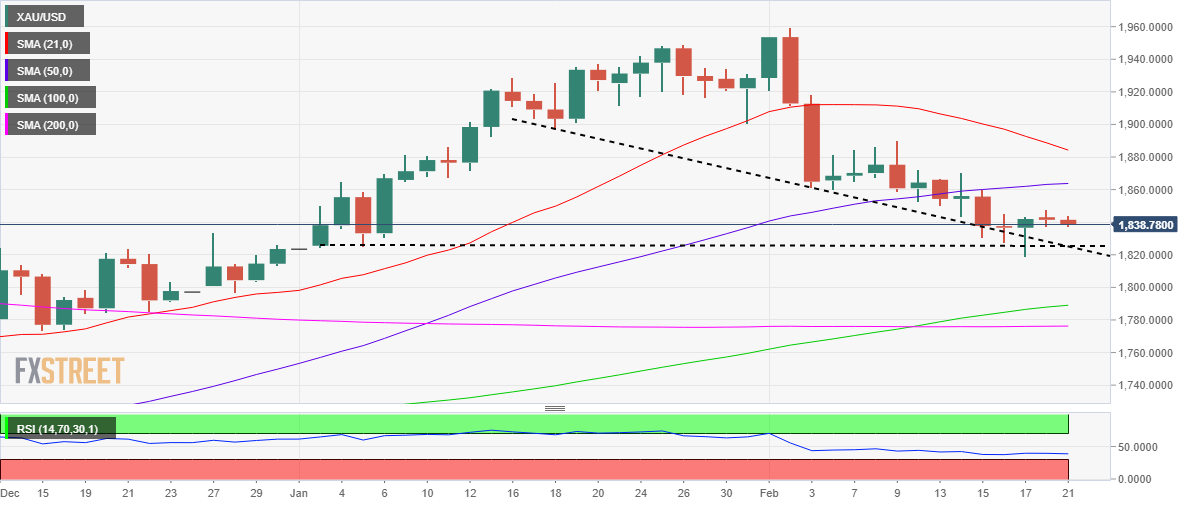
Technically, nothing seems to have changed for the Gold price, as bears are likely to retain control amid a bearish 14-day Relative Strength Index (RSI).
The critical horizontal trendline support from the January 5 low at $1,825 remains a tough nut to crack for Gold bears. Ahead of that, the $1,830 round figure should be taken out on a sustained basis.
Friday’s low of $1,819 will be next on Gold sellers’ radars should the downside gather traction once again.
On the other side, any recovery attempts will need to find acceptance above the $1,850 psychological level, above which a fresh run-up toward the flattish 50-Daily Moving Average (DMA) at $1,864 cannot be ruled out.
Further, Valentine’s Day at $1,870 will be the next stop for Gold bulls.
Author

Dhwani Mehta
FXStreet
Residing in Mumbai (India), Dhwani is a Senior Analyst and Manager of the Asian session at FXStreet. She has over 10 years of experience in analyzing and covering the global financial markets, with specialization in Forex and commodities markets.

















