Gold Price Forecast: XAU/USD seems vulnerable as Trump’s Iran war deadline looms
- Gold struggles with $4,650 extends into Tuesday as Trump sharpens rhetoric on Iran.
- The US Dollar finds haven bids on fading US-Iran ceasefire hopes, looming Trump deadline and hawkish Fed bets.
- Gold closed Monday below the 100-day SMA support-turned-resistance, as bearish bias persists.

Gold is lacking a clear direction, gyrating around the $4,650 mark in Asian trading on Tuesday, after having faced rejection at higher levels on several occasions.
Gold: Another TACO Tuesday as Trump deadline nears?
Gold remains a ‘sell on rallies’ trade as the US Dollar (USD) continues to capitalize on persistent safe-haven demand, courtesy of US President Donald Trump-induced renewed escalation in the Middle East war.
Hopes for a potential truce between the United States (US) and Iran faded as Trump sharpened his rhetoric on Iran, reiterating the deadline to attack Iran’s energy and transportation infrastructure on Tuesday at 8 PM Eastern Time (ET) if the Strait of Hormuz is not reopened.
Trump ramped up his threat by noting that Iran “can be taken out in one night, and that might be tomorrow night”.
Meanwhile, the US President said that the latest proposal for a US ceasefire with Iran is “not good enough.” On the other hand, Iran rejected the proposal and called for a permanent end to the war, according to Iranian state-run media.
In fact, an advisor to Iran's Parliament Speaker Mohammad Bagher Ghalibaf warned on Tuesday that Trump has about 20 hours to either surrender to Iran, or his allies will return to the Paleolithic Age.
Amid the looming deadline and Trump’s extensive threats, Gold traders prefer to wait on the sidelines and refrain from creating fresh positions, keeping the bright metal in a familiar range.
Hawkish expectations about the US Federal Reserve (Fed) interest rate outlook also favor USD bulls, rendering negative for non-yielding assets such as Gold.
That being said, fresh headlines concerning the Mideast conflict will continue to play a pivotal role in driving the USD and Gold price action in the sessions ahead.
Gold price technical analysis: Daily chart
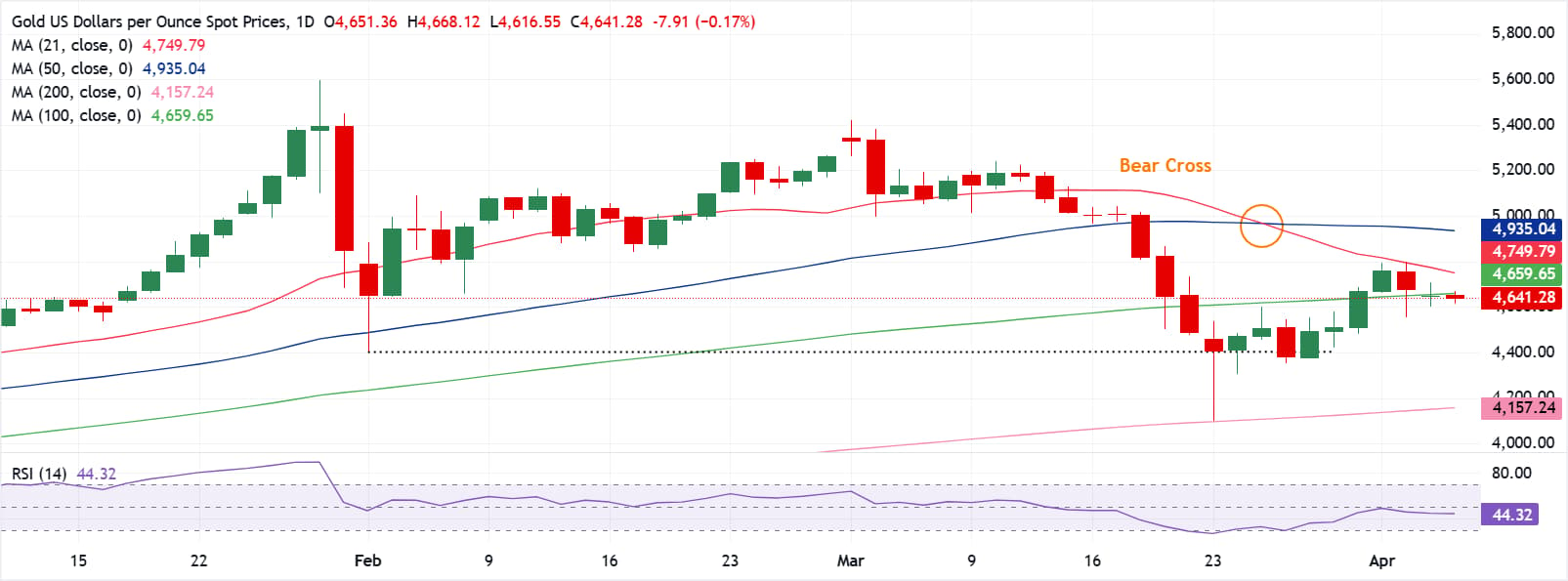
The metal holds a broadly bearish near-term bias as it remains entrenched below the 21-day simple moving average (SMA) at $4,774.95 and the 50-day SMA at $4,935, keeping the recent rebound capped within a corrective context. Momentum aligns with this tone, with the Relative Strength Index (14) hovering around 45, suggesting subdued buying interest after the earlier oversold bounce. The bearish bias also remains justified by a Bear Cross in play. The 21-day SMA closed below the 50-day SMA on March 25, confirming the bearish crossover.
On the downside, immediate support is seen at the April 2 low of $4,554, where a clear break would expose the next, more strategic floor at the 200-day SMA around $4,150.48. Ahead of that, the $4,400 demand area will be tested. On the topside, bulls would need a daily close above the 21-day SMA at $4,774.95 to ease current pressure, with further resistance then anticipated at the 50-day SMA at $4,935, which guards a more meaningful recovery phase.
(The technical analysis of this story was written with the help of an AI tool.)
(The third bullet point in the story was corrected on Tuesday at 4:13 GMT to say that "Gold closed Monday below the 100-day SMA support-turned-resistance," not Tuesday.)
Author

Dhwani Mehta
FXStreet
Residing in Mumbai (India), Dhwani is a Senior Analyst and Manager of the Asian session at FXStreet. She has over 10 years of experience in analyzing and covering the global financial markets, with specialization in Forex and commodities markets.