Gold Price Forecast: XAU/USD risks a correction, as US markets return
- Gold price kicks off Q2 and Easter Monday at a new all-time high above $2,250.
- US Dollar stays subdued amid upbeat mood, soft Core PCE inflation data.
- Gold price hits the Bull Flag target at $2,251, a correction in the offing?

Gold price is consolidating the latest uptick to a new all-time high of $2,260, kicking off Easter Monday and the second quarter of 2024 on a positive note. Extended Easter holiday-induced thin liquidity conditions aid the Gold price uptrend amid a broadly subdued US Dollar.
A June Fed policy pivot bets underpin Gold price
The US Dollar remains defensive, as markets set off the new quarter with optimism, especially after China’s Manufacturing and Services PMI data surpassed expectations in March. On Sunday, China’s official Manufacturing Purchasing Managers' Index (PMI) jumped to 50.8 in March, compared with the 49.1 contraction reported in February and above the estimates of a 49.9 figure. The Non-Manufacturing PMI rose to 53.3 in the same period vs. February’s 51.4. Meanwhile, China's Caixin Manufacturing Purchasing Managers' Index (PMI) edged higher to 51.1 in March on Monday, beating estimates of 51.0.
Additionally, increased bets that the US Federal Reserve (Fed) will begin lowering interest rates in June, following Friday’s US Personal Consumption Expenditures (PCE) Price Index, exert downside pressure on the US Dollar, keeping Gold price underpinned.
Inflation in the US, as measured by the change in Personal Consumption Expenditures (PCE) Price Index, increased slightly to 2.5% on a yearly basis in February, data released by the US Bureau of Economic Analysis (BEA) showed Friday. The reading met the consensus forecast and followed January’s 2.4% increase. The Core PCE Price Index, which excludes volatile food and energy prices, rose at an annual pace of 2.8%, in line with the market expectations but slowing from a 2.9% increase reported previously.
Markets are currently pricing a 68% probability of a June Fed rate cut, up from 63% seen before the PCE data release. Heightened expectations of a June Fed rate cut come even after Fed Chair Jerome Powell said Friday that “the economy is strong” and there is “no hurry to cut rates.” Powell participated in a discussion at the Macroeconomics and Monetary Policy Conference, in San Francisco, on Friday.
Looking ahead, the US Nonfarm Payrolls data, due on Friday, will be critical to sealing in a June Fed rate cut, having a significant impact on the value of the US Dollar and on the Gold price direction. In the meantime, the return of full markets in the US after the long Easter weekend break could trigger a bout of profit-taking in Gold price, as markets resort to position readjustment, in anticipation of the US employment data, trickling in from Tuesday.
Later on Monday, the US ISM Manufacturing PMI data will be also closely scrutinized for fresh hints on the strength of the US economy, influencing the market’s pricing of the Fed rate cut expectations and, in turn, the non-interest-beating Gold price.
Gold price technical analysis: Daily chart
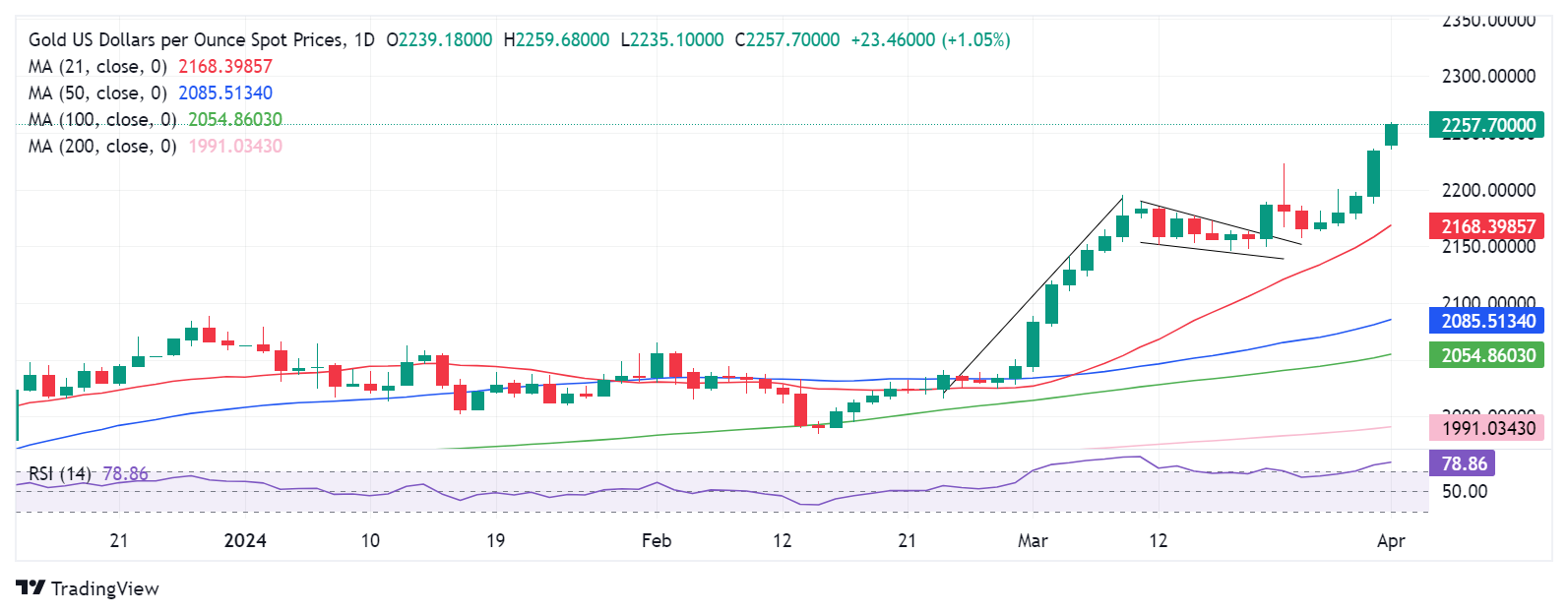
As observed on the day chart, Gold price achieved the Bull Flag target measured at $2,251 on its way to renewing the lifetime highs at $2,260 on Monday.
The 14-day Relative Strength Index (RSI), lies in the extremely overbought zone near 80.0, suggesting that Gold price remains primed for a corrective pullback any time soon.
If that happens, the immediate support could be found at the previous record high of $2,236 set on Thursday. A breach of the latter could fuel a sharp drop toward the $2,200 threshold.
Further south, Thursday’s low of $2,187 will be challenged, followed by the bullish 21-day Simple Moving Average (SMA) at $2,168.
Should Gold buyers manage to defy the bearish odds, a test of the $2,270 round level cannot be ruled out.
The next on Gold buyers’ radars will be the $2,300 psychological level.
Gold FAQs
Gold has played a key role in human’s history as it has been widely used as a store of value and medium of exchange. Currently, apart from its shine and usage for jewelry, the precious metal is widely seen as a safe-haven asset, meaning that it is considered a good investment during turbulent times. Gold is also widely seen as a hedge against inflation and against depreciating currencies as it doesn’t rely on any specific issuer or government.
Central banks are the biggest Gold holders. In their aim to support their currencies in turbulent times, central banks tend to diversify their reserves and buy Gold to improve the perceived strength of the economy and the currency. High Gold reserves can be a source of trust for a country’s solvency. Central banks added 1,136 tonnes of Gold worth around $70 billion to their reserves in 2022, according to data from the World Gold Council. This is the highest yearly purchase since records began. Central banks from emerging economies such as China, India and Turkey are quickly increasing their Gold reserves.
Gold has an inverse correlation with the US Dollar and US Treasuries, which are both major reserve and safe-haven assets. When the Dollar depreciates, Gold tends to rise, enabling investors and central banks to diversify their assets in turbulent times. Gold is also inversely correlated with risk assets. A rally in the stock market tends to weaken Gold price, while sell-offs in riskier markets tend to favor the precious metal.
The price can move due to a wide range of factors. Geopolitical instability or fears of a deep recession can quickly make Gold price escalate due to its safe-haven status. As a yield-less asset, Gold tends to rise with lower interest rates, while higher cost of money usually weighs down on the yellow metal. Still, most moves depend on how the US Dollar (USD) behaves as the asset is priced in dollars (XAU/USD). A strong Dollar tends to keep the price of Gold controlled, whereas a weaker Dollar is likely to push Gold prices up.
Author

Dhwani Mehta
FXStreet
Residing in Mumbai (India), Dhwani is a Senior Analyst and Manager of the Asian session at FXStreet. She has over 10 years of experience in analyzing and covering the global financial markets, with specialization in Forex and commodities markets.














