Gold Price Forecast: XAU/USD remains primed for a profit-taking pullback; not yet?
- Gold is off the record highs, but buyers retain control amid a broadly weaker US Dollar.
- Renewed US-China trade tensions, bets for two more Fed rate cuts offset upbeat IMF global growth outlook.
- Gold challenges the upper boundary of a rising channel on the daily chart, with RSI still heavily overbought.

Gold keeps on making higher highs on the daily time frame, sitting close to fresh record highs below $4,200 early Wednesday.
Gold remains a ‘buy-on-pullbacks’ trade
Markets continue to witness dip-buying on every pullback in Gold so far this week, as buyers remain undeterred by the bullish sentiment on global stocks.
The latest leg up in Gold seems to be sponsored by the renewed trade tensions between the United States (US) and China after US President Donald Trump posted on social media late Tuesday that he was considering terminating business with China having to do with cooking oil, and other elements of trade, as retribution.
Meanwhile, both sides began charging tit-for-tat port fees on Tuesday, per Reuters. This followed Trump’s retaliatory threats to slap 100% tariffs on Chinese imports as the trade war escalated after China tightened controls on its rare earth exports last week.
US-Sino trade worries combined with persistent bets for two interest rate cuts by the US Federal Reserve (Fed) render negative for the US Dollar (USD), benefiting the non-yielding bright metal.
Despite Fed Chair Jerome Powell’s prudent remarks on Tuesday, markets continue to price in over 90% probabilities for the October and the December monetary policy meetings, the CME Group’s FedWatch Tool shows.
Powell noted that the overall US economy "may be on a somewhat firmer trajectory than expected," while also cautioning that "there is no risk-free path for policy as we navigate the tension between our employment and inflation goals."
Further, the USD also feels the heat from a stronger Yuan (CNY) fix by the People’s Bank of China (PBOC), which surprised markets.
On Wednesday, the People’s Bank of China (PBOC) set the USD/CNY central rate at 7.0995 compared to the previous day's fix of 7.1021 and 7.1281 Reuters estimate.
All eyes now remain on a bunch of Fed speakers for fresh policy cues amid a lack of high-impact US economic releases.
Additionally, the broad market sentiment and US-China trade updates will continue to play a pivotal role in the Gold price action going forward.
Gold price technical analysis: Daily chart
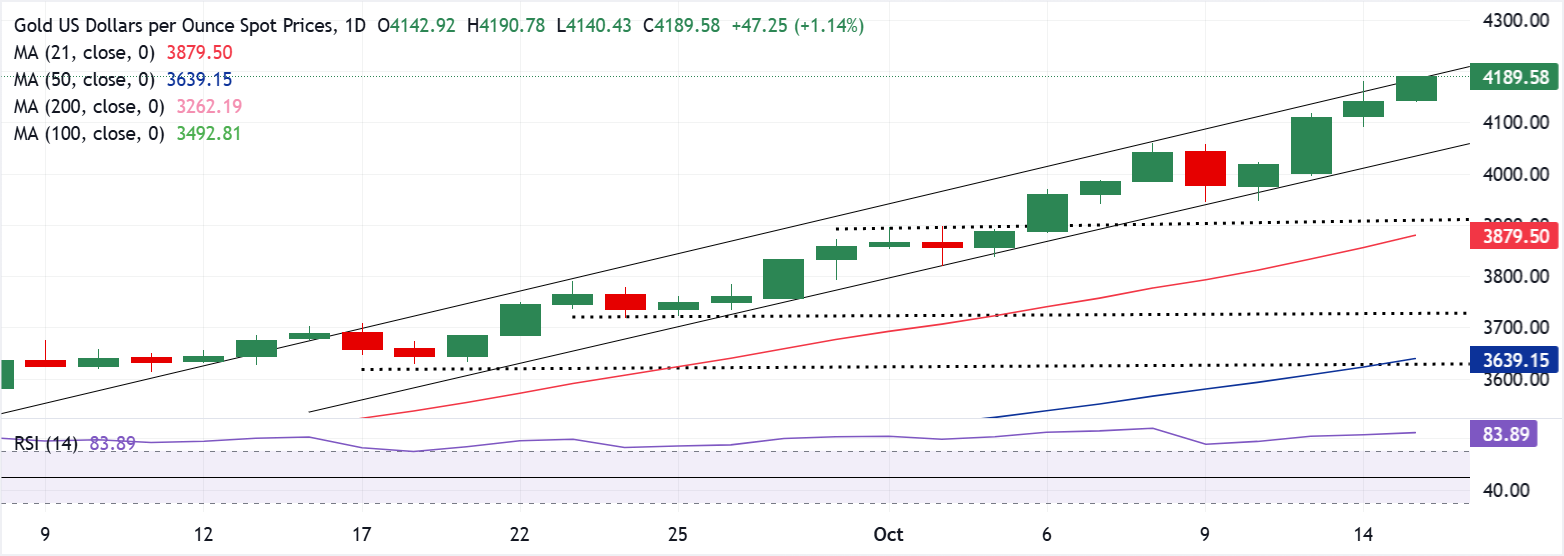
The daily chart shows that the 14-day Relative Strength Index (RSI) is inching further into the extreme overbought zone, currently near 84, suggesting that a pullback remains in the offing.
Meanwhile, Gold buyers are once again challenging the upper boundary of the month-long rising channel, now at $4,184.
Buyers must find acceptance above the topside hurdle of the channel on a daily candlestick basis to resume the record-setting rally beyond the $4,200 round level.
The $4,250 psychological level will be next on tap for Gold optimists.
On the contrary, sellers could fall back toward the $4,100 round level in case Gold faces rejection at the above-mentioned channel resistance.
The next crucial support is seen at the lower boundary of the rising channel at $4,036.
A sustained move below the channel support would confirm a pattern breakdown, fuelling further correction toward the $3,950 psychological mark.
Gold FAQs
Gold has played a key role in human’s history as it has been widely used as a store of value and medium of exchange. Currently, apart from its shine and usage for jewelry, the precious metal is widely seen as a safe-haven asset, meaning that it is considered a good investment during turbulent times. Gold is also widely seen as a hedge against inflation and against depreciating currencies as it doesn’t rely on any specific issuer or government.
Central banks are the biggest Gold holders. In their aim to support their currencies in turbulent times, central banks tend to diversify their reserves and buy Gold to improve the perceived strength of the economy and the currency. High Gold reserves can be a source of trust for a country’s solvency. Central banks added 1,136 tonnes of Gold worth around $70 billion to their reserves in 2022, according to data from the World Gold Council. This is the highest yearly purchase since records began. Central banks from emerging economies such as China, India and Turkey are quickly increasing their Gold reserves.
Gold has an inverse correlation with the US Dollar and US Treasuries, which are both major reserve and safe-haven assets. When the Dollar depreciates, Gold tends to rise, enabling investors and central banks to diversify their assets in turbulent times. Gold is also inversely correlated with risk assets. A rally in the stock market tends to weaken Gold price, while sell-offs in riskier markets tend to favor the precious metal.
The price can move due to a wide range of factors. Geopolitical instability or fears of a deep recession can quickly make Gold price escalate due to its safe-haven status. As a yield-less asset, Gold tends to rise with lower interest rates, while higher cost of money usually weighs down on the yellow metal. Still, most moves depend on how the US Dollar (USD) behaves as the asset is priced in dollars (XAU/USD). A strong Dollar tends to keep the price of Gold controlled, whereas a weaker Dollar is likely to push Gold prices up.
Author

Dhwani Mehta
FXStreet
Residing in Mumbai (India), Dhwani is a Senior Analyst and Manager of the Asian session at FXStreet. She has over 10 years of experience in analyzing and covering the global financial markets, with specialization in Forex and commodities markets.














