Gold Price Forecast: XAU/USD regains traction on geopolitical risks, ahead of US inflation test
- Gold returns to green early Wednesday, looking to retest record highs amid intensifying geopolitical tensions.
- US Dollar stalls its recovery from the Nonfarm Payrolls Benchmark Revision-led blow.
- Bets for aggressive Fed rate cuts are on the table ahead of US PPI inflation data.
- Gold attempts a fresh leg north despite the daily RSI still heavily overbought.

Gold is finding fresh haven demand early Wednesday as geopolitical tensions hog the limelight, while the US Dollar (USD) recovery fizzles out ahead of US Producer Price Index (PPI) inflation data release.
Gold looks to geopolitics, US inflation data
Having witnessed volatile trading on Tuesday, Gold is primed for another such day this Wednesday as fresh geopolitical headlines hit the wires and revive Gold’s appeal as a traditional store of value.
Reuters reported suspected Russian drone incursions into Poland’s airspace, putting the Polish air defenses as Russia breached the North Atlantic Treaty Organization (NATO) airspace.
In response, US Representative Joe Wilson immediately called out the Russian incursion as ‘an act of war’, with investors fretting over a full-blown war.
There is no big market reaction to the above headlines, but Gold is seeing a fresh uptick, reversing the previous retracement slide from all-time highs of $3,675.
A bout of fresh USD selling on traders’ repositioning ahead of US PPI data also aids the upswing in Gold.
Looking ahead, only an upside surprise in the US PPI inflation data could negate the near-term bearishness in the USD and check Gold’s record run.
In the meantime, increased bets for aggressive interest rate cuts by the US Federal Reserve (Fed) this month could continue to power the non-yielding Gold at the expense of the Greenback.
Markets are pricing in an 84% chance of a 25 basis points (bps) rate cut at the Fed's September meeting and a 6% probability of a jumbo 50 bps rate cut, according to the CME Group's FedWatch tool.
Further, speculations are rife that the Fed could deliver more than two rate cuts this year.
Traders also digest the latest news that a US Federal judge blocked Trump's effort to fire Federal Reserve Board Governor Lisa Cook.
On Tuesday, Gold rallied hard and refreshed record highs at $3,675 after the highly anticipated Nonfarm Payrolls (NFP) Benchmark Revision report showed downward revisions of nearly a million fewer jobs to previous government estimates for the April 2024 to March 2025 period, per Reuters.
The downward revisions amplified US labor market concerns, calling for big Fed rate cut next week.
Gold also received another booster shot from Israeli attacks on Hamas leadership in Doha, Qatar’s capital.
"The name of the operation in Doha is Summit of Fire. These were air strikes," an Israeli military official said.
However, Gold failed to sustain at higher levels as profit-taking seeped in amid the USD resurgence on a global flight to safety.
Gold price technical analysis: Daily chart
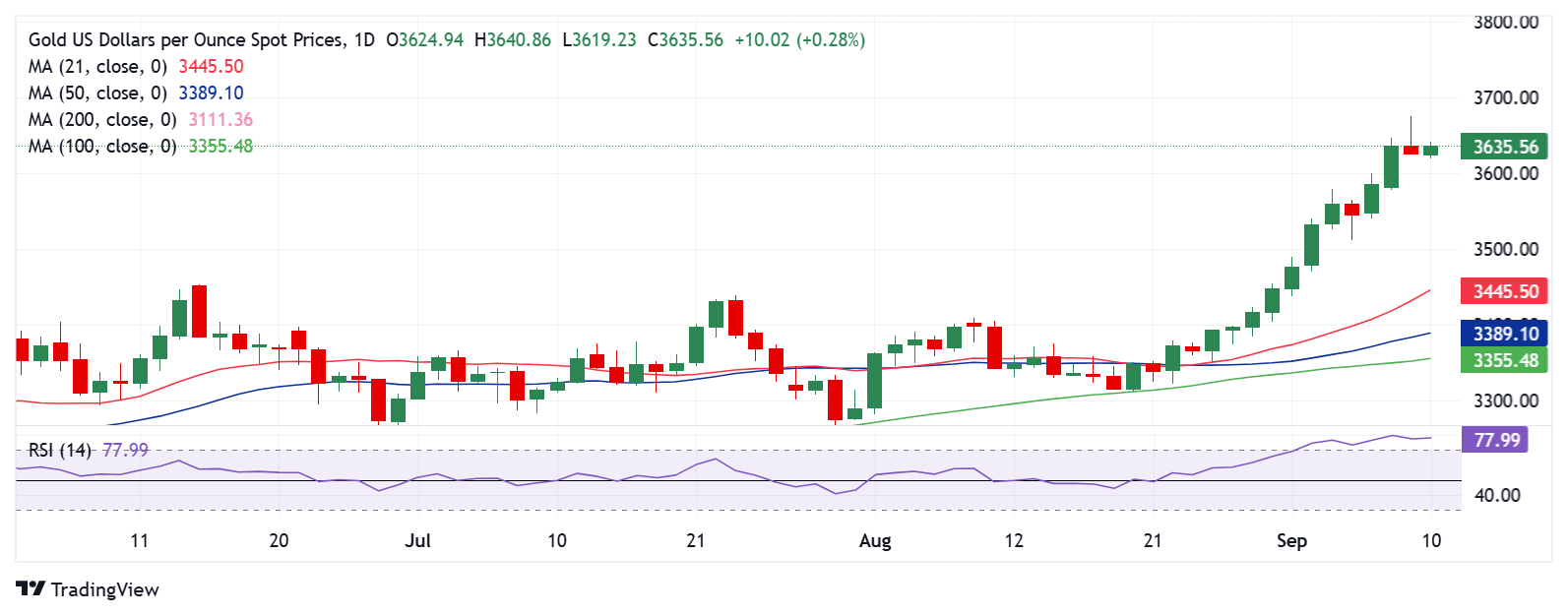
The daily chart shows that Gold could see another pullback from higher levels as the 14-day Relative Strength Index (RSI) remains in a heavily overbought zone. The leading indicator is currently near 78.
If Gold buyers lose their ground, the immediate support is seen at the $3,600 round number, below which this week’s low of $3,578 could be tested.
A sustained break below the latter will open up a fresh downside toward the $3,550 psychological mark.
However, if buyers refuse to give up, the record high of $3,675 will be retested.
The next topside barrier is seen at the $3,700 level, above which the $3,750 region could offer some resistance.
Gold FAQs
Gold has played a key role in human’s history as it has been widely used as a store of value and medium of exchange. Currently, apart from its shine and usage for jewelry, the precious metal is widely seen as a safe-haven asset, meaning that it is considered a good investment during turbulent times. Gold is also widely seen as a hedge against inflation and against depreciating currencies as it doesn’t rely on any specific issuer or government.
Central banks are the biggest Gold holders. In their aim to support their currencies in turbulent times, central banks tend to diversify their reserves and buy Gold to improve the perceived strength of the economy and the currency. High Gold reserves can be a source of trust for a country’s solvency. Central banks added 1,136 tonnes of Gold worth around $70 billion to their reserves in 2022, according to data from the World Gold Council. This is the highest yearly purchase since records began. Central banks from emerging economies such as China, India and Turkey are quickly increasing their Gold reserves.
Gold has an inverse correlation with the US Dollar and US Treasuries, which are both major reserve and safe-haven assets. When the Dollar depreciates, Gold tends to rise, enabling investors and central banks to diversify their assets in turbulent times. Gold is also inversely correlated with risk assets. A rally in the stock market tends to weaken Gold price, while sell-offs in riskier markets tend to favor the precious metal.
The price can move due to a wide range of factors. Geopolitical instability or fears of a deep recession can quickly make Gold price escalate due to its safe-haven status. As a yield-less asset, Gold tends to rise with lower interest rates, while higher cost of money usually weighs down on the yellow metal. Still, most moves depend on how the US Dollar (USD) behaves as the asset is priced in dollars (XAU/USD). A strong Dollar tends to keep the price of Gold controlled, whereas a weaker Dollar is likely to push Gold prices up.
Author

Dhwani Mehta
FXStreet
Residing in Mumbai (India), Dhwani is a Senior Analyst and Manager of the Asian session at FXStreet. She has over 10 years of experience in analyzing and covering the global financial markets, with specialization in Forex and commodities markets.