Gold Price Forecast: XAU/USD recovers modestly as oil prices decline, US elections in focus
- Gold rebounds to near $3,900 as oil prices come under pressure.
- Washington signals that it prefers a diplomatic resolution with Iran.
- Investors keenly focus on US mid-term elections and the NFP data.

Gold attracts some bids at the start of the United States (US) mid-term election week after remaining under intense pressure in the last week of October. The precious metal is up 0.7% to near $3,900 after an over 3% decline last week, as oil prices have declined sharply on renewed hopes of United States (US)-Iran diplomacy.
Why oil prices fall significantly?
The comments from Washington that US President Donald Trump is prioritizing diplomacy with Iran over restarting the war, indicated earlier, have eased fears of prolonged energy supply disruption.
As of writing, the WTI Oil price is down 2% to near $100 after correcting sharply from its five-month high of $104.00 posted on Friday.
US Secretary of State Marco Rubio said that Washington hasn’t made any decision to renews strikes on Tehran and that President Donald Trump prefers a diplomatic resolution. Rubio further stated that the US retains the capabilities to achieve whatever military objective Trump decides to pursue.
Over the past weeks, oil prices were consistently rising as US and Israel had signaled the resumption of joint operation on Iran after elections in their respective economies.
Theoretically, a period of correction in oil prices anchors inflation expectations. Such a scenario diminishes fears of prolonger higher interest rates by central banks. This bodes well for non-yielding assets, such as Gold.
What are next key triggers for Gold?
Investors brace a high volatile week for Gold with US mid-term elections and key employment-related data, notably the Nonfarm Payrolls (NFP), on schedule.
According to analysts at ING, “a Democratic sweep is trading around 68% in prediction markets, and that could be seen as slightly negative for the US Dollar from a few angles, from higher risk of government shutdown and gridlock on debt ceiling negotiations to potential damage to already shaky AI-related sentiment.”
Technically, a lower US Dollar makes the Gold price an attractive risk-reward bet for investors. At the start of the week, the US Dollar Index (DXY), which gauges the Greenback’s value against six major currencies, trades subduedly near 101.95.
The US NFP data on Friday is expected to have a significant impact on Federal Reserve’s (Fed) monetary policy outlook. Ahead of the US NFP release, investors will focus on JOLTS Job Openings data for September and the ADP Employment Change data for October.
Gold Technical Analysis
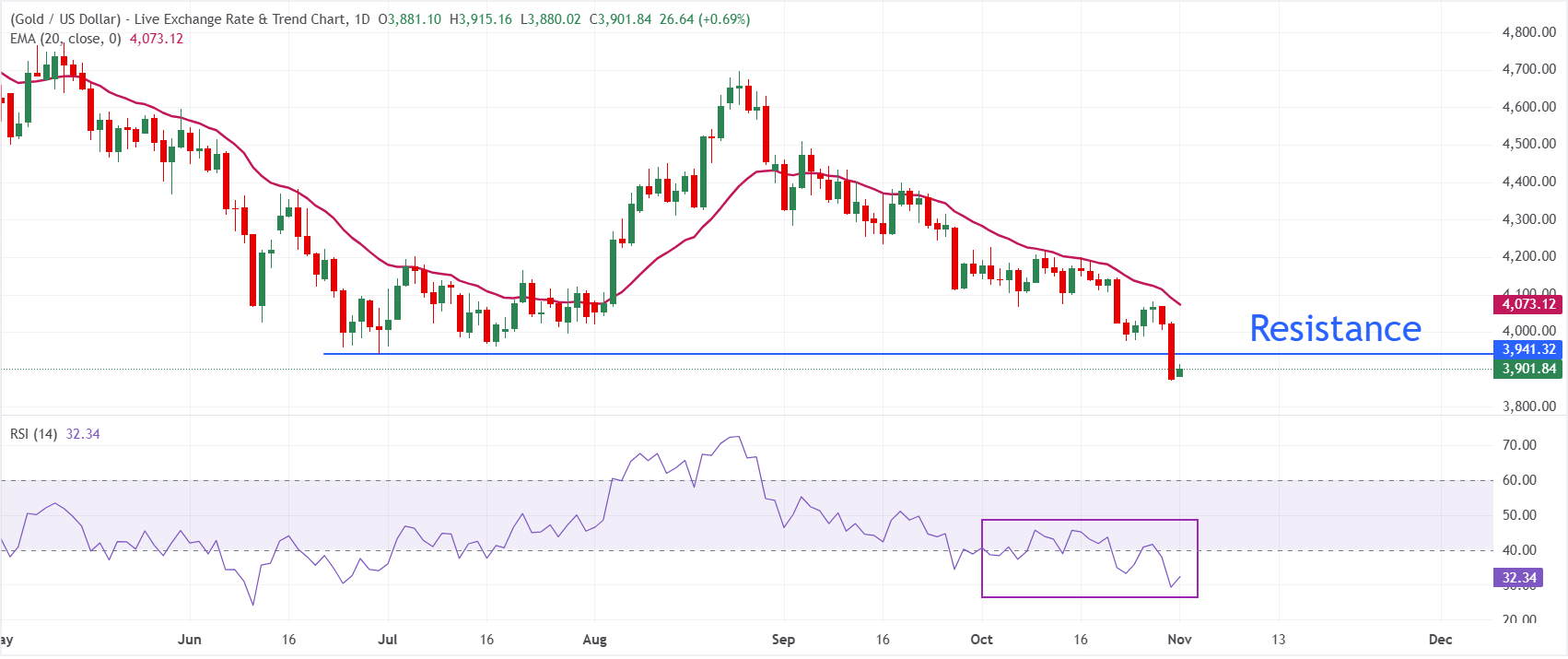
In the daily chart, XAU/USD trades at $3,901.58, maintaining a bearish near-term tone as spot holds decisively below the 20-period exponential moving average (EMA) at $4,073.10. The downside break under this key dynamic barrier suggests that rallies remain capped for now, while the Relative Strength Index (14) at 32.31 hovers near oversold territory, hinting that bearish pressure is strong but approaching levels where selling could start to lose momentum.
On the topside, initial resistance is the June 30 low at $3,941.76, followed by the 20-period EMA at $4,073.10, and a sustained recovery above this level would be needed to ease the current downside bias and open the way for a more meaningful rebound. Looking down, the Gold price would be exposed to $3,800 if it fails to hold the immediate support at $3,870.
(The technical analysis of this story was written with the help of an AI tool. Know more.)
Gold FAQs
Gold has played a key role in human’s history as it has been widely used as a store of value and medium of exchange. Currently, apart from its shine and usage for jewelry, the precious metal is widely seen as a safe-haven asset, meaning that it is considered a good investment during turbulent times. Gold is also widely seen as a hedge against inflation and against depreciating currencies as it doesn’t rely on any specific issuer or government.
Central banks are the biggest Gold holders. In their aim to support their currencies in turbulent times, central banks tend to diversify their reserves and buy Gold to improve the perceived strength of the economy and the currency. High Gold reserves can be a source of trust for a country’s solvency. Central banks added 1,136 tonnes of Gold worth around $70 billion to their reserves in 2022, according to data from the World Gold Council. This is the highest yearly purchase since records began. Central banks from emerging economies such as China, India and Turkey are quickly increasing their Gold reserves.
Gold has an inverse correlation with the US Dollar and US Treasuries, which are both major reserve and safe-haven assets. When the Dollar depreciates, Gold tends to rise, enabling investors and central banks to diversify their assets in turbulent times. Gold is also inversely correlated with risk assets. A rally in the stock market tends to weaken Gold price, while sell-offs in riskier markets tend to favor the precious metal.
The price can move due to a wide range of factors. Geopolitical instability or fears of a deep recession can quickly make Gold price escalate due to its safe-haven status. As a yield-less asset, Gold tends to rise with lower interest rates, while higher cost of money usually weighs down on the yellow metal. Still, most moves depend on how the US Dollar (USD) behaves as the asset is priced in dollars (XAU/USD). A strong Dollar tends to keep the price of Gold controlled, whereas a weaker Dollar is likely to push Gold prices up.
Author

Sagar Dua
FXStreet
Sagar Dua is associated with the financial markets from his college days. Along with pursuing post-graduation in Commerce in 2014, he started his markets training with chart analysis.