US Dollar Weekly Forecast: A hawkish Fed is no longer enough
- The US Dollar regained the upper hand, reversing two weekly drops.
- US inflation remained elevated in September, according to the PCE.
- The Federal Reserve delivered a hawkish hold on Wednesday.

The week that was
The US Dollar (USD) managed to regain some composure, ending the week with acceptable gains after surrendering some ground following earlier two-week highs.
Indeed, the US Dollar Index (DXY), at some point in the last few days, popped to as high as the 102.50 zone, just to lose some momentum soon afterwards despite keeping its weekly bullish mood well in place.
Despite inflation and GDP data banging on markets’ consensus, the Greenback seems to have run out of steam in the wake of the hawkish hold by the Federal Reserve (Fed) on Wednesday. Indeed, everybody knew the tone would be hawkish, but the lack of any extra surprise seemed to have fuelled a kind of ‘sell the fact’ market axiom.
The other two factors behind the US Dollar’s positive performance were the unabated uncertainty from the Middle East, with no apparent credible solution in the short-term horizon, and, as a consequence of that, the relentless move higher in prices of the barrel of crude Oil, which in turn feeds into higher inflation and the Fed's tighter-for-longer never-ending loop.
Nothing worth mentioning from the US debt market, where US Treasury yields declined on the short end and the belly of the curve vs. a consolidative theme on the long end.
Fed and inflation
As expected, the Fed maintained its Fed Funds Target Range (FFTR) unchanged at 3.75%-4.00% at its event on Wednesday, matching most analysts’ predictions.
The performance of US inflation was once again at the centre of the debate during the press conference held by Chair Kevin Warsh and the subsequent Q&A session with the media.
The September inflation gauge tracked by the Personal Consumption Expenditures (PCE) confirmed and even reinforced the Fed’s cautious stance when it was released the following day.
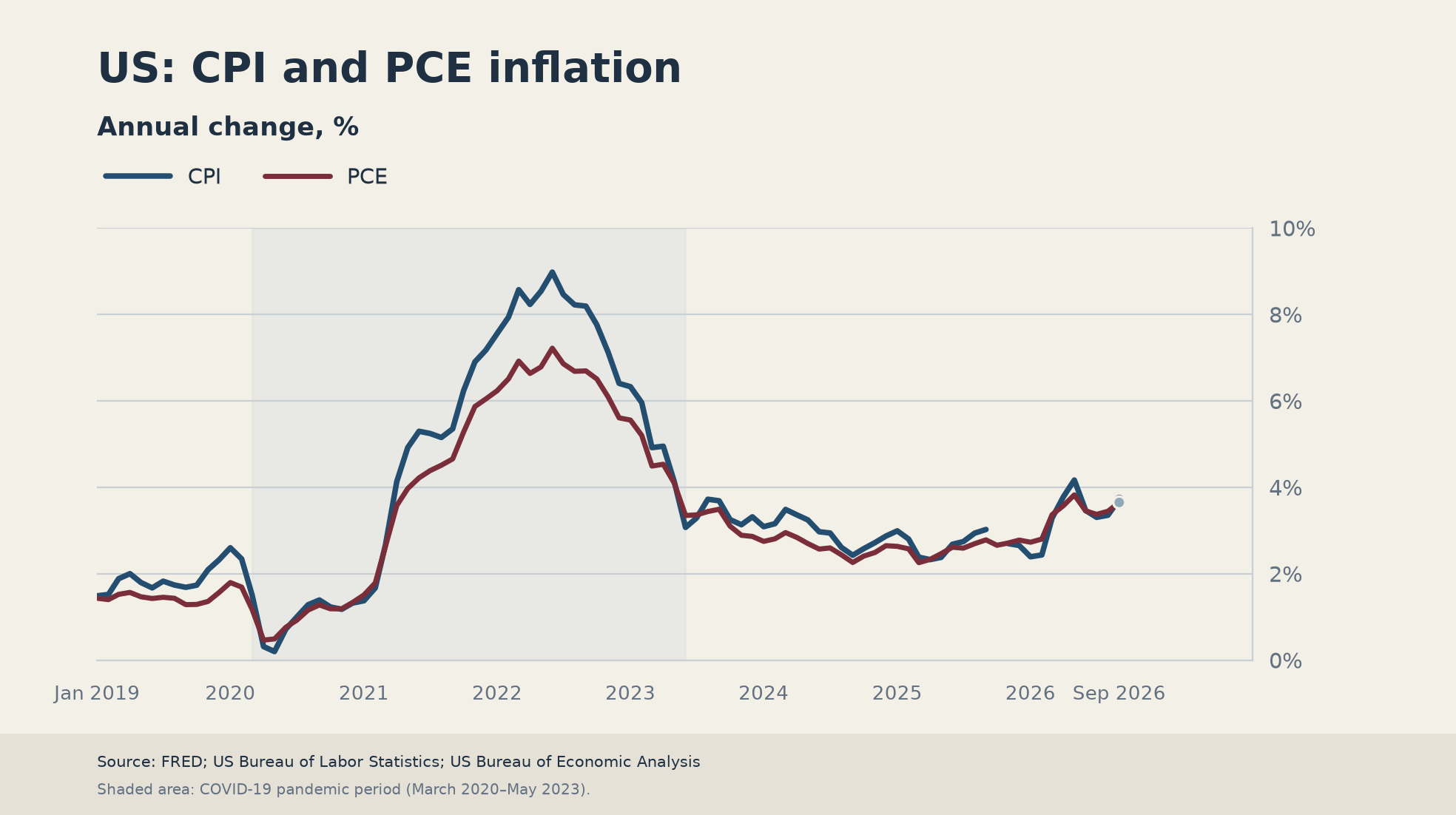
Fed officials agree on the destination, but not the pace
Fed officials increasingly agree on the need to bring inflation down, but they differ on how quickly policy should tighten. Chair Kevin Warsh has argued that the Fed’s “monetary medicine” is beginning to work and that incoming data will guide the next move, while several colleagues believe further rate increases are needed.
Thomas Barkin (Richmond) said the direction of travel was "straightforward", with the main question being the pace. He favours a gradual approach, as businesses are facing broad cost pressures and are preparing to pass on higher expenses to customers. Barkin also warned that the AI investment surge was pressuring supply chains and generating demand-side inflation, precisely the kind of pressure monetary policy can address.
Alberto Musalem (St. Louis) struck a more urgent tone, saying the Fed would need to raise rates again soon. Inflation remains too high, he argued, and is unlikely to ease without further action. He favours incremental moves rather than abrupt tightening, but he considers financial conditions only modestly tighter and still broadly accommodative.
Finally, Lorie Logan (Dallas) went further, saying the Fed needs at least two additional quarter-point hikes to make policy modestly restrictive. She argued that skipping a meeting would not change the eventual destination, although a pause after 50 basis points of increases could make sense while policymakers assess the effects. Strong growth, solid consumer spending and financial conditions that are still providing a tailwind all support her view that the Fed has more work to do.
Warsh’s position remains more measured, but not dovish. At his press conference, he has stressed that inflation is too high, the Fed cannot describe financial conditions as restrictive and the 2% PCE target is not negotiable.
Taken together, the recent comments show broad agreement on the need for further restraint, with the debate centred on whether to wait for more evidence, move gradually or begin delivering the next increases soon.
Longs recover, but fresh conviction remains limited
The Greenback’s bullish positioning strengthened in the week to October 20, according to Commodity Futures Trading Commission (CFTC) data. Net speculative longs rose to over 15K contracts, while the four-week change increased to just over 4.7K contracts. This confirms that the recovery in bullish sentiment is gaining momentum.
Open interest fell to almost 49.4K contracts. Since net longs increased while overall participation declined, the move appears to have been driven mainly by short covering rather than by a broad wave of fresh USD buying.
Speculative exposure rose sharply to 30.43%, while its percentile increased to 50.5. In the same line, the Net Position Percentile also climbed to 59.7. Both measures are now above neutral, suggesting that USD positioning has become more supportive, although it is not yet historically stretched.
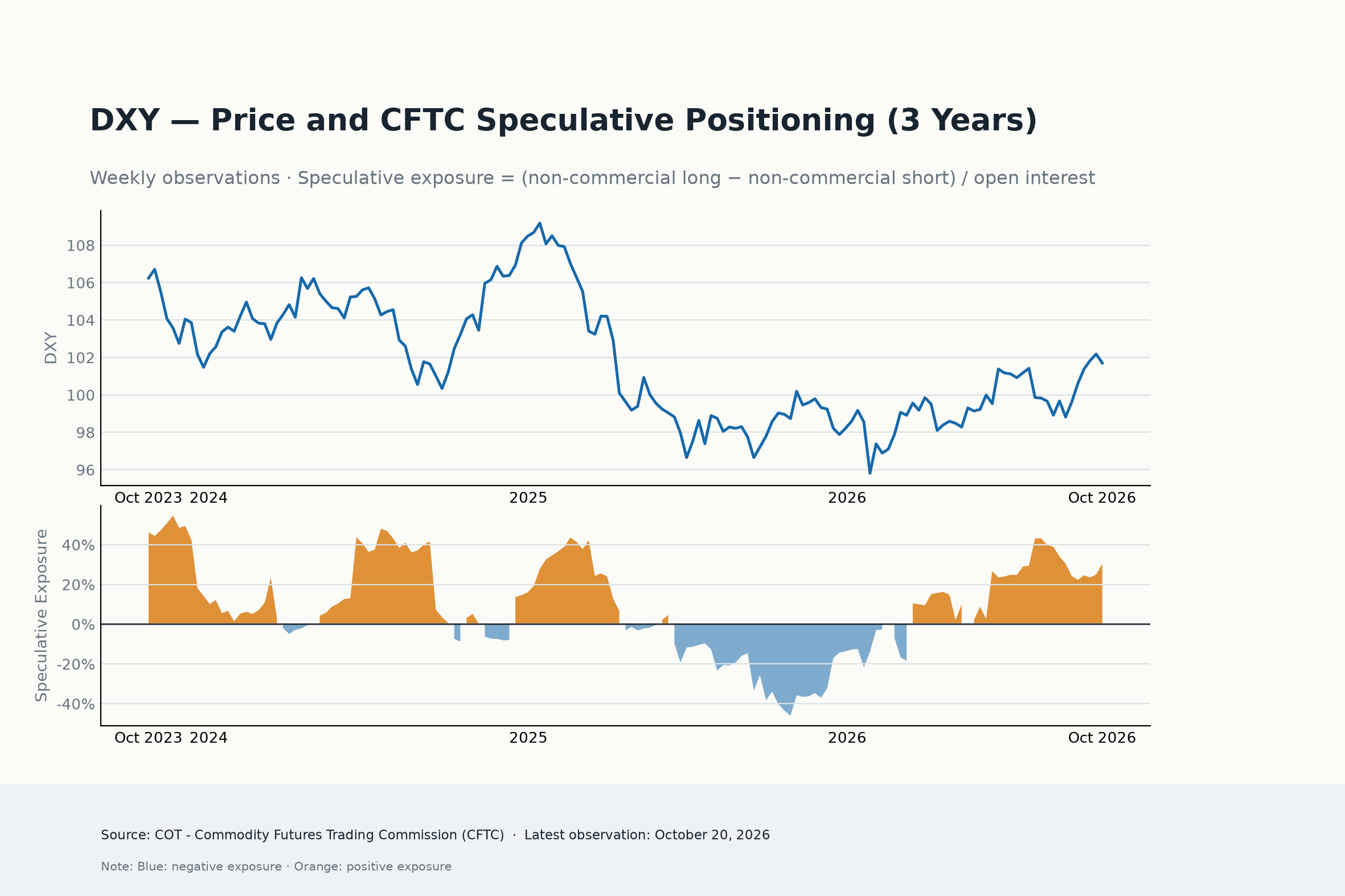
All in all, the USD positioning backdrop has improved clearly. The positive four-week trend and higher net-position percentile point to a rebuilding bullish mood, but the decline in open interest indicates that the latest improvement reflects the unwinding of bearish exposure more than strong new long conviction.
What’s next for the US Dollar
It will be a very intriguing week, as politics return to the fore with the Midterm elections on Tuesday, while the domestic calendar features the release of ISM gauges of business activity, and the labour market takes centre stage with the publication of JOLTS data, the ADP report and the always-relevant Nonfarm Payrolls.
Comments from Fed officials will also be a key focus following this week’s FOMC event, along with any developments from the Middle East conflict.
The Dollar has the backing, but where is the momentum?
The US Dollar heads into November with plenty of reasons to remain supported but considerably fewer to extend its rally. Sticky inflation, a Fed unwilling to declare victory and persistent geopolitical uncertainty should continue to discourage aggressive selling. Still, the Greenback's inability to fully capitalise on an increasingly hawkish backdrop suggests that much of the good news may already be reflected in its price.
Speculative positioning adds another layer to the story. US Dollar bulls are gradually regaining the upper hand, although the recovery appears to owe more to the unwinding of bearish bets than to a convincing wave of fresh buying. That leaves the currency supported, but hardly unstoppable.
The coming week could put that fragile balance to the test. US labour market figures, business activity surveys and the Midterm elections will offer fresh clues about the economy, the Fed's next move and investors' appetite for risk.
For now, the Greenback retains a cautiously bullish bias, but another leg higher may require more than a hawkish Fed.
It may need a genuine surprise.
Fed FAQs
Monetary policy in the US is shaped by the Federal Reserve (Fed). The Fed has two mandates: to achieve price stability and foster full employment. Its primary tool to achieve these goals is by adjusting interest rates. When prices are rising too quickly and inflation is above the Fed’s 2% target, it raises interest rates, increasing borrowing costs throughout the economy. This results in a stronger US Dollar (USD) as it makes the US a more attractive place for international investors to park their money. When inflation falls below 2% or the Unemployment Rate is too high, the Fed may lower interest rates to encourage borrowing, which weighs on the Greenback.
The Federal Reserve (Fed) holds eight policy meetings a year, where the Federal Open Market Committee (FOMC) assesses economic conditions and makes monetary policy decisions. The FOMC is attended by twelve Fed officials – the seven members of the Board of Governors, the president of the Federal Reserve Bank of New York, and four of the remaining eleven regional Reserve Bank presidents, who serve one-year terms on a rotating basis.
In extreme situations, the Federal Reserve may resort to a policy named Quantitative Easing (QE). QE is the process by which the Fed substantially increases the flow of credit in a stuck financial system. It is a non-standard policy measure used during crises or when inflation is extremely low. It was the Fed’s weapon of choice during the Great Financial Crisis in 2008. It involves the Fed printing more Dollars and using them to buy high grade bonds from financial institutions. QE usually weakens the US Dollar.
Quantitative tightening (QT) is the reverse process of QE, whereby the Federal Reserve stops buying bonds from financial institutions and does not reinvest the principal from the bonds it holds maturing, to purchase new bonds. It is usually positive for the value of the US Dollar.
Author

Pablo Piovano
FXStreet
Born and bred in Argentina, Pablo has been carrying on with his passion for FX markets and trading since his first college years.

















