Gold Price Forecast: XAU/USD plunges with renewed US Dollar demand

XAU/USD Current price: 2,014.40
- Stock markets extend the rally after solid earnings reports and upbeat US data.
- The Bank of Canada kept its monetary policy unchanged, as widely anticipated.
- XAU/USD turned bearish in the near term, aims to test the $2.000 mark.
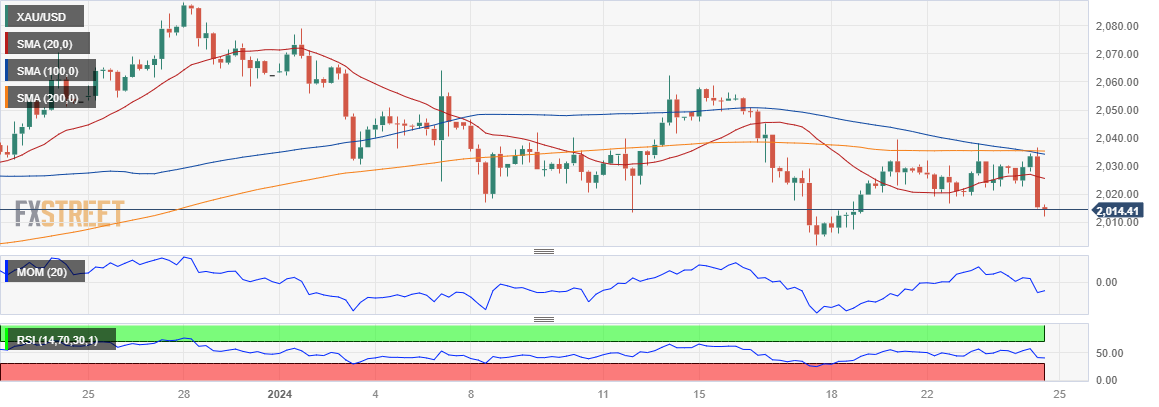
The US Dollar surged in the American session, driving XAU/USD down to $2,011.72, a fresh weekly low. Upbeat United States (US) data boosted the local currency. S&P Global published the preliminary estimate of the January Producer Manager Indexes (PMIs), which showed manufacturing output improved to 50.3, much better than the 47.9 previous and the highest reading in over a year. The Services PMI came in at 52.9, beating the expected 51 and above the previous 51.4. According to the official report, business activity grew at the “sharpest rate in seven months.”
Meanwhile, the Bank of Canada (BoC) announced it left its key rate unchanged at 5% following the January policy. The statement was slightly more hawkish than anticipated, weighing down the odds for an April rate cut to around 40%. Still, stock markets maintain the positive tone, with Wall Street resuming its record rally on the back of better-than-anticipated earnings reports signaling economic health.
XAU/USD short-term technical outlook
From a technical point of view, XAU/USD is poised to extend its slump. The daily chart shows it met sellers around a bearish 20 Simple Moving Average (SMA), providing dynamic resistance at around the daily high of $2,036.80. At the same time, technical indicators resumed their declines within negative levels, gaining downward strength. Finally, the 100 and 200 SMAs remain below the current level, losing directional strength.
The 4-hour chart shows a long bearish candle following a test of converging 100 and 200 SMAs, also around the intraday high, and XAU/USD accelerating the slide below a mildly bearish 20 SMA. Furthermore, technical indicators accelerated north, heading south almost vertically within negative levels, in line with another leg south.
Support levels: 2,011.70 2,001.60 1,988.60
Resistance levels: 2,021.80 2,033.10 2,040.30
Author

Valeria Bednarik
FXStreet
Valeria Bednarik was born and lives in Buenos Aires, Argentina. Her passion for math and numbers pushed her into studying economics in her younger years.