Gold Price Forecast: XAU/USD looks to Fedspeak, as technicals flip bearish
- Gold price treads water near $2,025 early Tuesday after hitting a weekly low on Monday.
- US Dollar, Treasury bond yields take a breather as risk sentiment improves.
- The tide seems to have turned against Gold buyers, as the daily RSI flips bearish.

Gold price is keeping its tepid recovery mode intact near $2,025 in the Asian session on Monday, having hit a weekly of $2,015 on Monday. The US Dollar (USD) is seeing a pullback from multi-month highs alongside the US Treasury bond yields, allowing Gold sellers to take a breather.
Fedspeak to steal the spotlight amid a data-light US docket
Strong US Nonfarm Payrolls report combined with the hawkish rhetoric maintained by the US Federal Reserve (Fed) Chairman Jerome Powell dialed back expectations of aggressive Fed rate cuts this year, propping up the US Dollar and the US Treasury bond yields at the expense of the non-interest-bearing Gold price.
Friday’s US labor market report showed that the US economy added a whopping 353K jobs in January, against the 180K expected. Fed Chair Jerome Powell, in an interview aired early Monday, dismissed a rate cut next month while pushing back against the timing of the rate cuts.
Early Monday, Gold price did receive some support from escalating geopolitical tensions between the West and the Iran-back Houthi rebels but the sentiment around the Fed expectations outweighed in the latter part of the day after the US ISM Services PMI came in stronger at 53.4 in January, as new orders increased and employment rebounded.
Gold price succumbed to fading hopes of early and steep interest rate cuts by the Fed, with markets now pricing in 115 basis points (bps) of cuts this year, compared with around 150 bps of reductions anticipated a month ago, per CME Group’s FedWatch tool.
So far this Tuesday’s trading, Gold price is struggling to extend its recovery mode even though the US Dollar retreats with the US Treasury bond yields amid an improvement in risk sentiment. Gold traders remain wary, digesting the latest mixed messages from the Fed policymakers.
Minneapolis Fed President Neel Kashkari argued on Monday that a possibly higher neutral rate means that the Fed can take more time to before deciding whether to cut. Meanwhile, Chicago Fed President Austan Goolsbee said late Friday, he does not take the strong January US job growth as a reason for waiting to cut interest rates.
Fed Chair Jerome Powell said, “with economy strong, we feel we can approach rate cut timing question carefully. Confidence is rising, but want more confidence before taking 'very important step' of starting rate cuts.”
In the absence of top-tier US economic data in the day ahead, Gold traders will closely scrutinize the comments from Fed policymakers for fresh hints on the timing and the pace of Fed rate cuts. Market sentiment will also likely play a pivotal role, with the US earnings season underway and rife Middle East geopolitical tensions.
Gold price technical analysis: Daily chart
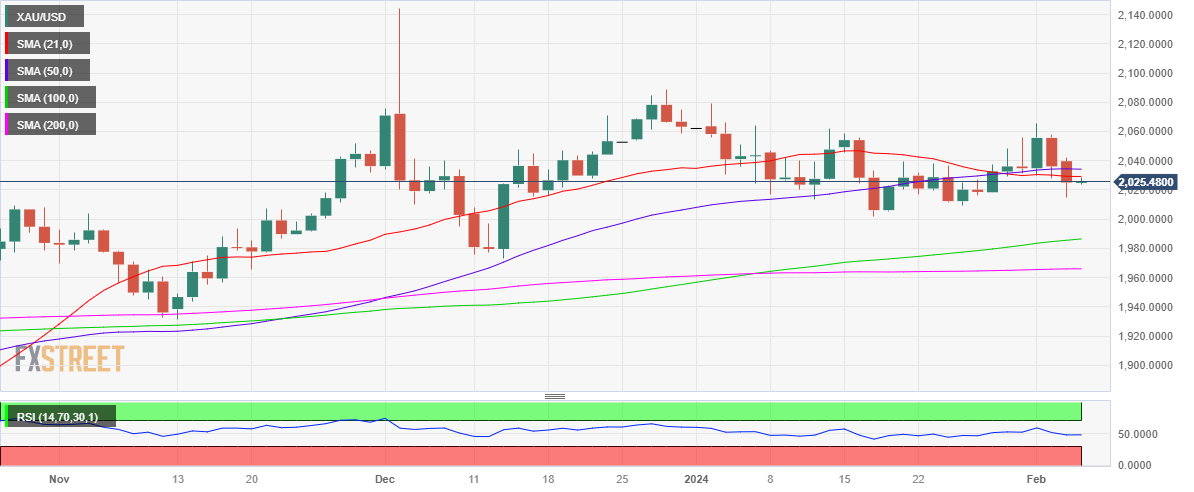
As observed on the daily chart, Gold price closed Monday below the critical support in the $2,030-$2,035 region. That level is the confluence of the 21-day and 50-day Simple Moving Averages (SMA).
Further, the 14-day Relative Strength Index (RSI) indicator also pierced through the 50 level for the downside.
These technical moves suggest that the tide has turned in favor of Gold sellers, reopening floors for a test of the $2,000 threshold if the $2,010 round figure gives way.
On the upside, the immediate powerful resistance at the abovementioned confluence support now turned resistance near $2,030. Gold buyers need to find a strong foothold above the latter on a daily candlestick closing basis to initiate a recovery toward the $2,050 psychological level.
Recapturing that level is critical to revisit the monthly top of $2,065, which could act as a tough nut to crack for Gold buyers.
Gold FAQs
Why do people invest in Gold?
Gold has played a key role in human’s history as it has been widely used as a store of value and medium of exchange. Currently, apart from its shine and usage for jewelry, the precious metal is widely seen as a safe-haven asset, meaning that it is considered a good investment during turbulent times. Gold is also widely seen as a hedge against inflation and against depreciating currencies as it doesn’t rely on any specific issuer or government.
Who buys the most Gold?
Central banks are the biggest Gold holders. In their aim to support their currencies in turbulent times, central banks tend to diversify their reserves and buy Gold to improve the perceived strength of the economy and the currency. High Gold reserves can be a source of trust for a country’s solvency. Central banks added 1,136 tonnes of Gold worth around $70 billion to their reserves in 2022, according to data from the World Gold Council. This is the highest yearly purchase since records began. Central banks from emerging economies such as China, India and Turkey are quickly increasing their Gold reserves.
How is Gold correlated with other assets?
Gold has an inverse correlation with the US Dollar and US Treasuries, which are both major reserve and safe-haven assets. When the Dollar depreciates, Gold tends to rise, enabling investors and central banks to diversify their assets in turbulent times. Gold is also inversely correlated with risk assets. A rally in the stock market tends to weaken Gold price, while sell-offs in riskier markets tend to favor the precious metal.
What does the price of Gold depend on?
The price can move due to a wide range of factors. Geopolitical instability or fears of a deep recession can quickly make Gold price escalate due to its safe-haven status. As a yield-less asset, Gold tends to rise with lower interest rates, while higher cost of money usually weighs down on the yellow metal. Still, most moves depend on how the US Dollar (USD) behaves as the asset is priced in dollars (XAU/USD). A strong Dollar tends to keep the price of Gold controlled, whereas a weaker Dollar is likely to push Gold prices up.
Author

Dhwani Mehta
FXStreet
Residing in Mumbai (India), Dhwani is a Senior Analyst and Manager of the Asian session at FXStreet. She has over 10 years of experience in analyzing and covering the global financial markets, with specialization in Forex and commodities markets.