|premium|

Gold Price Forecast: XAU/USD looks south as US dollar cheers stimulus gloom

  • Gold tracked stocks lower on Tuesday after Trump rejected stimulus talks. 
  • Trump’s latest call for partial stimulus lent some support, but not for long.
  • Technical indicators favor the bears ahead of Fedspeak, FOMC minutes.

The latest tweet from US President Donald Trump on stimulus early Wednesday saved the day for the gold bulls, as Gold (XAU/USD) attempts a tepid bounce from weekly lows of $1874. Trump called on for partial stimulus, urging Congress to approve paycheck protection and airline support. The sentiment received a fresh lift propping the Asian equities while the US dollar stalled its overnight rally.

Despite gold’s pullback, the path of least resistance remains to the downside, as the safe-haven dollar will likely remain in demand amid fresh concerns on the US economic recovery, in the wake of no prospects of fiscal stimulus until after the US elections. Also, markets would favor the US currency ahead of the Fedspeak and FOMC minutes, keeping the gold bulls at bay.

Late Tuesday, President Trump rejected House Speaker Nancy Pelosi’s $2.4 trillion fiscal aid offer, which triggered a fresh risk-aversion wave across the financial markets. Gold tumbled in tandem with the Wall Street stocks amid resurgent demand for the greenback, as a safe-bet.

Gold: Short-tern technical outlook

Hourly chart
fxsoriginal
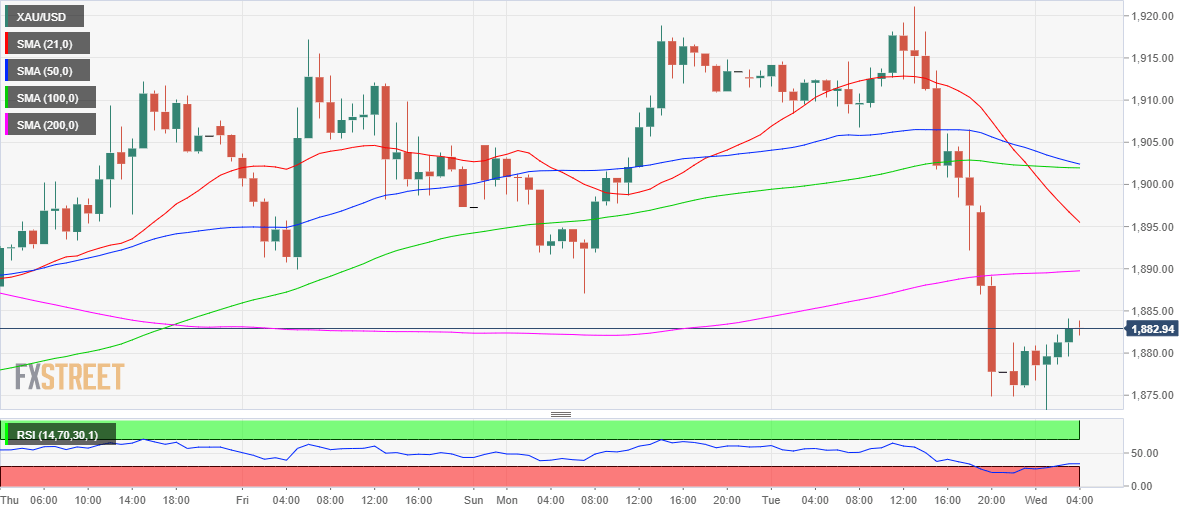
Looking at gold’s hourly chart, the price seems struggling to extend the recovery momentum from weekly lows, with the immediate upside barrier seen at horizontal 200-hourly Simple Moving Average (HMA), currently at $1890.

Acceptance above the latter would expose the bearish 21-HMA at $1895. The next critical resistance awaits at $1902, the confluence of the 50 and 100-HMAs.

Alternatively, a failure to defend the weekly lows of $1873, the next robust support at $1860 will be put to test, which is the 100-day Simple Moving Average (DMA).    

The hourly Relative Strength Index (RSI) trades flat around 33.40, after bouncing from the oversold territory, suggesting that there is more scope to the downside.

Premium

You have reached your limit of 3 free articles for this month.

Start your subscription and get access to all our original articles.

Subscribe to PremiumSign In

Author

Dhwani Mehta

Dhwani Mehta

FXStreet

Residing in Mumbai (India), Dhwani is a Senior Analyst and Manager of the Asian session at FXStreet. She has over 10 years of experience in analyzing and covering the global financial markets, with specialization in Forex and commodities markets.


More from Dhwani Mehta
Share:

Editor's Picks

GBP/USD bounces off lows, back above 1.3200

After bottoming out near 1.3160, GBP/USD manages to regain a bit of shine and reclaim the 1.3200 mark and beyond at the end of the week. Stronger-than-expected UK Retail Sales data seem to be helping the British Pound limit its losses, while the chaotic UK political environment keeps the bulls at bay for now.

EUR/USD looks consolidative around 1.1460

EUR/USD stages a modest rebound after slipping to a three-month low below 1.1420 at the end of the week. That said, the pair now looks to consolidate humble gains just above 1.1460 despite growing uncertainty surrounding the next round of US-Iran negotiations, which keeps the US Dollar’s downside contained.

Gold slips back to six-day lows, targets $4,100

Gold retreats for the third consecutive day on Friday, eroding gains seen in the first half of the week and approaching the key $4,100 mark per troy ounce. Indeed, the precious metal continues to face headwinds from the Fed's hawkish stance and renewed uncertainty surrounding the next round of US-Iran negotiations.

Breaking: Iran closes the Strait of Hormuz amid ceasefire deal violation
Iran says it is closing the Strait of Hormuz after accusing the United States (US) and Israel of violating the ceasefire. According to Iran, the decision came over the continued Israeli strikes in Lebanon. The Iranian Revolutionary Guard Corps Navy issued a warning to all vessels: "Do not approach the Strait of Hormuz; otherwise, your security will be jeopardized."
The Iran war didn't break the US economy, but what happens next?

Nearly four months after the start of the Iran war, the US economy remains remarkably resilient. While the conflict initially triggered a severe disruption to global energy markets and a sharp rise in Oil prices, recent diplomatic progress between Washington and Tehran has eased concerns about a prolonged supply shock.

Regime change: Inside Kevin Warsh's first move to make the Fed unreadable on purpose

The rate did not move. That was the least interesting thing about Kevin Warsh's first meeting in charge of the Fed. The FOMC held its benchmark at 3.50%-3.75% for the fourth straight meeting, exactly as priced, and then the new chair used his first press conference to dismantle the machinery the market has leaned on for a decade.