Gold Price Forecast: XAU/USD looks north on geopolitical risks, US economic woes
- Gold price consolidates previous gains below $3,400 early Thursday.
- The US Dollar bounces after weak US data-led declines, will it last?
- Gold price battle with key resistance zone at $3,377 on the daily chart extends.
- Focus remains on Russia-Ukraine geopolitical updates, trade headlines.

Gold price is consolidating the previous recovery gains while remaining below $3,400 early Thursday. Traders refrain from placing fresh bets on Gold price amid a likely Russia-Ukraine geopolitical escalation and some optimism on the trade front.
Gold price appears torn between geopolitical risks, trade optimism
In Thursday’s trading so far, Gold price is struggling for a fresh upside boost amid renewed hopes of a likely trade deal between the US and Canada, EU-US and optimism over a potential call between US President Donald Trump and his Chinese counterpart Xi Jinping on Friday.
The fresh enthusiasm on the trade front seems to be helping the US Dollar (USD) attempt a tepid bounce following Wednesday’s steep decline.
However, the downside in the traditional safe-haven Gold price remains cushioned by simmering geopolitical tensions between Russia and Ukraine.
Ukraine launched a surprise attack using smuggled drones to strike Russian airbases on 1 June, targeting what it said were nuclear-capable long-range bombers.
Responding to Ukraine’s aggression, Russian President Vladimir Putin said that he doubted over any possibility of a ceasefire after these latest attacks.
Speaking after a phone call with the Russian president, Trump said: "President Putin did say, and very strongly, that he will have to respond to the recent attack on the airfields."
If Russia responds strongly, we could see a re-escalation of the Ukraine conflict, with intense flight to safety propelling Gold price.
Meanwhile, traders will keep a close eye on the speeches from several Federal Reserve (Fed) policymakers and the US Jobless Claims data, especially after the latest weak economic data.
Data published by ADP showed on Wednesday that the US private sector payrolls increased just 37,000 for the month, below the downwardly revised 60,000 in April and the forecast for 115,000.
The US May ISM Services PMI unexpectedly contracted to 49.9, following April’s 51.6 and 52 expected.
Disappointing US economic data revived dovish Fed expectations, boosting the non-yielding Gold price at the expense of the USD.
Gold price technical analysis: Daily chart
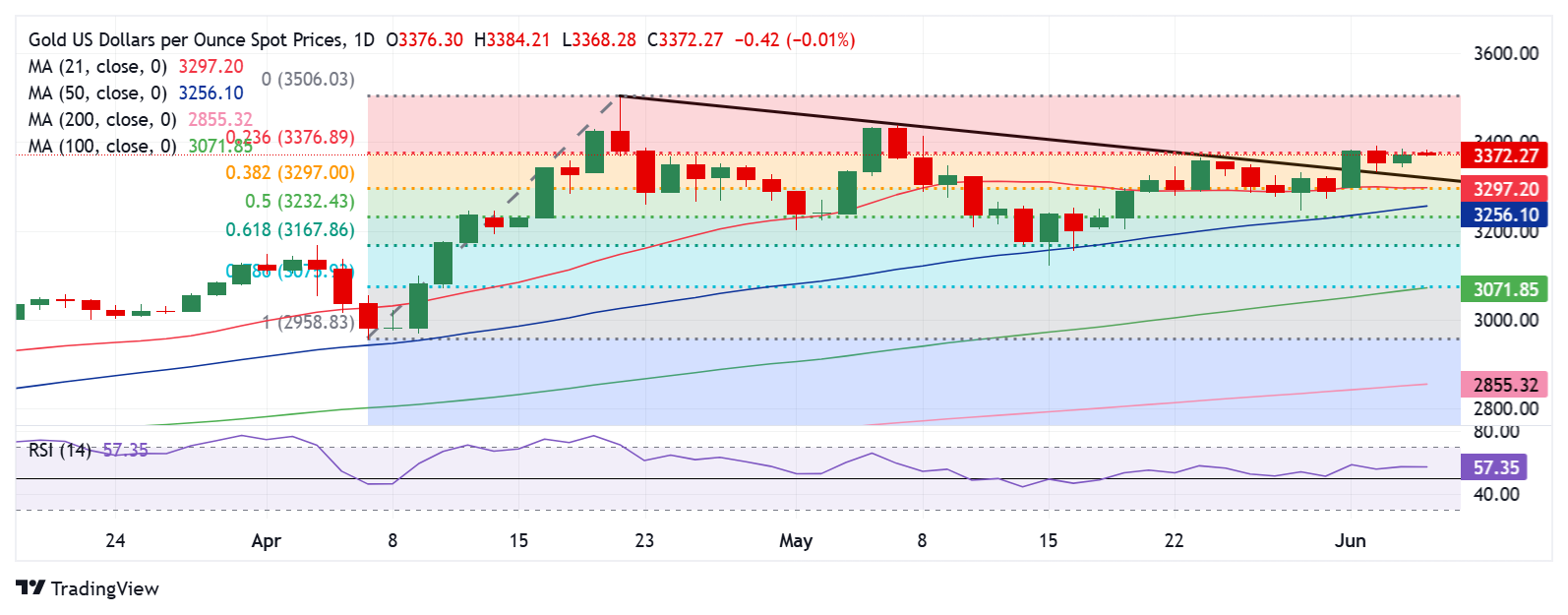
The near-term technical outlook for Gold price remains more or less the same.
Gold buyers remain hopeful so long as the confluence of the 21-day Simple Moving Average (SMA) and the 38.2% Fibonacci Retracement (Fibo) level of the April record rally at $3,297 is held.
The 14-day Relative Strength Index (RSI) is sitting comfortably above the midline, adding credence to the bullish potential.
Gold buyers must find acceptance above the 23.6% Fibo resistance at $3,377 on a daily candlestick closing basis to resume the recent upswing toward the lifetime highs of $3,500.
Ahead of that, the May high of $3,439 must be taken out.
Alternatively, sellers could attempt control on a break below the falling trendline resistance-turned-support, now at $3,322.
The next support is seen at the abovementioned powerful confluence of $3,297.
Further south, sellers will target support near $3,240, where the 50% Fibo level and the 50-day SMA hang around.
Gold FAQs
Gold has played a key role in human’s history as it has been widely used as a store of value and medium of exchange. Currently, apart from its shine and usage for jewelry, the precious metal is widely seen as a safe-haven asset, meaning that it is considered a good investment during turbulent times. Gold is also widely seen as a hedge against inflation and against depreciating currencies as it doesn’t rely on any specific issuer or government.
Central banks are the biggest Gold holders. In their aim to support their currencies in turbulent times, central banks tend to diversify their reserves and buy Gold to improve the perceived strength of the economy and the currency. High Gold reserves can be a source of trust for a country’s solvency. Central banks added 1,136 tonnes of Gold worth around $70 billion to their reserves in 2022, according to data from the World Gold Council. This is the highest yearly purchase since records began. Central banks from emerging economies such as China, India and Turkey are quickly increasing their Gold reserves.
Gold has an inverse correlation with the US Dollar and US Treasuries, which are both major reserve and safe-haven assets. When the Dollar depreciates, Gold tends to rise, enabling investors and central banks to diversify their assets in turbulent times. Gold is also inversely correlated with risk assets. A rally in the stock market tends to weaken Gold price, while sell-offs in riskier markets tend to favor the precious metal.
The price can move due to a wide range of factors. Geopolitical instability or fears of a deep recession can quickly make Gold price escalate due to its safe-haven status. As a yield-less asset, Gold tends to rise with lower interest rates, while higher cost of money usually weighs down on the yellow metal. Still, most moves depend on how the US Dollar (USD) behaves as the asset is priced in dollars (XAU/USD). A strong Dollar tends to keep the price of Gold controlled, whereas a weaker Dollar is likely to push Gold prices up.
Author

Dhwani Mehta
FXStreet
Residing in Mumbai (India), Dhwani is a Senior Analyst and Manager of the Asian session at FXStreet. She has over 10 years of experience in analyzing and covering the global financial markets, with specialization in Forex and commodities markets.

















