Gold Price Forecast: XAU/USD keeps record-setting rally intact despite overbought conditions
- Gold price stalls after refreshing record highs above $3,050 early Thursday.
- The dovish Fed outlook and stagflation fears continue to push the US Dollar and Treasury yields lower.
- Gold price eyes triangle target at $3,080 but overbought conditions warrant caution.


Gold price is taking a breather early Thursday after extending its record-setting rally well above the $3,050 threshold. Further upside in Gold price could be limited amid overbought conditions on the daily time frame and ahead of the mid-tier US economic data releases.
Gold price cheers dovish Fed outlook
Despite the latest cooldown, the fundamental outlook for Gold price remains bullish, courtesy of US President Donald Trump’s tariff-led economic concerns and the Federal Reserve’s (Fed) dovish outlook.
The non-yielding Gold price built on its recent record rally on Wednesday after the Fed’s Dot Plot chart signalled two interest rate cuts this year. The Fed raised its inflation forecast while lowering its growth and employment outlook due to the impact of Trump's tariffs, fueling fears of potential stagflation in the United States (US). The Fed left its policy rate in the 4.25%-4.50% range.
Besides, the traditional safe-haven Gold price continues to benefit from escalating geopolitical tensions in the Middle East. Israel announced renewed ground operations in Gaza on Wednesday and issued what it called a "last warning" to residents of the Palestinian territory to return hostages and remove Hamas from power.
The renewed tensions occurred after Israel and the US sought to change the terms of the ceasefire deal by extending phase one -- a stance rejected by Hamas.
Looking ahead, the mid-tier US Jobless Claims and Existing Home Sales data will be closely scrutinized for fresh hints on the state of the US economy. However, developments on the geopolitical and trade front will continue to play a pivot role in driving Gold price in the sessions ahead.
Earlier in the Asian session. US President Donald Trump took to his social media account and urged the Fed to lower rates as tariffs are hurting the economy.
Traders will also look forward to the speeches from Fed officials as they return to the rostrum after the ‘blackout’ period.
Gold price technical analysis: Daily chart
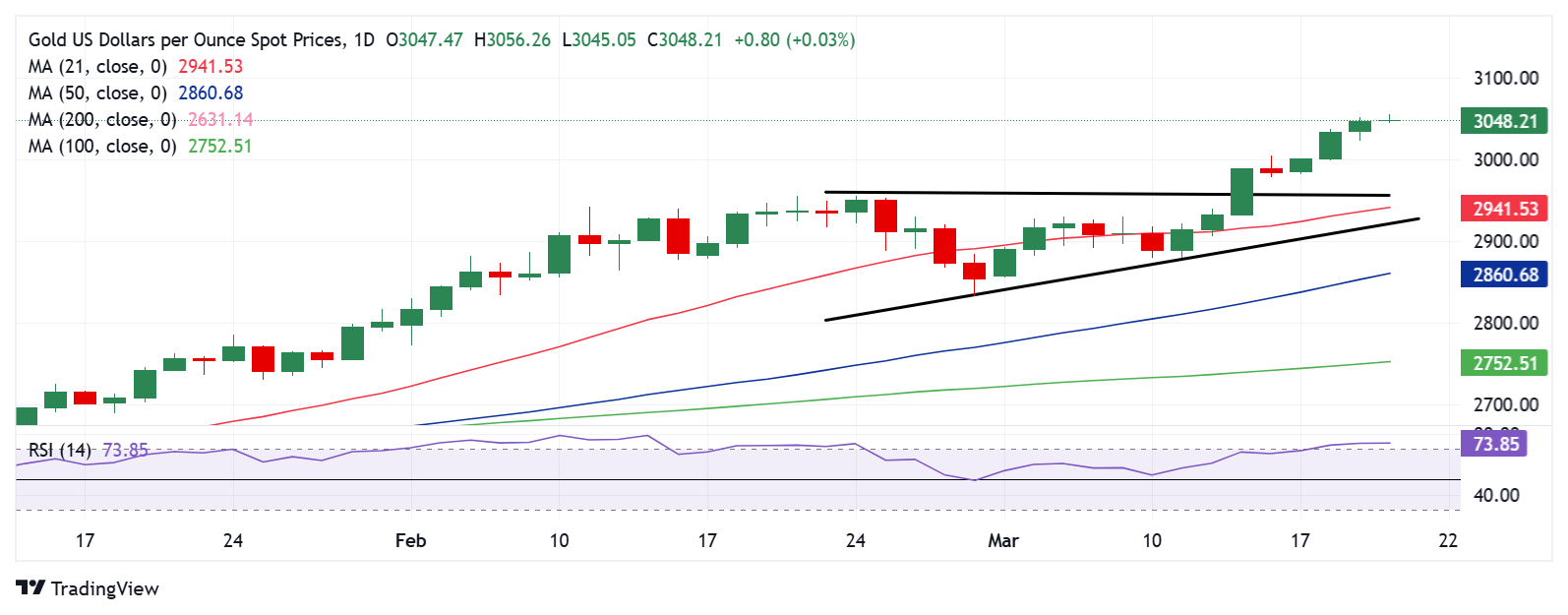
Technically, nothing changes for the Gold price in the near term as the bullish bias remains intact, with the ascending triangle breakout in play.
However, a brief pullback cannot be ruled out as the 14-day Relative Strength Index (RSI) hovers in the overbought region, near 74, at the time of writing.
On a corrective move lower, Gold price could test the previous day’s low of $3,023, below which the $,3000 level will be eyed.
The next downside caps are at the weekly low of $2,982 and the previous triangle resistance-turned-support at $2,956.
Conversely, Gold price could retest the record high of $3,056 if buyers regain poise. Further up, the triangle target measured at $3,080 will be put to the test.
Gold FAQs
Gold has played a key role in human’s history as it has been widely used as a store of value and medium of exchange. Currently, apart from its shine and usage for jewelry, the precious metal is widely seen as a safe-haven asset, meaning that it is considered a good investment during turbulent times. Gold is also widely seen as a hedge against inflation and against depreciating currencies as it doesn’t rely on any specific issuer or government.
Central banks are the biggest Gold holders. In their aim to support their currencies in turbulent times, central banks tend to diversify their reserves and buy Gold to improve the perceived strength of the economy and the currency. High Gold reserves can be a source of trust for a country’s solvency. Central banks added 1,136 tonnes of Gold worth around $70 billion to their reserves in 2022, according to data from the World Gold Council. This is the highest yearly purchase since records began. Central banks from emerging economies such as China, India and Turkey are quickly increasing their Gold reserves.
Gold has an inverse correlation with the US Dollar and US Treasuries, which are both major reserve and safe-haven assets. When the Dollar depreciates, Gold tends to rise, enabling investors and central banks to diversify their assets in turbulent times. Gold is also inversely correlated with risk assets. A rally in the stock market tends to weaken Gold price, while sell-offs in riskier markets tend to favor the precious metal.
The price can move due to a wide range of factors. Geopolitical instability or fears of a deep recession can quickly make Gold price escalate due to its safe-haven status. As a yield-less asset, Gold tends to rise with lower interest rates, while higher cost of money usually weighs down on the yellow metal. Still, most moves depend on how the US Dollar (USD) behaves as the asset is priced in dollars (XAU/USD). A strong Dollar tends to keep the price of Gold controlled, whereas a weaker Dollar is likely to push Gold prices up.
Premium
You have reached your limit of 3 free articles for this month.
Start your subscription and get access to all our original articles.
Author
Dhwani Mehta
FXStreet
Residing in Mumbai (India), Dhwani is a Senior Analyst and Manager of the Asian session at FXStreet. She has over 10 years of experience in analyzing and covering the global financial markets, with specialization in Forex and commodities markets.

















