Gold Price Forecast: XAU/USD eyes fresh record highs and counting
- Gold price enters a bullish consolidation phase as Trump’s tariffs affect risk sentiment.
- US Dollar struggles to hold ground despite hawkish Fed Minutes as US Treasury yields decline weighs.
- Gold price awaits acceptance above $2,950 as the daily technical setup favors buyers.

Gold price has entered a bullish consolidative mode early Thursday, just under record highs hitting near $2,950 on Wednesday. US President Donald Trump’s tariff talks continue to spook markets, with investors running for cover in the traditional store of value – Gold.
Gold price maintains its winning streak on Trump’s tariffs
Trump on Wednesday said he will announce tariffs related to imports of timber, cars, semiconductors and pharmaceuticals "over the next month or sooner", re-emphasizing his planned announced a day earlier about imposing auto tariffs "in the neighbourhood of 25%" and similar duties on semiconductors and pharmaceuticals.
Further, US Commerce Secretary Howard Lutnick said in a Fox News interview late Wednesday that President Trump’s “goal is simple: to abolish the Internal Revenue Service and let all the outsiders pay.”
These tariff threats remain a drag on the market’s appetite for risk, accentuated by a lack of policy support from the Chinese central bank and looming tensions between the US and the European Union (EU) over the Russia-Ukraine peace deal.
The US excluded Ukraine and the EU in its peace talks to end the Ukraine conflict with Russian top delegates. This has mounted pressure on the EU to form a clear and cohesive response to Trump’s decision to negotiate directly with Russia to end the war in Ukraine.
Meanwhile, the People’s Bank of China (PBOC) kept the one-year loan prime rate (LPR) unchanged at 3.1%, and the five-year LPR at 3.6% “as Beijing prioritizes financial stability over interest rate easing to bolster the economy,” per CNBC News.
Despite the tepid risk sentiment, the US Dollar (USD) struggles to gain ground, undermined by the recent decline in the US Treasury bond yields. US tariff threats boost the safe-haven flows into the US government bonds, weighing negatively on the Treasury yields.
Markets looked past the hawkish Minutes of the US Federal Reserve (Fed) January policy meeting as US tariff talks continue to hog the limelight. The Minutes showed on Wednesday that “many participants noted that the committee could hold the policy rate at a restrictive level if the economy remained strong and inflation remained elevated” in the face of Trump’s trade policies.
Looking ahead, the mid-tier US Jobless Claims data and speeches from Fed officials will likely play second fiddle to US tariff talks as the Republican President Trump continues to inject volatility into the markets.
Therefore, Gold price remains exposed to upside risks on Trump’s tariffs uncertainty and the market’s nervousness.
Gold price technical analysis: Daily chart
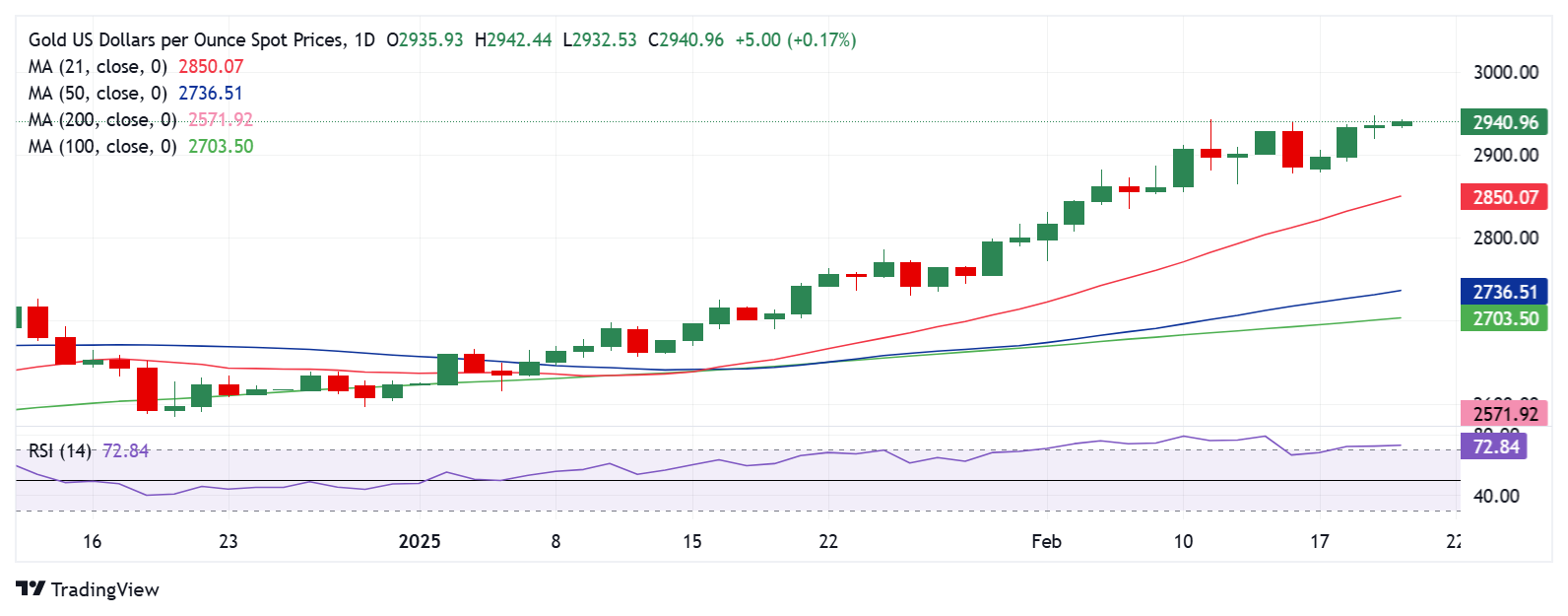
The short-term technical outlook for Gold price remains more or less the same.
The daily chart shows that Gold price hangs near the record high of $2,947. The 14-day Relative Strength Index (RSI) flatlines in the overbought territory, currently near 73, suggesting that there is some room to the upside before a correction kicks in.
Gold buyers await acceptance above the $2,950 barrier on a daily closing basis to extend the record rally. The next relevant resistance is seen at the $2,970 round level.
Conversely, a fresh pullback could call for a test of the $2,900 round level, below which the February 14 low of $2,877 will be threatened.
A firm break of that level will initiate a fresh downside toward the $2,850 psychological barrier.
Gold FAQs
Gold has played a key role in human’s history as it has been widely used as a store of value and medium of exchange. Currently, apart from its shine and usage for jewelry, the precious metal is widely seen as a safe-haven asset, meaning that it is considered a good investment during turbulent times. Gold is also widely seen as a hedge against inflation and against depreciating currencies as it doesn’t rely on any specific issuer or government.
Central banks are the biggest Gold holders. In their aim to support their currencies in turbulent times, central banks tend to diversify their reserves and buy Gold to improve the perceived strength of the economy and the currency. High Gold reserves can be a source of trust for a country’s solvency. Central banks added 1,136 tonnes of Gold worth around $70 billion to their reserves in 2022, according to data from the World Gold Council. This is the highest yearly purchase since records began. Central banks from emerging economies such as China, India and Turkey are quickly increasing their Gold reserves.
Gold has an inverse correlation with the US Dollar and US Treasuries, which are both major reserve and safe-haven assets. When the Dollar depreciates, Gold tends to rise, enabling investors and central banks to diversify their assets in turbulent times. Gold is also inversely correlated with risk assets. A rally in the stock market tends to weaken Gold price, while sell-offs in riskier markets tend to favor the precious metal.
The price can move due to a wide range of factors. Geopolitical instability or fears of a deep recession can quickly make Gold price escalate due to its safe-haven status. As a yield-less asset, Gold tends to rise with lower interest rates, while higher cost of money usually weighs down on the yellow metal. Still, most moves depend on how the US Dollar (USD) behaves as the asset is priced in dollars (XAU/USD). A strong Dollar tends to keep the price of Gold controlled, whereas a weaker Dollar is likely to push Gold prices up.
Author

Dhwani Mehta
FXStreet
Residing in Mumbai (India), Dhwani is a Senior Analyst and Manager of the Asian session at FXStreet. She has over 10 years of experience in analyzing and covering the global financial markets, with specialization in Forex and commodities markets.

















