Gold Price Forecast: XAU/USD eyes deeper correction on US-China trade optimism, pre-Fed positioning
- Gold off lows but in the red below $4,100 early Monday as risk flows dominate.
- US Dollar slips on dovish Fed bets, risk appetite, while US Treasury bond yields climb on easing US-China trade concerns.
- Technically, Gold risks renewed downside amid a Bear Cross on the 4H chart and bearish RSI.

Gold extends its consolidative phase into a fourth trading day on Monday, after having failed once again above the $4,100 mark.
Gold’s correction set to extend on US-China trade deal hopes
The latest leg down in Gold could be attributed to the renewed market optimism surrounding a US-China trade deal after a preliminary consensus on topics including export controls, fentanyl and shipping levies was reached by both sides during their two-day talks in Malaysia.
On Sunday, US Treasury Secretary Scott Bessent noted: “So I would expect that the threat of the 100% has gone away, as has the threat of the immediate imposition of the Chinese initiating a worldwide export control regime.”
In an ABC News interview, Bessent further said that China would delay its rare-earth restrictions “for a year while they reexamine it.”
These optimistic comments ramped up the odds of a trade deal likely to be reached when Trump and Chinese President Xi Jinping meet on Thursday in South Korea.
Risk flows extended into Asia on increased dovish bets surrounding the US Federal Reserve’s (Fed) easing outlook and the US-China trade deal hopes.
Markets are almost fully pricing in two interest rate cuts this year, with a 25 basis points (bps) cut seen on Wednesday.
On Friday, the Bureau of Labor Statistics (BLS) showed that the US Consumer Price Index (CPI rose 0.3% in September, which drove the annual inflation rate from 2.9% to 3%, the highest it’s been since January. The annual CPI inflation came in softer than the market forecast of 3.1%.
The US-China trade deal hopes seem to have offset the dovish Fed sentiment, undermining Gold price.
Moreover, investors continue to take profits off the table on their Gold longs ahead of the Fed’s two-day monetary policy meeting that begins on Tuesday.
Therefore, a further corrective decline cannot be ruled out in the upcoming sessions, as the US government shows no signs of reopening, and hence, trade and Fed sentiment continue to emerge as the key drivers for the bright metal.
Gold price technical analysis: Four-hour chart
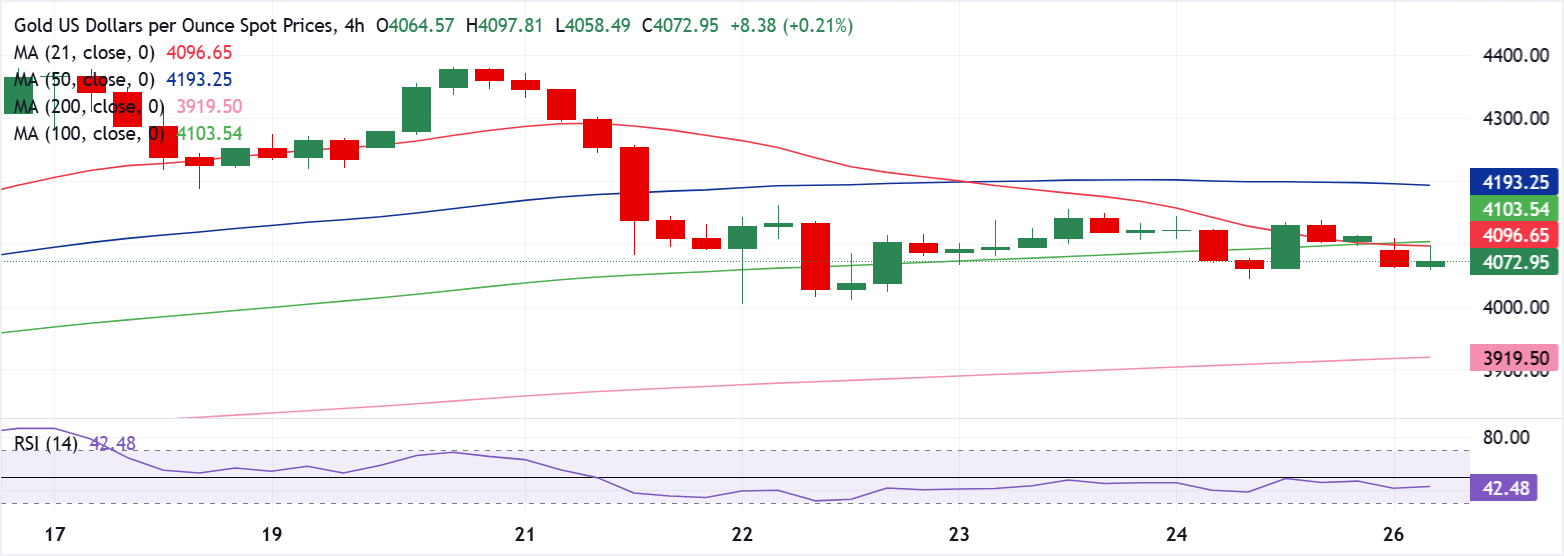
The four-hour chart shows that Gold price has once again breached the powerful support near $4,100.
That area is the confluence of the 21-Simple Moving Average (SMA) and the 100 SMA.
Meanwhile, the Relative Strength Index (RSI) stays below the midline, currently near 42.50.
Adding credence to the bearish bias, the 21 SMA closed below the 100 SMA on a four-hourly candlestick closing basis, validating a Bear Cross.
If the declines accelerate, Gold could challenge the $4,000 round level, below which the $3,950 psychological barrier will be targeted.
The next critical support is located at $3,920, the 200 SMA.
Alternatively, if buyers find a strong foothold above the aforesaid key support-turned-resistance at around $4,100, a fresh advance toward the $4,150 level could be in the offing.
Further north, Gold buyers could challenge the 50 SMA at $4,193.
Fed FAQs
Monetary policy in the US is shaped by the Federal Reserve (Fed). The Fed has two mandates: to achieve price stability and foster full employment. Its primary tool to achieve these goals is by adjusting interest rates. When prices are rising too quickly and inflation is above the Fed’s 2% target, it raises interest rates, increasing borrowing costs throughout the economy. This results in a stronger US Dollar (USD) as it makes the US a more attractive place for international investors to park their money. When inflation falls below 2% or the Unemployment Rate is too high, the Fed may lower interest rates to encourage borrowing, which weighs on the Greenback.
The Federal Reserve (Fed) holds eight policy meetings a year, where the Federal Open Market Committee (FOMC) assesses economic conditions and makes monetary policy decisions. The FOMC is attended by twelve Fed officials – the seven members of the Board of Governors, the president of the Federal Reserve Bank of New York, and four of the remaining eleven regional Reserve Bank presidents, who serve one-year terms on a rotating basis.
In extreme situations, the Federal Reserve may resort to a policy named Quantitative Easing (QE). QE is the process by which the Fed substantially increases the flow of credit in a stuck financial system. It is a non-standard policy measure used during crises or when inflation is extremely low. It was the Fed’s weapon of choice during the Great Financial Crisis in 2008. It involves the Fed printing more Dollars and using them to buy high grade bonds from financial institutions. QE usually weakens the US Dollar.
Quantitative tightening (QT) is the reverse process of QE, whereby the Federal Reserve stops buying bonds from financial institutions and does not reinvest the principal from the bonds it holds maturing, to purchase new bonds. It is usually positive for the value of the US Dollar.
Author

Dhwani Mehta
FXStreet
Residing in Mumbai (India), Dhwani is a Senior Analyst and Manager of the Asian session at FXStreet. She has over 10 years of experience in analyzing and covering the global financial markets, with specialization in Forex and commodities markets.















