|premium|

Gold Price Forecast: XAU/USD eases further as markets aim to stabilize

XAU/USD Current price: $2,388.23

  • Financial markets are looking to stabilize, but fears persist.
  • A firm recovery in government bond yields backs US Dollar’s gains.
  • XAU/USD extends slide within Monday’s range, aims for lower lows.
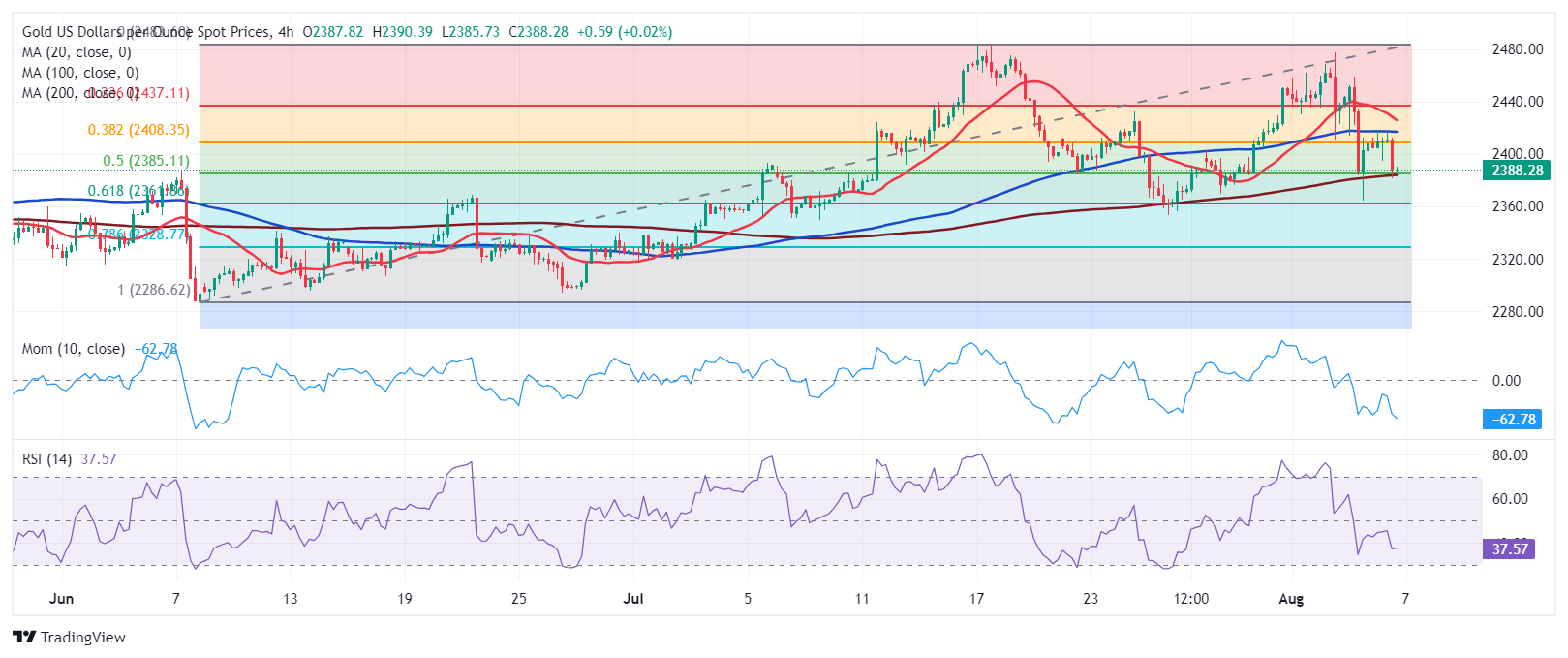
XAU/USD extends Monday’s losses and trades in the $2,380 price zone as markets abandon panic. On the one hand, stocks are in better shape after collapsing at the beginning of the week, with United States (US) indexes trading in the green after mixed results among their overseas counterparts. The better tone of equities undermines demand for Gold.

On the other hand, government bond yields recovered, with the 10-year Treasury note yield up over 20 basis points (bps) after falling to fresh multi-year lows, supporting the US Dollar against the bright metal. Nevertheless, market players are still concerned about the United States (US) economic health and maintain bets on massive interest rate cuts before year-end.

XAU/USD short-term technical outlook  

XAU/USD trades around the 50% Fibonacci retracement of its June/July rally at $2,388.70, and technical readings in the daily chart show that the risk is skewed to the downside. The pair met intraday buyers around the 38.2% retracement of the same run at $2,411.20, while the 20 Simple Moving Average (SMA) converges with the mentioned level, losing its bullish strength. Technical indicators, in the meantime, head south within negative levels, in line with a downward extension.

In the near term, and according to the 4-hour chart, the bearish case is even stronger. Technical indicators resumed their slides within negative levels and after correcting oversold conditions. At the same time, the 20 SMA gains downward traction well above the current level, while XAU/USD keeps putting pressure on a mildly bullish 200 SMA.

 Support levels: 2,372.90 2,366.00 2,352.40

Resistance levels: 2,411.20 2,424.10 2,438.80

Premium

You have reached your limit of 3 free articles for this month.

Start your subscription and get access to all our original articles.

Subscribe to PremiumSign In

Author

Valeria Bednarik

Valeria Bednarik was born and lives in Buenos Aires, Argentina. Her passion for math and numbers pushed her into studying economics in her younger years.


More from Valeria Bednarik
Share:

Editor's Picks

GBP/USD corrects lower after testing 1.3400

Following Monday's advance, GBP/USD touched its highest level since mid-June slightly above 1.3400 early Tuesday but lost its bullish momentum. The pair trades marginally lower on the day at around 1.3380 as investors adopt a cautious stance following news of Iran targeting commercial ships attempting to pass through the Strait of Hormuz.

EUR/USD holds above 1.1400 as markets focus on Middle East news

EUR/USD struggles to gain traction and trades in a narrow channel above 1.1400 on Tuesday after failing to reclaim 1.1450. The pair's upside remains capped amid a modest recovery in the safe-haven US Dollar, as renewed tensions in the Strait of Hormuz and Asian tech sell-off fuel risk aversion.

Gold recovers above $4,150 following earlier decline

Gold stages a rebound after dropping toward $4,100 earlier Tuesday and trades above $4,150 in the American session. Crude oil prices edge higher amid renewed tensions in the Strait of Hormuz, reviving inflationary concerns. This, in turn, triggers a fresh leg up in US Treasury bond yields, offering some support to the US Dollar, and making it difficult for the yellow metal to gain traction.

Bonk extends correction after $20 million hack from BonkDAO treasury

Bonk remains under pressure, trading below $0.0000044 after losing over 10% in the previous day. Monday’s correction occurred as Bonk Decentralized Autonomous Organization announced a governance exploit that resulted in the theft of $20 million worth of BONK tokens from its treasury.

Bye, forward guidance: How to trade when central banks choose silence
Central banks have spent years telling markets what might come next. Now, traders face the possibility that they say a lot less. From the Federal Reserve to the European Central Bank and the Bank of England, policymakers are pushing back against forward guidance, arguing that the current world demands more flexibility.
Bye, forward guidance: How to trade when central banks choose silence

Central banks have spent years telling markets what might come next. Now, traders face the possibility that they say a lot less. From the Federal Reserve to the European Central Bank and the Bank of England, policymakers are pushing back against forward guidance.