Gold Price Forecast: XAU/USD defends 200-day EMA amid risk-aversion, bearish bias remains
- Gold price consolidates its recent losses to the lowest level since July 7 touched this Monday.
- China's economic woes, the US-China tensions and geopolitical risks lend support to the metal.
- Bets for one more rate hike by Federal Reserve underpin the US Dollar and cap the XAU/USD.

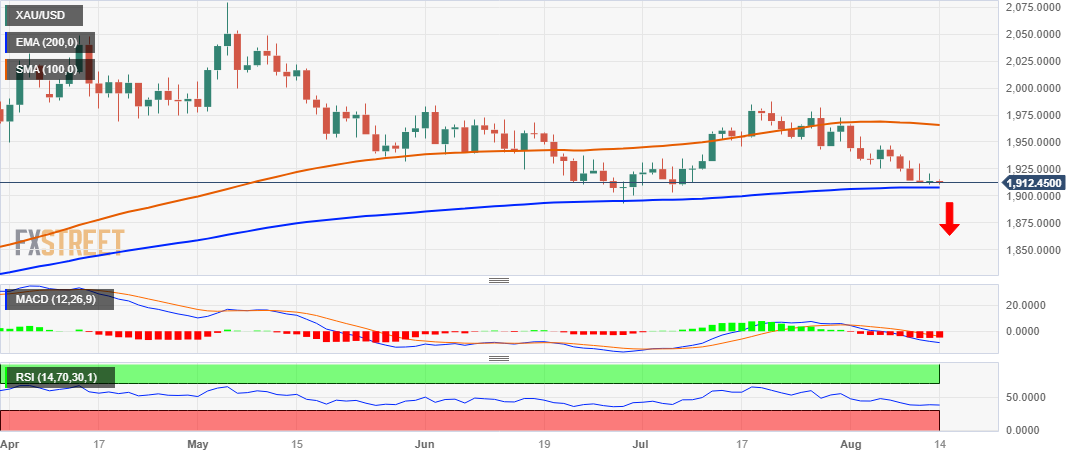
Gold price enters a bearish consolidation phase on the first day of a new week and seesaws between tepid gains/minor losses just above the $1,910 level, or the lowest since July 7 touched during the Asian session. The fundamental backdrop, meanwhile, seems tilted in favour of bearish traders and supports prospects for an extension of over a three-week-old descending trend.
A fresh wave of the global risk-aversion trade – as depicted by a sea of red across the Asian equity markets - is seen lending some support to the safe-haven Gold price. Against the backdrop of concerns about slowing economic growth in China, the worsening US-China relations and geopolitical tensions temper investors' appetite for riskier assets. It is worth recalling that US President Joe Biden last week signed an executive order that prohibits new US investment in China in sensitive technologies like computer chips and requires government notification in other tech sectors.
Meanwhile, China has condemned Taiwan Vice President William Lai's sensitive trip to the United States (US). Lai is officially making only transit stops on his way to and from Paraguay. China, however, sees it as a further sign of the US support for Taiwan and announces an anti-dumping tariff for polycarbonate imported from Taiwan effective from August 15. On the geopolitical front, the Russian warship fired warning shots at a cargo ship in the southwestern Black Sea on Sunday, which further weigh on investors' sentiment and benefit traditional safe-haven assets.
That said, the underlying bullish sentiment surrounding the US Dollar fails to assist the Gold price to register any meaningful recovery. In fact, the USD Index (DXY), which tracks the Greenback against a basket of currencies, climbs to a fresh six-week high and remains well supported by growing acceptance that the Federal Reserve (Fed) will keep interest rates higher for longer. The bets were lifted by the US Producer Price Index (PPI) released on Friday, which rose 0.8% on a yearly basis during the reported month, up sharply from a flat reading in June.
Against the backdrop of a moderate increase in consumer prices in July, the data suggested that the battle to bring inflation back to the Fed's 2% target is far from being won. The outlook keeps the door for one more 25 basis points (bps) Fed rate hike move by the end of this year wide open, which continues to push the US Treasury bond yields and act as a tailwind for the USD. This, in turn, is seen as another factor that contributes to capping the upside for the US Dollar-denominated Gold price and suggests that the path of least resistance is to the downside.
Technical Outlook
From a technical perspective, the XAU/USD, so far, has managed to defend and hold above the 200-day Exponential Moving Average (EMA). The said support is currently pegged around the $1,907 area, which should now act as a pivotal point. This is followed by the $1,900 round figure, which if broken decisively will be seen as a fresh trigger for bearish traders and pave the way for further losses. The Gold price might then accelerate the slide further below the June monthly swing low, around the $1,893-$1,892 region, towards testing the next relevant support near the $1,870 horizontal zone en route to the $1,858-$1,857 region.
On the flip side, the $1,925 area is likely to act as an immediate hurdle ahead of the $1,934-$1,935 region and the $1,942 supply zone. A sustained strength beyond the latter might trigger a short-covering rally towards the $1,954-$1,955 resistance en route to the $1,965 area. The latter coincides with the 100-day Simple Moving Average (SMA), which if cleared will negate the negative outlook and shift the near-term bias in favour of bullish traders.
Author

Haresh Menghani
FXStreet
Haresh Menghani is a detail-oriented professional with 10+ years of extensive experience in analysing the global financial markets.

















