Gold Price Forecast: XAU/USD awaits US PCE inflation data for a sustained move higher
- Gold price picks up bids once again above $3,000 but remains in a familiar range on Thursday.
- The US Dollar corrects from three-week highs on Trump’s tariff exemption and economic worries.
- Gold buyers keep their sights on record high amid bullish daily technical setup.

Gold price is finding fresh demand above $3,000 early Thursday, following a lacklustre performance on Wednesday. Gold buyers try their luck and aim for the record high of $3,058 once again as they near Friday’s US inflation test.
Gold price remains at the mercy of tariff developments
So far in Thursday’s trading, Gold price is capitalizing on a fresh US Dollar (USD) pullback from three-week highs against its major rivals on reduced haven demand. Markets breathed a sigh of relief after US President Donald Trump announced earlier in the Asian session a one-month tariff exemption for auto parts imports from his new 25% automotive tariffs.
Further, US economic slowdown concerns resurfaced as traders assess the impact on Trump’s tariffs, lifting the traditional store of value Gold at the expense of the US Dollar.
However, it remains to be seen if Gold price sustains the upswing, especially after Wednesday’s subdued price action. The US final Gross Domestic Product (GDP) revision for the fourth quarter and the weekly Jobless Claims data will likely play a second fiddle to developments surrounding US tariffs. Speeches from several Federal Reserve (Fed) policymakers will be closely eyed.
Gold price fluctuated in a narrow range on Wednesday, initially holding ground amid renewed tariff threats from US President Donald Trump. According to reports, Trump was set to impose three escalating levels of tariffs, with Canada likely to be on the lower end of the April 2 tariffs. Bloomberg News reported that the US President “plans to implement copper import tariffs within weeks.”
These reports initially weighed on the USD, allowing Gold price to build on Tuesday’s rebound but the tide turned in favor of the Greenback after Trump late on Wednesday re-announced plans for long-promised 25% tariffs on automotive imports, which are set to go into effect on April 2.
Fresh tariff threats spooked markets and revived the safety bids for the US Dollar. Meanwhile, hawkish commentary from Fed policymakers also underpinned the US Dollar recovery, wiping out the earlier gains in Gold price to settle almost unchanged on the day.
Amid increased upside risks to the inflation outlook, courtesy of Trump’s tariffs, St Louis Fed President Alberto Musalem said on Wednesday the Fed had no urgency to cut rates. Minneapolis Fed President Neel Kashkari said the Fed should stay put amid continued policy uncertainty, per Reuters.
Gold price technical analysis: Daily chart
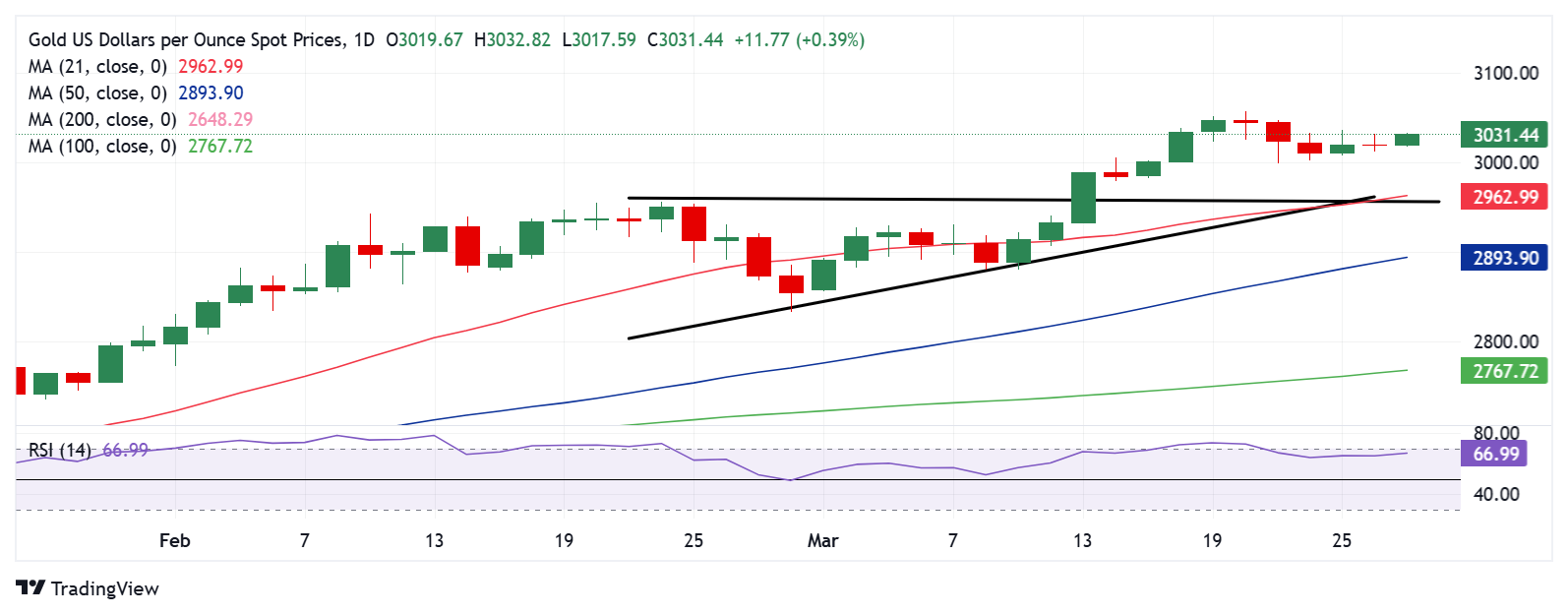
The technical setup on the daily chart favors buyers, with their sights set on the ascending triangle target, measured at $3,080.
The 14-day Relative Strength Index (RSI) is trending higher, currently at 67, backing the upside.
Gold price appears poised to retake the record high of $3,058 on its way to achieving the triangle target of $3,080.
Conversely, the $3,000 round level will emerge as a powerful support. The next downside cap is aligned at the previous week’s low of $2,982.
Further south, the 21-day Simple Moving Average (SMA) and the triangle support confluence at $2,963 will be a tough nut to crack for sellers.
(This story was corrected on March 27 at 5:57 to say that "The US Dollar corrects from three-week highs," not lows.)
Author

Dhwani Mehta
FXStreet
Residing in Mumbai (India), Dhwani is a Senior Analyst and Manager of the Asian session at FXStreet. She has over 10 years of experience in analyzing and covering the global financial markets, with specialization in Forex and commodities markets.