Gold Price Forecast: What’s next for XAU/USD after correction from record highs
- Gold struggles to resume its record rally early Thursday, following Wednesday’s sharp pullback.
- US Dollar enters upside consolidation phase as Fed rate cut wagers wobble, eyes turn to US data, Fedspeak.
- Will Gold buyers defy the overbought RSI conditions on the daily chart?

Gold is struggling to reverse the previous day’s correction from record highs of $3,791 in Thursday’s Asian trades, eagerly awaiting the mid-tier US data and more speeches from Federal Reserve (Fed) officials for a fresh trading impulse.
Gold looks to mid-tier US data and Fedspeak
Despite a pause in Gold’s retracement, buyers remain unnerved as markets pare back odds of two interest rate cuts by the Fed this year.
A slew of cautious remarks from Fed policymakers have prompted markets to reprice their expectations, with only 43 basis points (bps) of easing priced in the remaining two policy meetings this year.
This shift in sentiment toward the Fed’s easing outlook helped the US Dollar (USD) rebound firmly to fresh nine-day highs against its major currency rivals.
However, the downside in Gold seems cushioned by the ongoing geopolitical tensions surrounding Russia, Ukraine and the West.
The Kremlin on Wednesday hit back at US President Donald Trump’s rhetoric on the Russia-Ukraine war, where he blamed Moscow for not ending the conflict.
Meanwhile, speaking at the UN's General Assembly (UNGA) in New York on Wednesday, Ukraine's President Volodymyr Zelensky warned that Russian President Vladimir Putin "will keep driving the war forward wider and deeper" if he is not stopped,
The Ukrainian leader also warned that Europe cannot afford to lose Moldova - which lies between Ukraine and the European Union (EU)-member Romania - to Russian influence.
Last week, Estonia and Poland requested a consultation with other NATO members after Russia violated its airspace in separate incidents. Romania, another Nato member, also said Russian drones breached its airspace.
Looking ahead, Gold traders will seek fresh policy cues from the upcoming mid-tier US Durable Goods, Jobless Claims and Existing Home Sales data ahead of Friday’s US core Personal Consumption Expenditures (PCE) Price Index, the Fed’s preferred inflation gauge.
Meanwhile, a bunch of Fed policymakers are scheduled to speak in the North American (NA) session, with the FXStreet Fed Sentiment Index showing an increase in the hawkish tone, trading near 105.50 as of writing, up from around 102 levels seen a day ago.
Gold price technical analysis: Daily chart
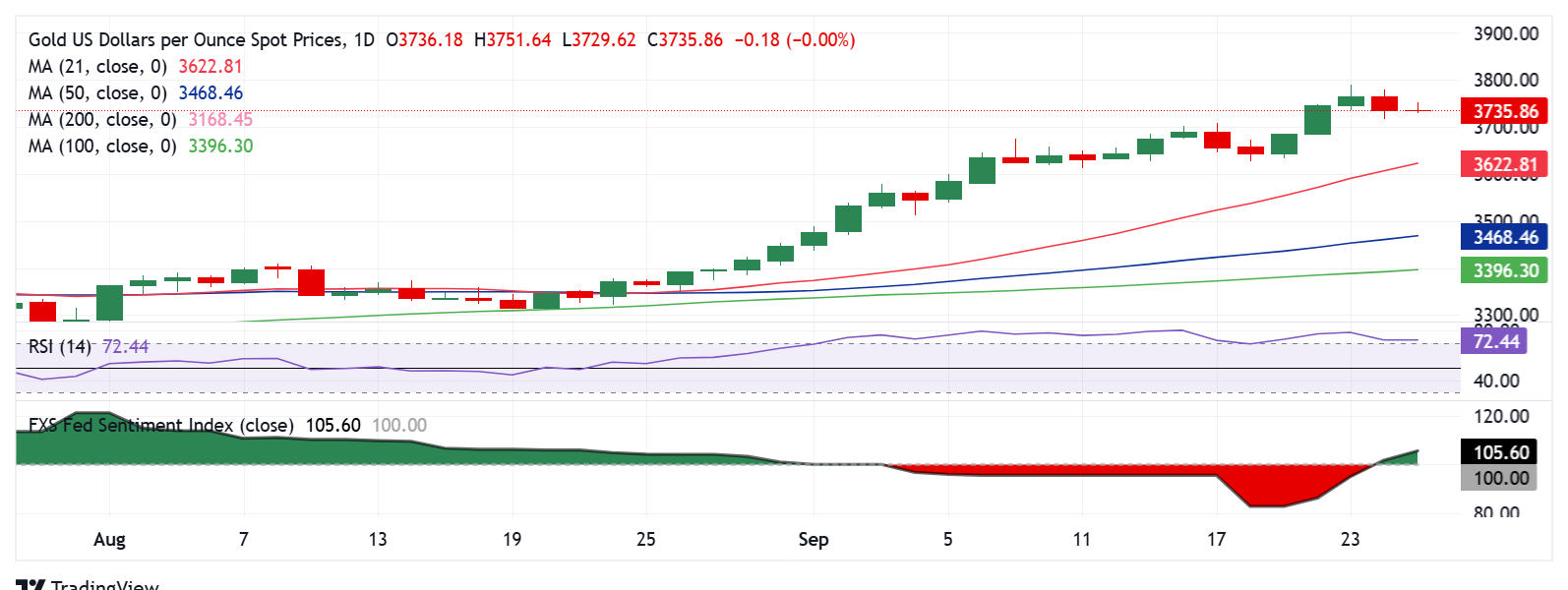
Technically, nothing seems to have changed for Gold in the near-term as the daily chart continues to portray overbought conditions, warranting caution for buyers.
The 14-day Relative Strength Index (RSI) is currently edging lower to near 72.50.
If the pullback regains momentum, the initial support is seen at the $3,700 threshold, below which Monday’s low of $3,684 will offer some comfort.
Further down, the $3,650 psychological barrier could come to the rescue of buyers.
On the other hand, buyers need acceptance above the $3,750 psychological level to revive the record rally.
The next topside hurdle is located at the lifetime high of $3,791, followed by the $3,800 barrier.
A sustained and decisive break above the latter could fuel a fresh advance toward the $3,850 psychological level.
Gold FAQs
Gold has played a key role in human’s history as it has been widely used as a store of value and medium of exchange. Currently, apart from its shine and usage for jewelry, the precious metal is widely seen as a safe-haven asset, meaning that it is considered a good investment during turbulent times. Gold is also widely seen as a hedge against inflation and against depreciating currencies as it doesn’t rely on any specific issuer or government.
Central banks are the biggest Gold holders. In their aim to support their currencies in turbulent times, central banks tend to diversify their reserves and buy Gold to improve the perceived strength of the economy and the currency. High Gold reserves can be a source of trust for a country’s solvency. Central banks added 1,136 tonnes of Gold worth around $70 billion to their reserves in 2022, according to data from the World Gold Council. This is the highest yearly purchase since records began. Central banks from emerging economies such as China, India and Turkey are quickly increasing their Gold reserves.
Gold has an inverse correlation with the US Dollar and US Treasuries, which are both major reserve and safe-haven assets. When the Dollar depreciates, Gold tends to rise, enabling investors and central banks to diversify their assets in turbulent times. Gold is also inversely correlated with risk assets. A rally in the stock market tends to weaken Gold price, while sell-offs in riskier markets tend to favor the precious metal.
The price can move due to a wide range of factors. Geopolitical instability or fears of a deep recession can quickly make Gold price escalate due to its safe-haven status. As a yield-less asset, Gold tends to rise with lower interest rates, while higher cost of money usually weighs down on the yellow metal. Still, most moves depend on how the US Dollar (USD) behaves as the asset is priced in dollars (XAU/USD). A strong Dollar tends to keep the price of Gold controlled, whereas a weaker Dollar is likely to push Gold prices up.
Author

Dhwani Mehta
FXStreet
Residing in Mumbai (India), Dhwani is a Senior Analyst and Manager of the Asian session at FXStreet. She has over 10 years of experience in analyzing and covering the global financial markets, with specialization in Forex and commodities markets.