Gold Price Forecast: Loses steam amid a better market mood

XAUUSD Current price: $1,851.45
- Stocks are firmly up after US President Biden said he would consider cutting tariffs on China.
- Inflation and growth-related concerns remain intact in the background.
- XAUUSD has room to extend its slide once below $1,849.20, an immediate support level.
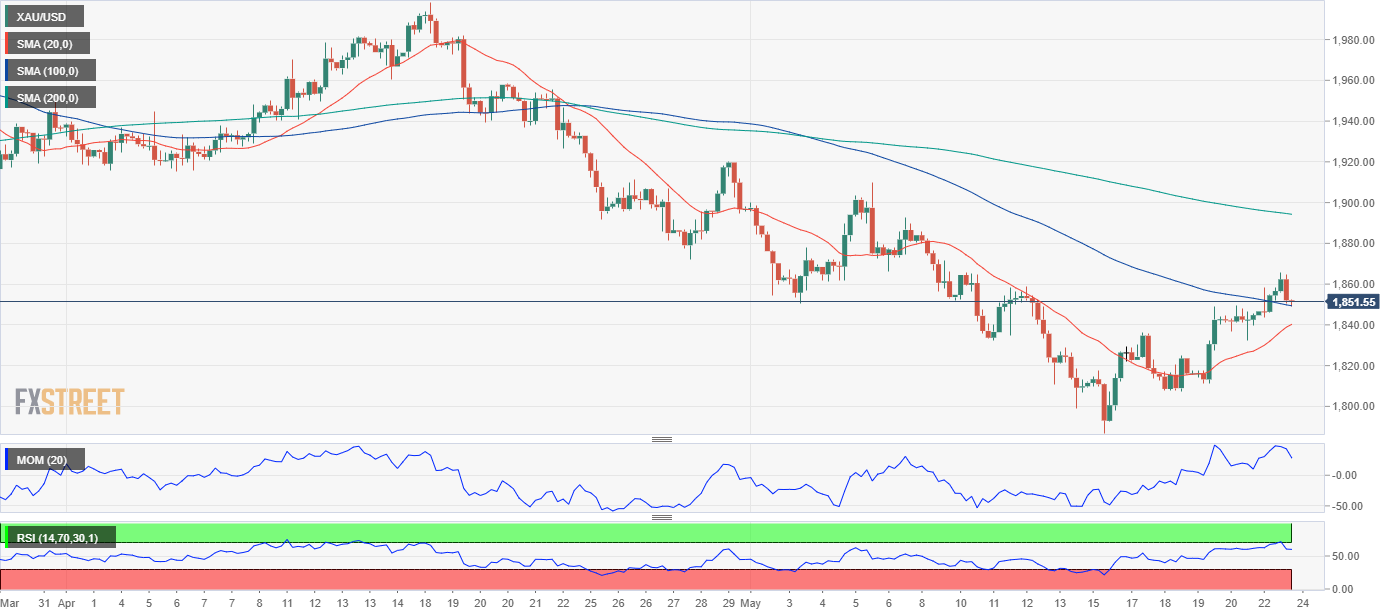
Spot gold peaked at $1,865.38 a troy ounce on Monday, but the rally lost steam after Wall Street’s open, now trading at around $1,851. The positive tone of equities undermines demand for the safe-haven metal, while the greenback remains out of investors’ radar.
The better market mood is the result of comments from US President Joe Biden, who said to be weighing cutting tariffs on Chinese goods. Under Donald Trump’s administration, tariffs were imposed on several goods, which were estimated to represent nearly $80 billion in tax increases. Biden also called on OPEC to raise oil production in the hopes it would help to cool down inflationary pressures.
Meanwhile, lingering concerns about inflation and growth remain the same. European Central Bank President Christine Lagarde came out with some hawkish comments in her appearance at the Davos World Economic Forum, as she hinted at a rate hike as soon as July and rates reaching neutral before year-end.
Gold Price short-term technical outlook
XAUUSD daily chart shows that the latest advance could have been just corrective. Technical indicators recovered from near oversold readings to turn flat within negative levels, indicating decreasing buying interest. Also, the 20 SMA maintains its bearish slope above the current level, providing dynamic resistance.
The near-term picture reflects the dwindling buying interest. In the 4-hour chart, the pair is battling with a bearish 100 SMA after extending gains above it earlier in the day. The 20 SMA heads firmly higher below the current level while technical indicators are retreating sharply from overbought levels. Another leg lower could be expected on a break below $1,849.20, the immediate support level.
Support levels: 1,849.20 1,836.00 1,825.50
Resistance levels: 1,865.38 1,879.65 1,887.90
Premium
You have reached your limit of 3 free articles for this month.
Start your subscription and get access to all our original articles.
Author

Valeria Bednarik
FXStreet
Valeria Bednarik was born and lives in Buenos Aires, Argentina. Her passion for math and numbers pushed her into studying economics in her younger years.