Gold Price Forecast: Hawkish Fed prospects drag XAU/USD further below $4,300
- Gold declines further to near $4,287 as US bond yields hit record highs.
- The Fed is anticipated to hike interest rates in the policy meeting this month.
- Investors await key US ADP Employment Change data for August.

Gold extends its decline on Wednesday, facing enormous pressure due to surging United States (US) Treasury Yields and rising oil prices.
US 10-year bond yields hit fresh almost three-year high
In Asian trade on Wednesday, 10-year US Treasury Yields hit a record high at 4.81%, the highest level seen since November 2023.
Higher yields on interest-bearing assets result in diminishing the appeal of non-yielding assets, such as Gold.
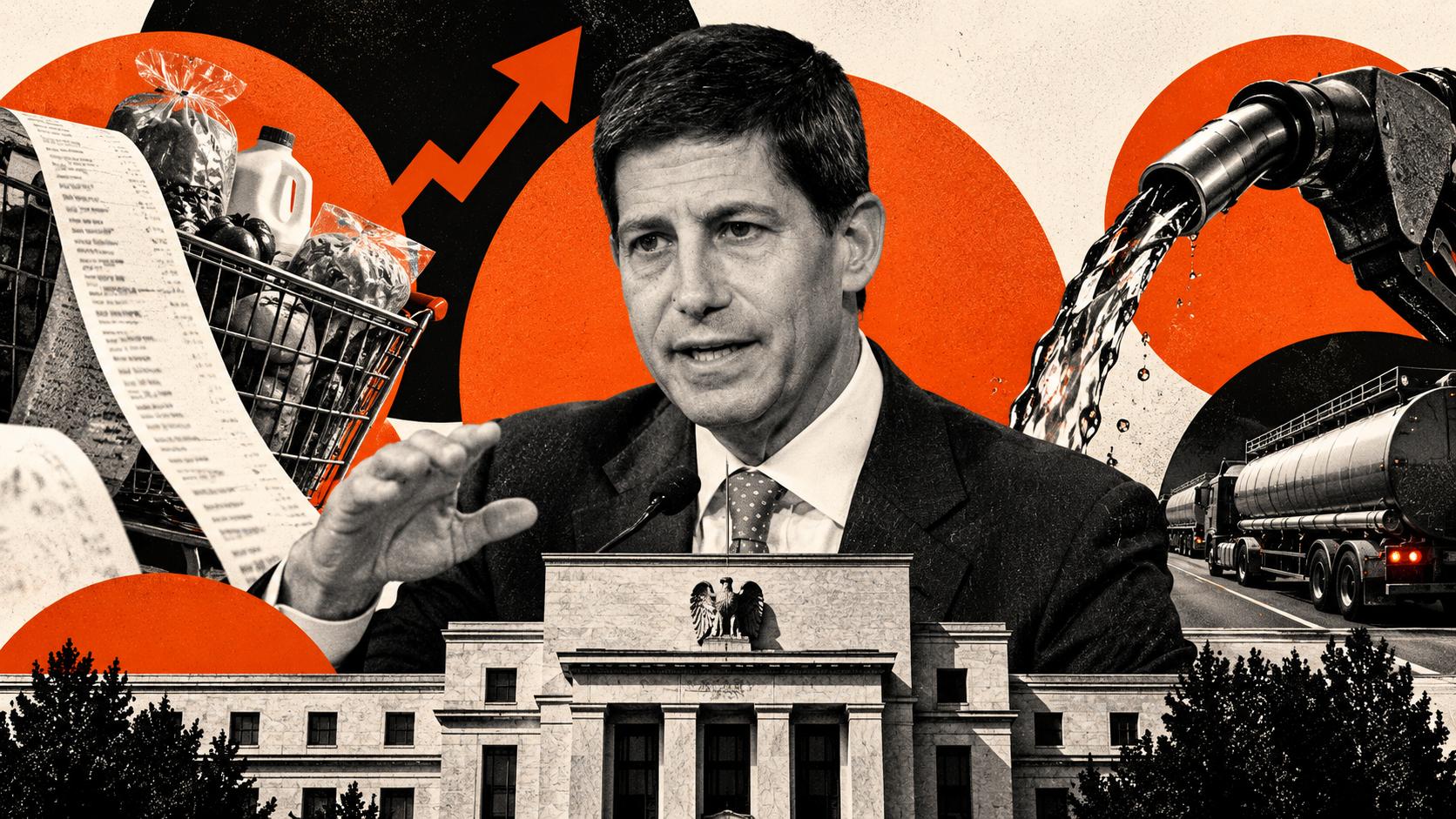
Strategists at BNY see “fiscal concerns and doubts about the Federal Reserve’s (Fed) credibility” as the key culprits behind the latest move in long-dated US yields. They also highlighted that Fed Chairman Kevin Warsh’s hawkish speech at the Jackson Hole Symposium led “overnight and swaps rates through the 2y yield all pricing in some tightening to come.”
Although Fed Chair Warsh stopped short of explicit forward guidance in his Jackson Hole address, he “stepped as close to the line as possible in advocating a hike,” with the market now “pricing an almost two-thirds probability for one at the FOMC’s September 16 meeting,” BNY said in a note.
According to the CME FedWatch tool, there is a 67% chance that the Fed will hike interest rates in the policy meeting this month.
Oil price reaches $90 mark on renewed Middle East risks
The WTI Oil price has extended its advance on Wednesday, posting a fresh five-week high at $90.78. Oil prices continue to rise as fears of prolonged energy supply disruption have returned due to renewed military aggression between the US and Iran.
On Tuesday, US President Donald Trump said in a post on Truth Social that Washington is striking Iranian targets near the Strait of Hormuz in retaliation for Iran’s "failed attempt" to add sea mines in the Strait, which currently “has no mines.” Trump added that the US base at Jordan successfully knocked down all eight missiles launched by Tehran.
Higher oil prices continue to boost global inflation expectations, a scenario that prompts fears of interest rate hikes by central banks. This bodes poorly for non-yielding assets, such as Gold.
US data awaited
In Wednesday’s session, investors will keep an eye on the US ADP Employment Change data for August, which will be published at 12:15 GMT. The US private sector is expected to have created 48K fresh jobs, slightly lower than 44K in July.
The US private employment data is expected to have a significant impact on Fed’s interest rate expectations.
Gold Price Technical Analysis: Daily Chart
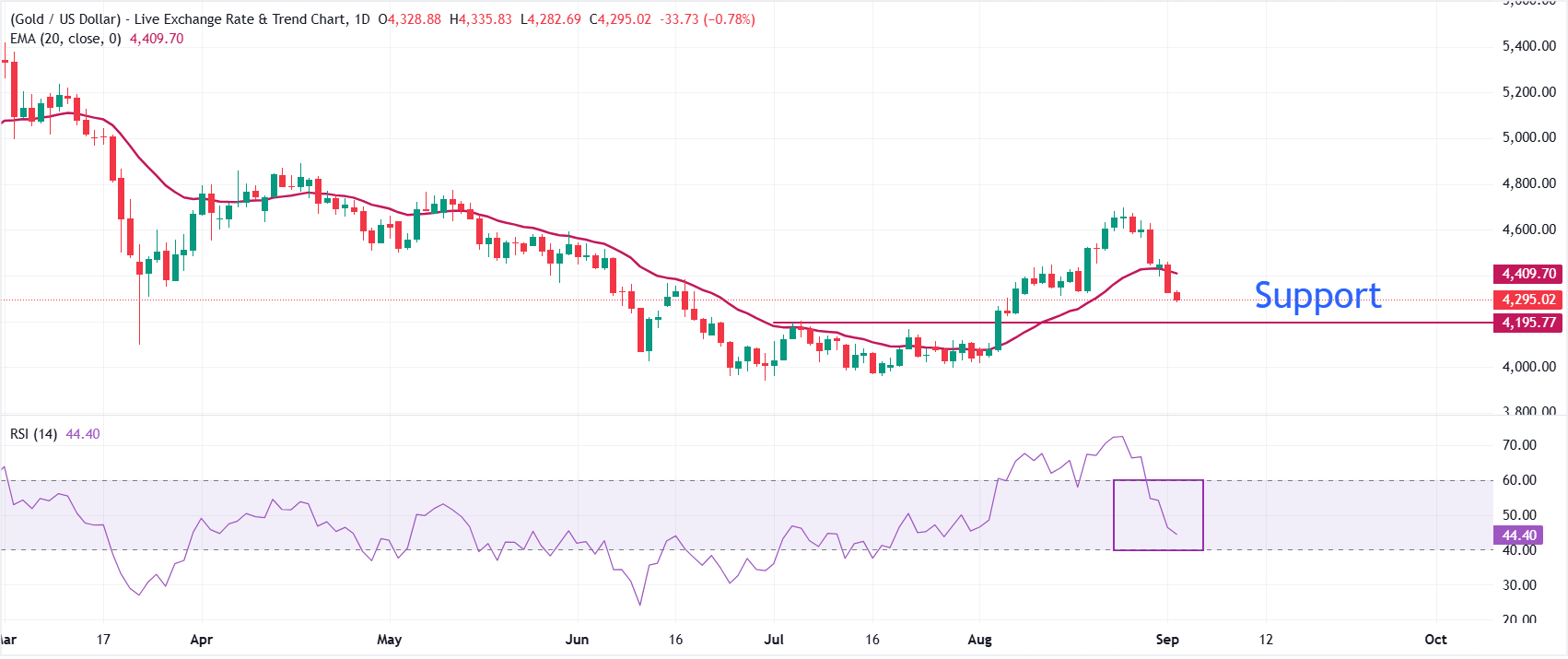
In the daily chart, XAU/USD trades at $4,295.45, maintaining a bearish near-term tone as it holds below the 20-day Exponential Moving Average (EMA) at around $4,409.75. The failure to reclaim this dynamic cap reinforces a downside bias, while the Relative Strength Index (14) near 44 suggests soft, but not extreme, negative momentum consistent with a corrective phase rather than a full oversold washout.
On the topside, immediate resistance is defined by the 20-day EMA at $4,409.75, and bulls would need a clear close above this barrier to ease the current downside pressure. With no clear structural supports provided in the dataset, traders may look to recent lows and intraday price action for interim demand zones, while the subdued RSI reading hints that further weakness cannot be ruled out as long as price remains capped beneath the 20-day EMA.
(The technical analysis of this story was written with the help of an AI tool. Know more.)
Gold FAQs
Gold has played a key role in human’s history as it has been widely used as a store of value and medium of exchange. Currently, apart from its shine and usage for jewelry, the precious metal is widely seen as a safe-haven asset, meaning that it is considered a good investment during turbulent times. Gold is also widely seen as a hedge against inflation and against depreciating currencies as it doesn’t rely on any specific issuer or government.
Central banks are the biggest Gold holders. In their aim to support their currencies in turbulent times, central banks tend to diversify their reserves and buy Gold to improve the perceived strength of the economy and the currency. High Gold reserves can be a source of trust for a country’s solvency. Central banks added 1,136 tonnes of Gold worth around $70 billion to their reserves in 2022, according to data from the World Gold Council. This is the highest yearly purchase since records began. Central banks from emerging economies such as China, India and Turkey are quickly increasing their Gold reserves.
Gold has an inverse correlation with the US Dollar and US Treasuries, which are both major reserve and safe-haven assets. When the Dollar depreciates, Gold tends to rise, enabling investors and central banks to diversify their assets in turbulent times. Gold is also inversely correlated with risk assets. A rally in the stock market tends to weaken Gold price, while sell-offs in riskier markets tend to favor the precious metal.
The price can move due to a wide range of factors. Geopolitical instability or fears of a deep recession can quickly make Gold price escalate due to its safe-haven status. As a yield-less asset, Gold tends to rise with lower interest rates, while higher cost of money usually weighs down on the yellow metal. Still, most moves depend on how the US Dollar (USD) behaves as the asset is priced in dollars (XAU/USD). A strong Dollar tends to keep the price of Gold controlled, whereas a weaker Dollar is likely to push Gold prices up.
Author

Sagar Dua
FXStreet
Sagar Dua is associated with the financial markets from his college days. Along with pursuing post-graduation in Commerce in 2014, he started his markets training with chart analysis.