Gold Price Forecast: Fed’s rate decision to drive XAU/USD’s next move
- Gold price trades marginally lower at around $4,330 at the start of the Fed’s monetary policy week.
- The Fed is highly anticipated to raise interest rates on Wednesday.
- US President Trump seems coming to terms with higher interest rates.

Gold reflects a subdued performance at the start of the Federal Reserve’s (Fed) monetary policy week at around $4,330. Fed’s interest rate expectations heavily influenced last week after the release of the hot United States (US) Producer Price Index (PPI) and Consumer Price Index (CPI) reports for August.
Hot inflation readings strengthen hawkish Fed expectations
Last week, Fed’s interest rate hike expectations boosted after the release of the hotter-than-expected Producer Price Index (PPI) and Consumer Price Index (CPI) reports for August. The PPI report showed that headline producer inflation accelerated to 5.4% Year-on-Year (YoY) from 4.8% in July.
On the consumer inflation front, YoY readings for both headline and the core inflation remain in line with estimates, but Month-on-Month (MoM) core inflation grew by 0.3% faster than expectations and the prior release of 0.2%.
According to the CME FedWatch tool, the odds of the Fed raising interest rates at the policy meeting on Wednesday have increased to 86.5% from 59.5% seen before the release of the US CPI and PPI data.
Such a scenario boosts yields on interest-bearing assets. At press time, 10-year US Treasury Yields trade close to its fresh highs of 4.99%, a level seen never since November 2023. Higher yields on US bonds diminish the appeal of non-yielding assets, like Gold.
Has Trump developed an appetite for higher interest rates
While speaking to reporters at the Irish Open golf tournament over the weekend, US President Donald Trump said, Trump said he did not know whether Fed policymakers will raise interest rates at their meeting this week. But he said the US "should be paying the lowest interest rate in the world" no matter what the Federal Reserve's data indicates about inflation and the economy, Business Standard reported.
This appears to be a dramatic shift in US President Trump’s take on higher interest rates who criticized former Fed Chair Jerome Powell several times for not reducing policy rates in his term and now suddenly seems coming to terms with higher interest rates.
Meanwhile, National Economic Council Director Kevin Hassett told Fox News Sunday that US President Trump "will defend the independence of Kevin Warsh above all" no matter what the Fed does with interest rates.
Gold Technical Analysis
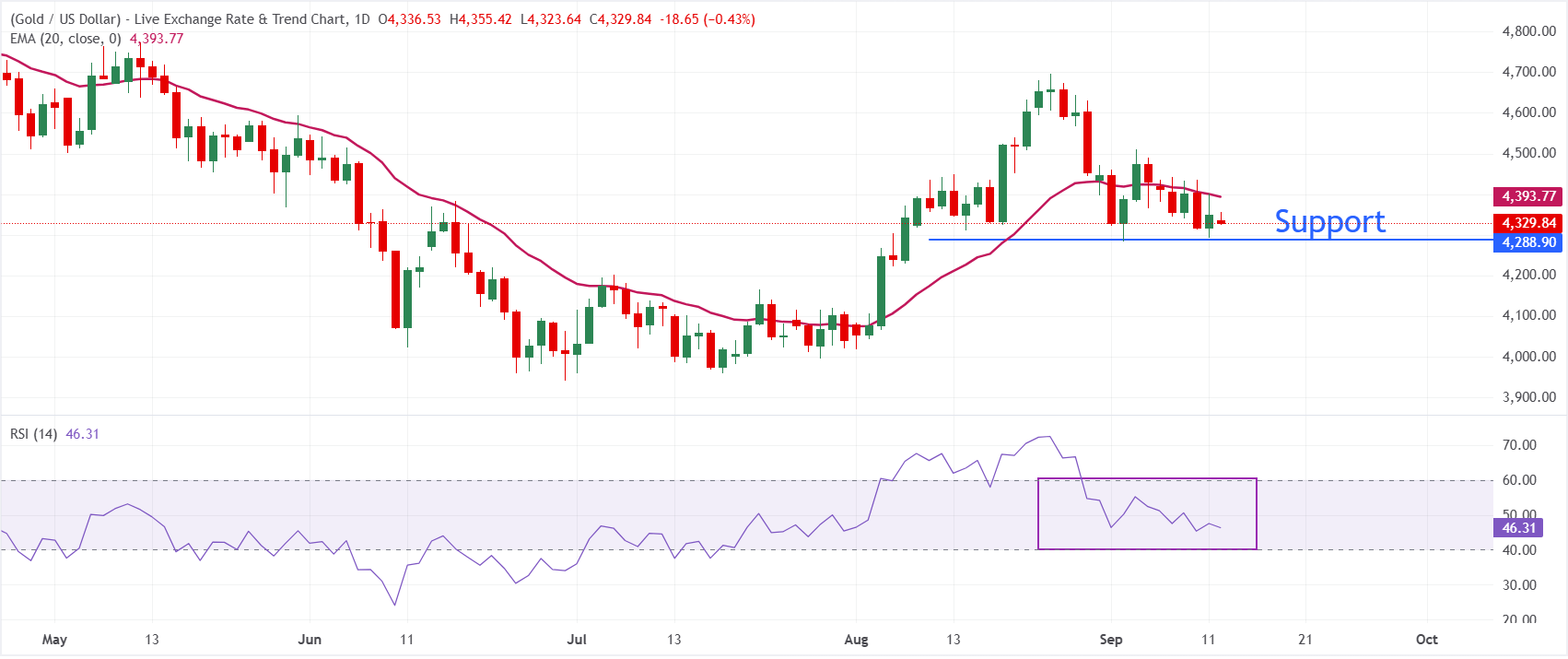
In the daily chart, XAU/USD trades at $4,330.30, holding below the 20-period exponential moving average (EMA) at $4,393.82, which keeps the near-term bias tilted to the bearish side. The metal has retreated from recent highs and remains capped by this short-term EMA, while the Relative Strength Index (RSI) at 46 leans slightly bearish but not oversold, suggesting sellers retain control without yet reaching exhaustion.
On the topside, immediate resistance is located at the 20-period EMA at $4,393.82, and a sustained break above this barrier would be needed to ease downside pressure and reopen the path toward recent record highs. Looking down, the Gold price could extends the decline towards the July 22 high around $4,166 if it fails to hold the September 2 low at $4,397.86.
(The technical analysis of this story was written with the help of an AI tool. Know more.)
Gold FAQs
Gold has played a key role in human’s history as it has been widely used as a store of value and medium of exchange. Currently, apart from its shine and usage for jewelry, the precious metal is widely seen as a safe-haven asset, meaning that it is considered a good investment during turbulent times. Gold is also widely seen as a hedge against inflation and against depreciating currencies as it doesn’t rely on any specific issuer or government.
Central banks are the biggest Gold holders. In their aim to support their currencies in turbulent times, central banks tend to diversify their reserves and buy Gold to improve the perceived strength of the economy and the currency. High Gold reserves can be a source of trust for a country’s solvency. Central banks added 1,136 tonnes of Gold worth around $70 billion to their reserves in 2022, according to data from the World Gold Council. This is the highest yearly purchase since records began. Central banks from emerging economies such as China, India and Turkey are quickly increasing their Gold reserves.
Gold has an inverse correlation with the US Dollar and US Treasuries, which are both major reserve and safe-haven assets. When the Dollar depreciates, Gold tends to rise, enabling investors and central banks to diversify their assets in turbulent times. Gold is also inversely correlated with risk assets. A rally in the stock market tends to weaken Gold price, while sell-offs in riskier markets tend to favor the precious metal.
The price can move due to a wide range of factors. Geopolitical instability or fears of a deep recession can quickly make Gold price escalate due to its safe-haven status. As a yield-less asset, Gold tends to rise with lower interest rates, while higher cost of money usually weighs down on the yellow metal. Still, most moves depend on how the US Dollar (USD) behaves as the asset is priced in dollars (XAU/USD). A strong Dollar tends to keep the price of Gold controlled, whereas a weaker Dollar is likely to push Gold prices up.
Author

Sagar Dua
FXStreet
Sagar Dua is associated with the financial markets from his college days. Along with pursuing post-graduation in Commerce in 2014, he started his markets training with chart analysis.
















