Anthropic pledged $270 billion to Amazon, Google, and Microsoft. Here's who actually gets paid

Anthropic owes Amazon, Google, and Microsoft at least $269.4 billion for computing power, even if it uses less. All three sell its models and handle its billing, and Amazon and Google own stakes and lend it money, so they get paid regardless of how the IPO goes.
The Dario Amodei-led Anthropic filed its initial public offering (IPO) on Monday, seeking a listing on the Nasdaq under the ticker ANT. The filing describes Amazon (AMZN), Alphabet (GOOG, GOOGL) and Microsoft (MSFT) as its investors, customers, distribution partners and competitors at the same time. The largest set of numbers in the document is what Anthropic owes them, and it's only one of the ways they get paid.
All three are among the NASDAQ-100's largest members, so a fund tracking the index already owns the companies that will receive Anthropic's payments. Under Nasdaq's rule for large new listings, the Elon Musk-founded SpaceX (SPCX) joined the index less than a month after it started trading, so the same fund could soon hold both sides of every contract in the filing.
$269.4 billion is the part of the bill with three names on it
Anthropic has committed to spend at least $114.5 billion with Google, Alphabet's cloud business, between April 2026 and July 2033. It owes at least $110 billion to Amazon between May 2026 and April 2036, and at least $44.9 billion to Microsoft between November 2026 and May 2033. None of the three can be cancelled unless the provider breaks the contract, and under the Google and Amazon deals, Anthropic pays the difference if it uses less than it promised. The Amazon contract runs for ten years, and Anthropic is five years old.
The rest of the bill is bigger. Anthropic rents chips from Broadcom (AVGO) under five-year leases worth about $161.2 billion, and can spend up to $120.5 billion on capacity running on Nvidia (NVDA) chips from SpaceXAI, a SpaceX unit, though either side can cancel on 90 days' notice from early 2027. Deals with Nscale, Lambda, and Advanced Micro Devices (AMD) add roughly $106 billion, much of it upper limits or estimates.
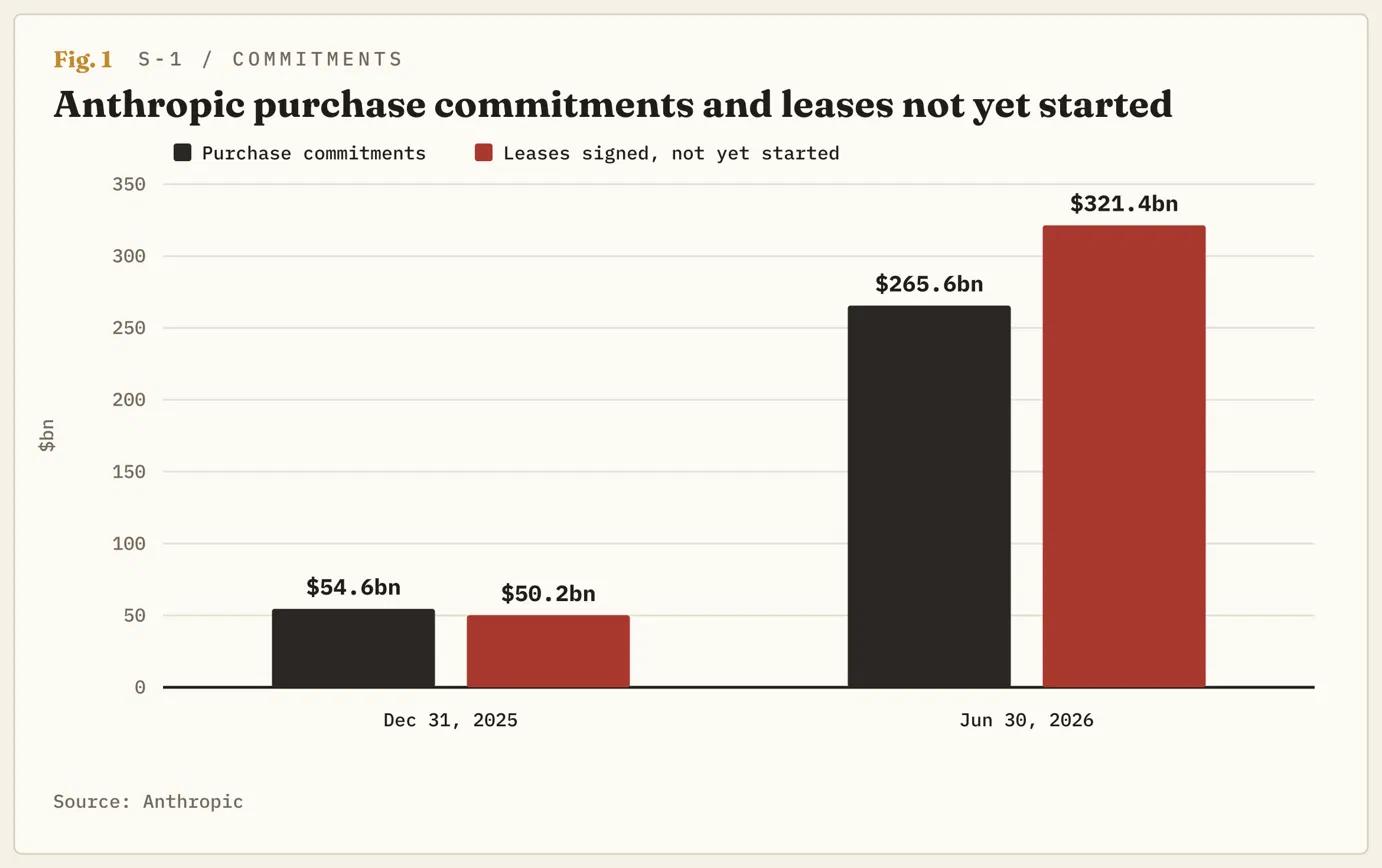
The pile grew fast. By the end of 2025, Anthropic's long-term purchase commitments, mostly cloud hosting, totaled $54.6 billion, and it had signed $50.2 billion in leases that hadn't started. By June 30, those figures were about $265.6 billion and $321.4 billion, and after June 30 it signed or amended deals with about $245 billion more in minimum payments. Revenue for the first six months of 2026 was $16.3 billion.
Anthropic orders computing capacity 12-18 months before it arrives, so the cost is fixed once the contract is signed and rises as machines are delivered, not as customers sign up. For Amazon, Google, and Microsoft, that's revenue that doesn't depend on how well Claude sells, and for Anthropic it's a cost that doesn't either.
The store takes its fee before Anthropic sees the money
In the first half of 2026, 48% of Anthropic's revenue came from customers who bought Claude through the Amazon, Google and Microsoft cloud stores, up from 11% in 2023. Those stores bill the customer, collect the payment and pass on what's left after their fee, and at June 30, they were holding 58% of what customers owed Anthropic.
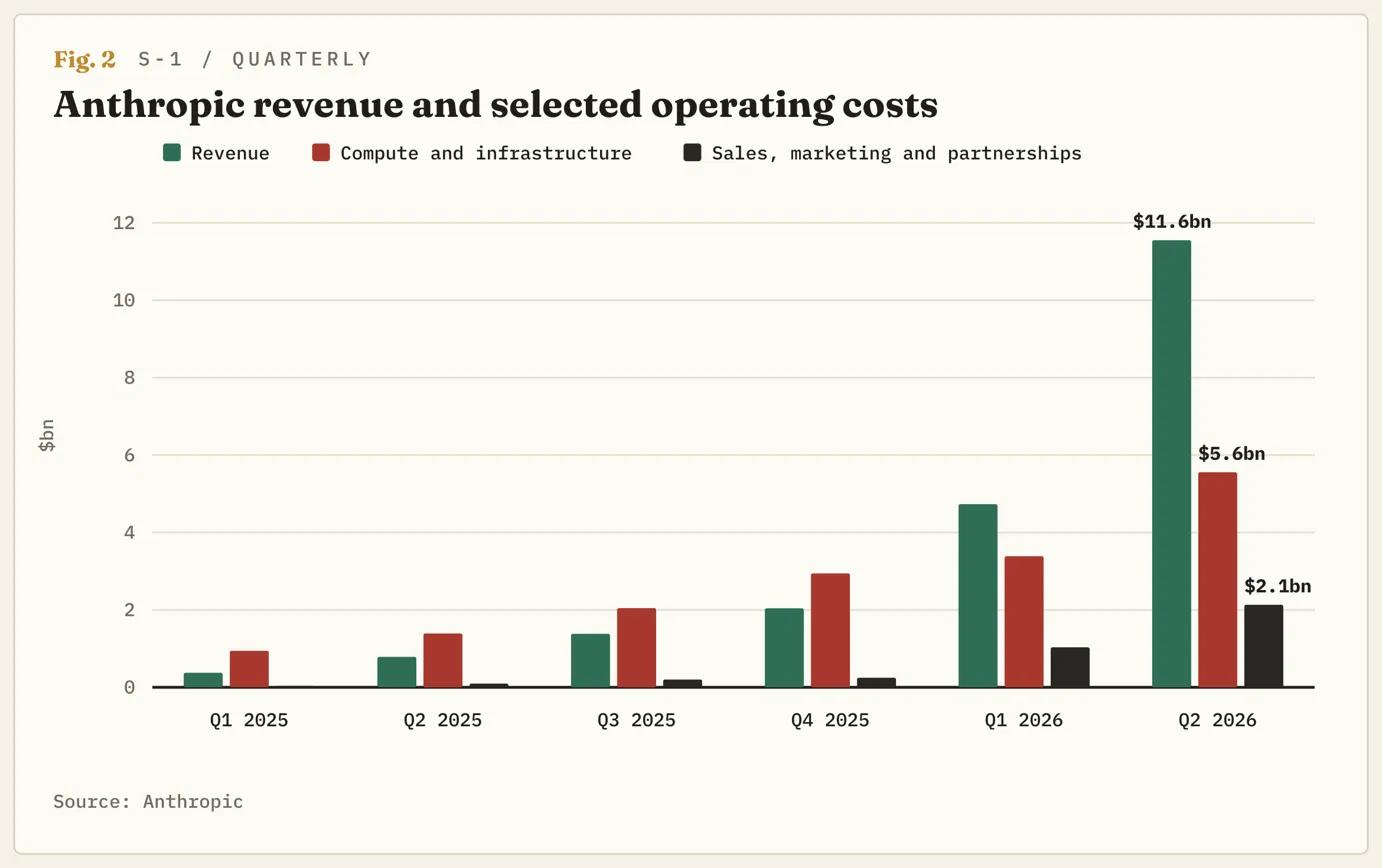
The fees land in a line Anthropic calls sales, marketing and partnerships, which rose from $120 million in the first half of 2025 to $3.2 billion, or 19% of revenue. The filing puts $2.7 billion of that increase down to fees paid to channel partners, the cloud stores among them. The three are paid twice on much of the same sale, once as the store and once for the computers it runs on, and the suppliers Anthropic owes the most see their revenue before Anthropic does.
The case for Anthropic is in the same table. Computing costs fell from 251% of revenue in the first quarter of 2025 to 48% in the second quarter of 2026; quarterly revenue reached $11.6 billion, and the company posted $974 million in operating income in the second quarter. It held $131.7 billion of cash and short-term investments as of June 30.
Most of the committed capacity hasn't arrived yet. The Microsoft contract starts in November, SpaceXAI capacity costs about $3.1 billion a month once it's fully delivered in December, and Broadcom's rent starts as each equipment batch is ready. The IPO will be priced using the ratio from the quarter before the biggest invoices start.
The lenders' money arrives when the revenue does
Amazon and Google also finance Anthropic. Google put $20 billion in during 2026, half at the Series G price and half in the Series H round, and can provide $20 billion more through 2030 against revenue targets, with the right to defer those draws. Amazon put in $10 billion and has $15 billion more, released in $5 billion steps as Anthropic hits compute milestones under its Amazon contracts. Both can be drawn as Anthropic shares at the average price of the previous 30 days.
Broadcom has $42 billion in convertible notes (loans that can be turned into shares), and the filing says the money can only be used strictly to pay rent on Broadcom's own equipment. The notes pay 9% a year in more notes, rising to 13% with a deeper conversion discount if Anthropic misses revenue conditions, and Broadcom can take 150% of what's owed in cash if Anthropic is sold. AMD will buy up to $5 billion of Anthropic stock as its own chips are delivered, starting in 2027.
The filing says its cloud and chip partners have funded or backed part of the build-out, and that relying less on them depends on borrowing against its own credit. Partner money is easier to access when revenue is growing, and costs more or arrives later when it isn't.
Anthropic's paper loss is Amazon's paper profit
Anthropic reported an $80.7 billion net loss for the first half of 2026 against an operating loss of $693 million, and almost all the difference came from two accounting lines tied to Amazon and Google. The first, $72.4 billion, is the rising value of convertible notes, which count as a bigger liability for Anthropic as its valuation climbs. The second, about $8.7 billion, comes mainly from the 2026 share deals, under which Google and Amazon bought at the Series G price while Anthropic sold its next shares at more than twice that.
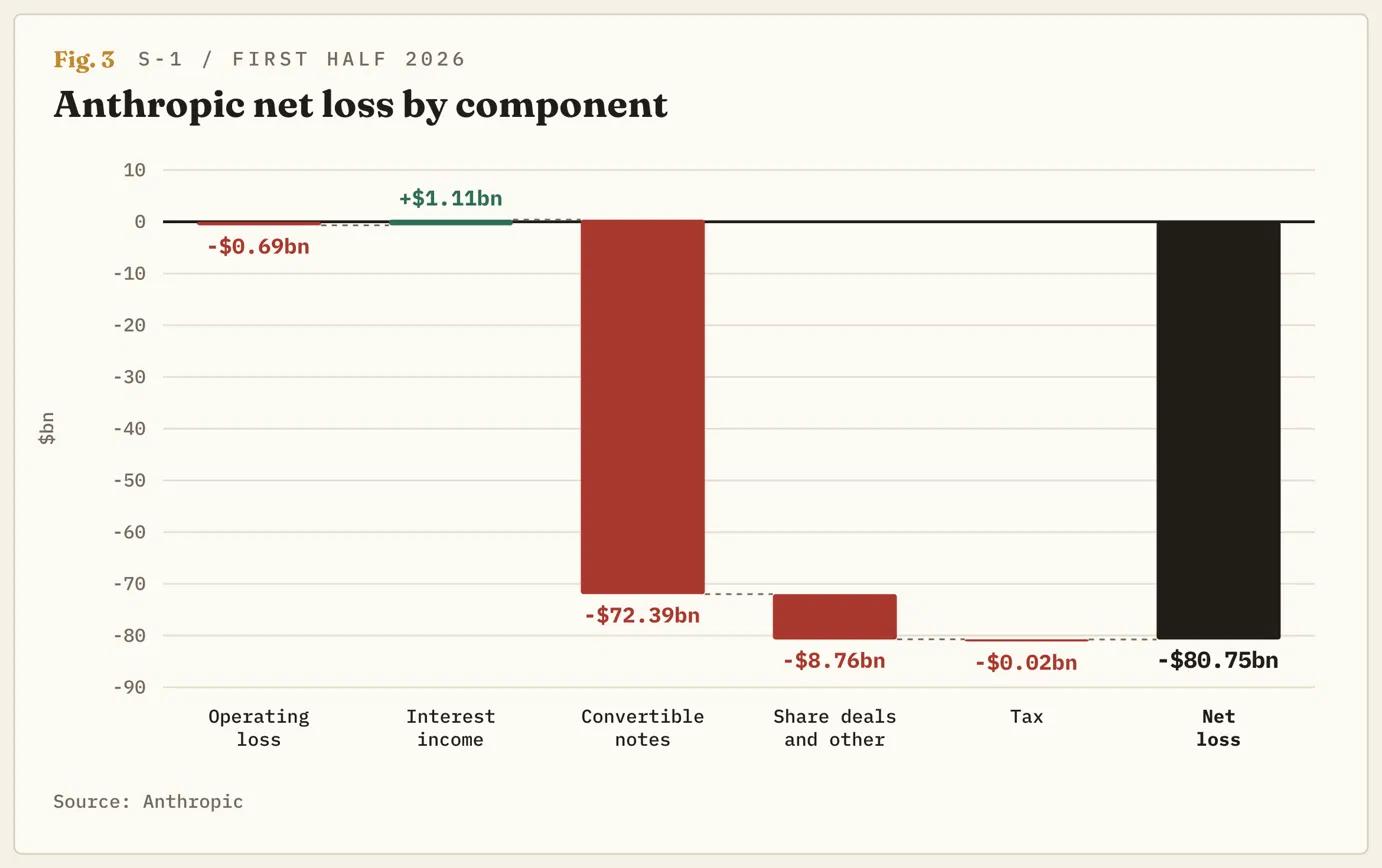
The notes still outstanding at June 30 were all Amazon's: $6.2 billion of principal that converts at about $2 and $5 a share, or the IPO price if that's lower, into about 1.84 billion shares. Series H investors paid about $59 a share, adjusted for the September split. That $6.2 billion was Anthropic's entire debt as the filing counts it, and Anthropic carried it at $108.6 billion.
Amazon reported $53.4 billion of non-operating gains in the second quarter, mainly from its Anthropic investments, and Alphabet reported about $28.7 billion in the first quarter from revaluing private stakes, mainly Anthropic. Any notes held back by Amazon's 12% ownership cap convert each quarter after the listing at the lowest of the original price, the IPO price, or the recent market price. At maturity, Amazon can collect what's left by cancelling money it owes Anthropic.
The IPO buyer gets the risk without the vote
Public shareholders' combined vote is capped at 49.9%. A single share held by the seven co-founders' company carries 50.1%, and the Long-Term Benefit Trust, five trustees with no financial stake, elects a majority of the board. Amazon's and Google's shares don't vote either, so the companies Anthropic pays the most have no say in how it spends.
Dilution keeps coming after the listing. Beyond Amazon's 1.84 billion shares, a public benefit fund Anthropic controls already holds 5% of the fully diluted shares, and can get up to 2% more each time the stock rises 50% from its last milestone. Another $26.6 billion of employee stock pay starts being expensed once the shares trade publicly.
The revenue line comes with caveats. Anthropic estimates that 5%-7% of nine-month revenue came from customers breaking its usage rules or commercial terms, and it stepped up enforcement in August and September. A federal appeals court upheld the Pentagon's supply-chain-risk label on September 25, and the filing warns of possible material revenue losses from it.
Index funds get paid either way
For anyone holding the NASDAQ-100, the answer to who gets paid is already clear. Amazon, Alphabet, Microsoft, and Broadcom collect their minimums whether Claude sales keep growing or stall, and the shortfall clauses mean a slowdown changes how much capacity Anthropic uses, not how much it pays for. IPO buyers take the other side without a vote, and they're paid only if revenue keeps outgrowing a cost base fixed into the 2030s.
The fork is one ratio. Computing and partner costs were about two-thirds of revenue in the second quarter. If that share holds once the Microsoft and SpaceXAI capacity is on the bill, the commitments were a supply deal that paid off. If it climbs toward revenue, the cloud companies still collect and the difference comes out of the margin IPO buyers paid for. The first sign comes before any quarter is reported: whether Google uses its $10 billion option to buy at the IPO price.
Author

Joshua Gibson
FXStreet
Joshua joins the FXStreet team as an Economics and Finance double major from Vancouver Island University with twelve years' experience as an independent trader focusing on technical analysis.