European Central Bank is expected to hold interest rates despite high inflation pressures
- The European Central Bank is expected to leave its benchmark interest rate steady at 2.50% after two rate hikes so far in 2026.
- ECB President Lagarde is likely to hint at further monetary tightening, amid high price pressures.
- The Euro risk remains skewed to the downside amid high Oil prices and France jitters.

The European Central Bank (ECB) concludes its two-day monetary policy meeting on Thursday and will announce its decision at 13:15 GMT. The bank is widely expected to leave the interest rate on the Main Refinancing Operations (MRO) and the Deposit Facility unchanged at 2.65% and 2.50%, respectively, after having raised both of them by 25 basis points (bps) in September.
Alongside the decision, the bank will release its Monetary Policy Statement, although the main focus of the event will be the press conference of ECB President Christine Lagarde, due at 13:45 GMT. Her comments to journalists will be carefully analysed to confirm market expectations of a third rate hike in December.
The Euro (EUR) is likely to draw some support from an unequivocally hawkish ECB message on Thursday, but the risk is strongly skewed to the downside. High Oil prices and investors’ concerns about France’s fiscal health are a heavy burden for the common currency, which might suffer a significant blow if Lagarde cools market hopes of a December hike.
What to expect from the ECB interest rate decision?
Markets are practically fully pricing in a monetary policy pause by the European Central Bank on Thursday. The ECB hiked rates by a quarter-point in September, following a previous hike in June, and they will want to assess the impact of the latest move before raising borrowing costs again – although the hot inflation pressures rule out any accommodative gesture.
Eurozone consumer inflation accelerated to a 3.8% year-on-year rate in September, the highest level in three years, up from 3.2% in August, fuelled by a nearly 19% yearly increase in energy prices. Oil, the main inflation driver, is about 50% above July lows and is likely to remain at high levels for some time, considering the uncertain and volatile situation in the Middle East.
Core inflation, on the other hand, has remained steady, providing some leeway for the ECB. The bank has also denied evidence of strong second-round inflationary effects, which adds to the case for a pause, but the steep increase in headline inflation must have set policymakers on alert.
Yet inflation will not be the only topic at the ECB’s committee on Thursday. France’s surging borrowing costs have raised all the alarms in bond markets, pushing the spread with the German Bund to levels not seen since the 2009-2011 financial crisis. Against this backdrop, speculation about a bond-buying toolkit from the ECB, namely the Transmission Protection Instrument (TPI), has arisen, although the chances of it being activated this week are remote
All things considered, ECB President Christine Lagarde will have to fine-tune its language to make everybody happy. Keeping inflation anchored is the bank’s main target, and, in that sense, she will be forced to hint at further interest rate hikes in the coming months. That said, recent Eurozone data suggests that economic growth remains frail, while surging bond yields are already tightening financial conditions and easing pressure to raise interest rates immediately.
Analysts at Brown Brothers Harriman point out that October's ECB survey “showed a further net tightening of credit standards and weaker loan demand in Q3,” a combination that “is a headwind to Eurozone economic activity and challenges the nearly 75bps of ECB hikes priced by markets over the next twelve months.”
With futures markets pricing in more than 80% odds of a quarter-point rate hike in December, the risk is on a too-dovish Lagarde, which might further undermine speculative support for an already weak Euro.
How could the ECB meeting impact EUR/USD?
The Euro has been falling against its main peers over the last few weeks. Concerns about the potential consequences of Oil prices above $100 for a protracted period of time, coupled with France’s debt problems and social unrest spreading through the country, have spooked investors away from the common currency in October.
The EUR/USD pair has dropped nearly 5% over the last two months, hitting 17-month lows just above 1.1100; the EUR/GBP depreciated about 2.8% in the same period, while the EUR/JPY lost about 6% of its value.
These figures highlight the importance of a hawkish ECB stance at Thursday’s meeting. Monetary policy expectations are unlikely to lift the Euro on their own, but they might help to ease bearish pressure, especially if they are accompanied by a clear commitment to support France.
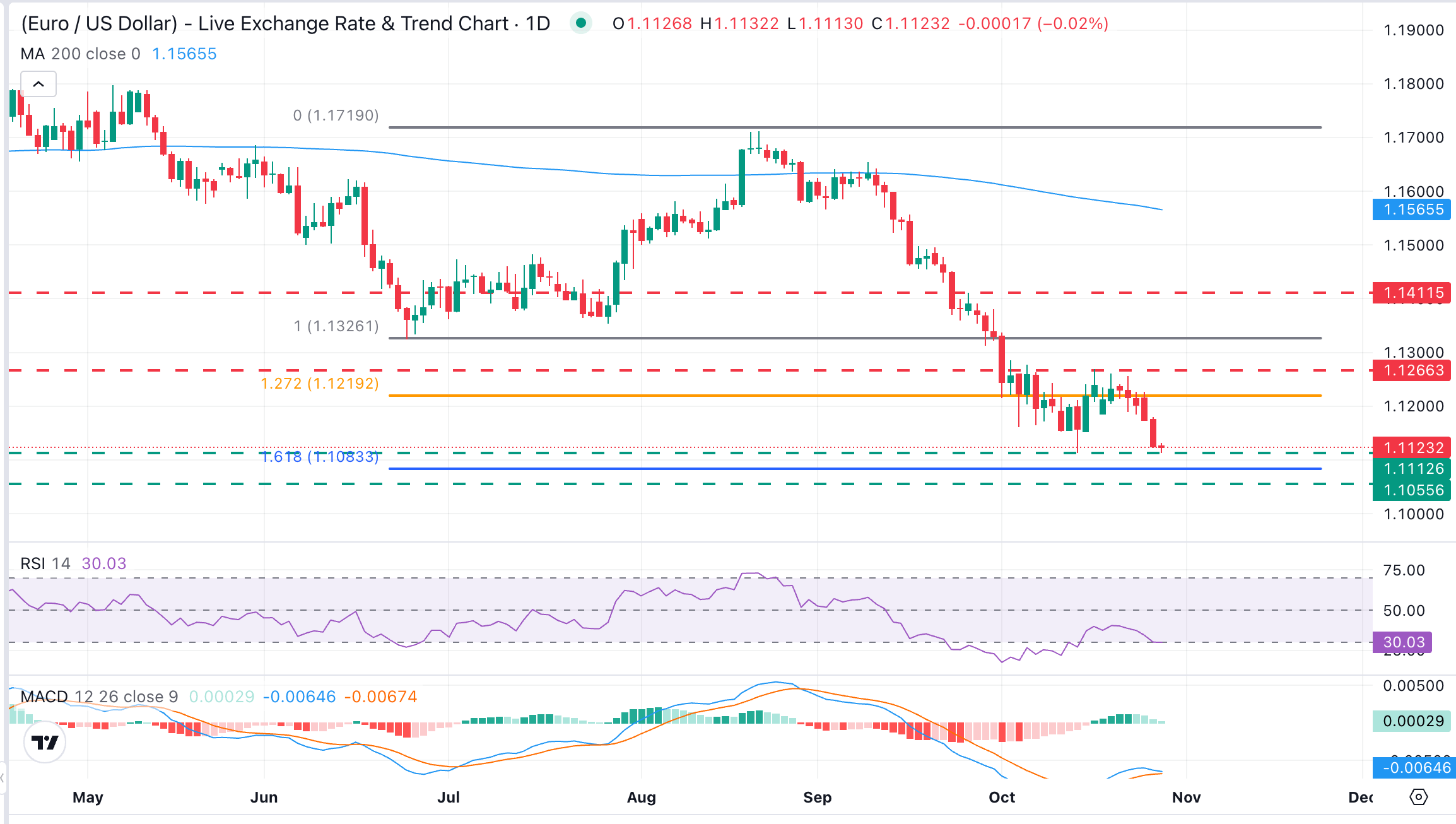
From a technical perspective, Guillermo Alcalá, FX Analyst at FXStreet, sees the Euro’s bearish cycle as overstretched, but observes that “the EUR/USD pair’s inability to return to the upper range of the 1.1200s keeps the negative trend fully in play.”
The daily chart shows early signs that bearish momentum is losing strength, but the Relative Strength Index (RSI) remains below 40, suggesting that bulls are absent, although the Moving Average Convergence Divergence (MACD) histogram has popped up above zero.
“Bulls should break the resistance area at 1.1255, which has been holding upside attempts in October, and shift the focus to the late-June lows, near 1.1325 to confirm a trend reversal,” says Alcalá.
Failure to do so, according to the FXStreet expert, would increase pressure towards the year-to-date low at 1.1113, and the 61.8% Fibonacci retracement of the June-August rally, at 1.1095, ahead of the late May 2025 lows at 1.1050.
Interest rates FAQs
Interest rates are charged by financial institutions on loans to borrowers and are paid as interest to savers and depositors. They are influenced by base lending rates, which are set by central banks in response to changes in the economy. Central banks normally have a mandate to ensure price stability, which in most cases means targeting a core inflation rate of around 2%. If inflation falls below target the central bank may cut base lending rates, with a view to stimulating lending and boosting the economy. If inflation rises substantially above 2% it normally results in the central bank raising base lending rates in an attempt to lower inflation.
Higher interest rates generally help strengthen a country’s currency as they make it a more attractive place for global investors to park their money.
Higher interest rates overall weigh on the price of Gold because they increase the opportunity cost of holding Gold instead of investing in an interest-bearing asset or placing cash in the bank. If interest rates are high that usually pushes up the price of the US Dollar (USD), and since Gold is priced in Dollars, this has the effect of lowering the price of Gold.
The Fed funds rate is the overnight rate at which US banks lend to each other. It is the oft-quoted headline rate set by the Federal Reserve at its FOMC meetings. It is set as a range, for example 4.75%-5.00%, though the upper limit (in that case 5.00%) is the quoted figure. Market expectations for future Fed funds rate are tracked by the CME FedWatch tool, which shapes how many financial markets behave in anticipation of future Federal Reserve monetary policy decisions.
Economic Indicator
ECB Rate On Deposit Facility
One of the European Central Bank's three key interest rates, the rate on the deposit facility, is the rate at which banks earn interest when they deposit funds with the ECB. It is announced by the European Central Bank at each of its eight scheduled annual meetings.
Read more.Next release: Thu Oct 29, 2026 13:15
Frequency: Irregular
Consensus: 2.5%
Previous: 2.5%
Source: European Central Bank
Author

FXStreet Team
FXStreet
Composed of a group of economic journalists and FX experts, the FXStreet content team produces and oversees all content published on FXStreet. It provides a purely journalistic approach to the Forex market.
















