Gold Price Forecast: Additional upside appears in the offing for XAU/USD
- Gold hangs close to fresh record highs above $3,870 early Wednesday.
- US Dollar consolidates the downside on US government shutdown concerns.
- Technically, Gold eyes more gains with the four-hourly RSI still within the bullish zone.

Gold keeps its record-setting rally intact early Wednesday, consolidating near lifetime highs above $3,870 as the United States (US) heads for an imminent government shutdown.
Gold capitalizes on US shutdown, delay in payrolls report
Kicking off the final quarter of 2025 on a bullish note, Gold buyers refuse to give up and flex their muscles as the US government funding expires at 04:00 GMT on Wednesday, with the Republicans and Democrats unlikely to strike a last-minute interim deal.
The last government shutdown stretched from December 22, 2018, to January 25, 2019, lasting 35 days – during US President Donald Trump’s first term.
The immediate effect of a government shutdown will likely be the delay in the monthly labor market report, scheduled for this Friday, which is critical for the markets to gauge whether the US Federal Reserve will remain on track for two additional interest rate cuts this year.
Markets are fully pricing in a 25 basis points (bps) Fed rate cut later this month, the CME Group’s FedWatch Tool shows.
A likelihood of prolonged uncertainty on the US fiscal and monetary policy front is expected to rattle investors’ confidence in the US assets, including the US Dollar (USD), fuelling an increased rush to safety in the traditional safe haven Gold.
Meanwhile, the Greenback is also reeling from the pain of a mixed reading for the Bureau of Labor Statistics' (BLS) Job Openings and Labor Turnover Survey (JOLTS). The report showed US openings increased marginally by 19,000 in August, while hiring declined, consistent with a softening labor market.
All eyes now remain on the US government shutdown scenario and its likely impact on the broader market sentiment. If a shutdown happens, the US private sector payrolls by the Automatic Data Processing (ADP) will hog the limelight on Wednesday, in the absence of the US Nonfarm Payrolls (NFP) release this Friday.
The US ISM Manufacturing PMI and speeches from Fed policymakers could also drive the sentiment around Gold price.
Gold price technical analysis: Four-hourly chart
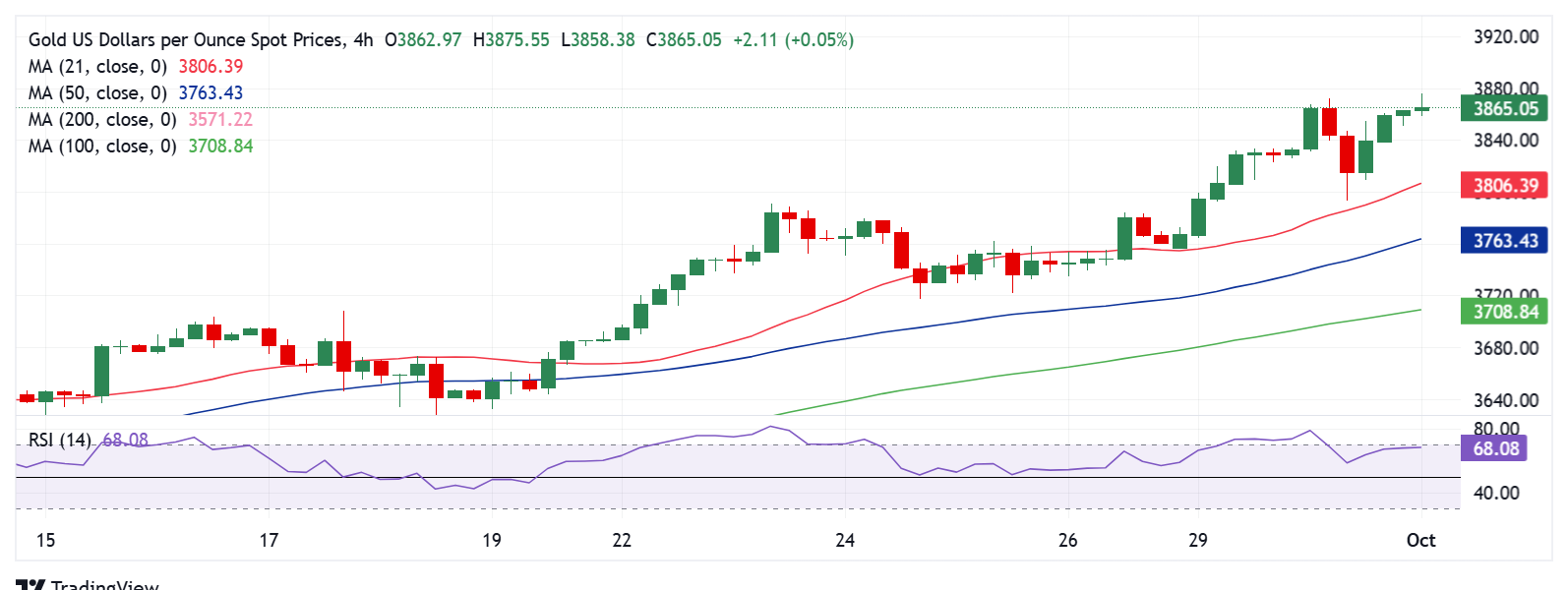
As observed on the four-hour chart, the 14-day Relative Strength Index (RSI) remains within the bullish territory, currently near 68.
Therefore, the leading indicator suggests that Gold still has more room to the upside, and that any dip could be quickly bought in.
However, if buyers refuse to give up, buyers yearn for acceptance above the $3,870 level on a daily closing basis to resume the bullish momentum.
The next topside hurdle is located at the $3,900 barrier as the hunt for the $4,000 mark remains on the radar.
Conversely, any retracement pullback could test the initial support at $3,806, the 21-Simple Moving Average (SMA), below which the 50-SMA at $3,763 would be tested.
Deeper correction could target the September 24 low at $3,718, followed by the 100-SMA at $3,708.
Fed FAQs
Monetary policy in the US is shaped by the Federal Reserve (Fed). The Fed has two mandates: to achieve price stability and foster full employment. Its primary tool to achieve these goals is by adjusting interest rates. When prices are rising too quickly and inflation is above the Fed’s 2% target, it raises interest rates, increasing borrowing costs throughout the economy. This results in a stronger US Dollar (USD) as it makes the US a more attractive place for international investors to park their money. When inflation falls below 2% or the Unemployment Rate is too high, the Fed may lower interest rates to encourage borrowing, which weighs on the Greenback.
The Federal Reserve (Fed) holds eight policy meetings a year, where the Federal Open Market Committee (FOMC) assesses economic conditions and makes monetary policy decisions. The FOMC is attended by twelve Fed officials – the seven members of the Board of Governors, the president of the Federal Reserve Bank of New York, and four of the remaining eleven regional Reserve Bank presidents, who serve one-year terms on a rotating basis.
In extreme situations, the Federal Reserve may resort to a policy named Quantitative Easing (QE). QE is the process by which the Fed substantially increases the flow of credit in a stuck financial system. It is a non-standard policy measure used during crises or when inflation is extremely low. It was the Fed’s weapon of choice during the Great Financial Crisis in 2008. It involves the Fed printing more Dollars and using them to buy high grade bonds from financial institutions. QE usually weakens the US Dollar.
Quantitative tightening (QT) is the reverse process of QE, whereby the Federal Reserve stops buying bonds from financial institutions and does not reinvest the principal from the bonds it holds maturing, to purchase new bonds. It is usually positive for the value of the US Dollar.
Author

Dhwani Mehta
FXStreet
Residing in Mumbai (India), Dhwani is a Senior Analyst and Manager of the Asian session at FXStreet. She has over 10 years of experience in analyzing and covering the global financial markets, with specialization in Forex and commodities markets.














