Gold Price Forecast: Acceptance above $2,350 is critical to sustain the upturn
- Gold price rebounds further from two-week lows on China optimism, Middle East geopolitical risks.
- The Dollar and Treasury bond yields stay listless amid a US market holiday on Monday.
- Gold price looks to recover, as the RSI prods the midline after the rising wedge breakdown.

Gold price is building on the recovery from two-week lows early Monday, as US holiday-induced thin market conditions support buyers.
China optimism and geopolitical tensions underpin Gold price
Besides, renewed optimism around China’s economic growth prospects and a fresh escalation in the war between Israel and Hamas provide extra legs to the ongoing rebound in Gold price.
Reuters reported that China launched a new state-backed investment fund with a registered capital of CNY 344 billion yuan to boost the semiconductor industry. This measure could help stimulate the economic recovery, in turn, boding well for Gold price. China is the world’s top Gold consumer.
Additionally, safe-haven flows ramped up into the Gold price, following CNN reports that at least 35 Palestinians were killed and dozens more were injured as a result of Israeli air attacks on a camp in Rafah for displaced people on Sunday. The ceasefire talks between both Israel and Gaza have stalled and are set to resume next week.
However, it remains to be seen if Gold price can sustain the rebound, as markets continue to trim their expectations of interest rate cuts by the US Federal Reserve (Fed) this year. It’s worth noting that thin liquidity could exaggerate Gold price movements. Both the UK and the US markets are closed on Monday, in observance of the Spring Bank Holiday and Memorial Day.
Gold price technical analysis: Daily chart
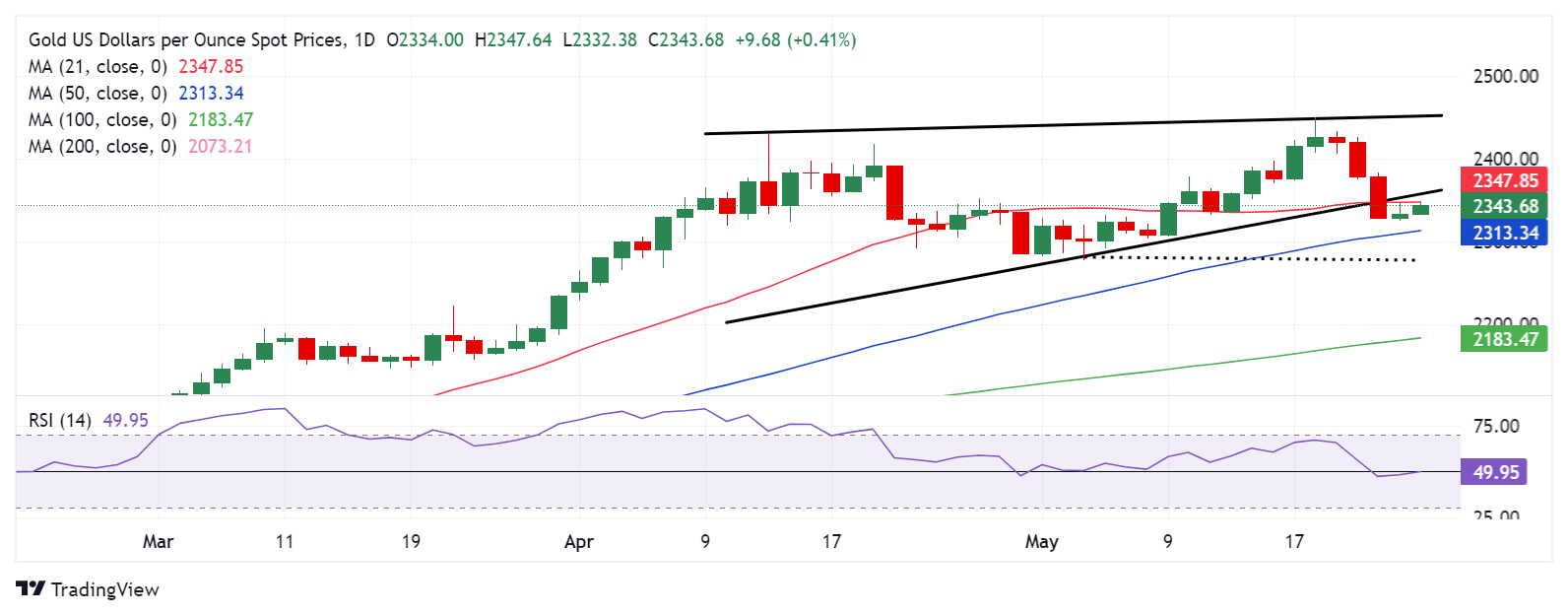
Following a downside break from a rising wedge formation confirmed last week, risks remain skewed to the downside for Gold price.
However, if the 14-day Relative Strength Index (RSI) manages to close Monday above the 50 level, we could see a sustained chance of recovery.
That said, acceptance above the wedge support at $2,356 is critical to unleashing additional recovery.
The immediate resistance for Gold buyers is seen at the 21-day Simple Moving Average (SMA) at $2,348.
If these two resistance levels are cleared, a fresh advance toward the $2,400 mark cannot be ruled out.
On the flip side, Gold sellers need to crack the 50-day SMA support at $2,313 to resume the downtrend.
The next cushion is aligned at the $2,300 level, below which the May 3 low of $2,277 will be tested.
Gold FAQs
Gold has played a key role in human’s history as it has been widely used as a store of value and medium of exchange. Currently, apart from its shine and usage for jewelry, the precious metal is widely seen as a safe-haven asset, meaning that it is considered a good investment during turbulent times. Gold is also widely seen as a hedge against inflation and against depreciating currencies as it doesn’t rely on any specific issuer or government.
Central banks are the biggest Gold holders. In their aim to support their currencies in turbulent times, central banks tend to diversify their reserves and buy Gold to improve the perceived strength of the economy and the currency. High Gold reserves can be a source of trust for a country’s solvency. Central banks added 1,136 tonnes of Gold worth around $70 billion to their reserves in 2022, according to data from the World Gold Council. This is the highest yearly purchase since records began. Central banks from emerging economies such as China, India and Turkey are quickly increasing their Gold reserves.
Gold has an inverse correlation with the US Dollar and US Treasuries, which are both major reserve and safe-haven assets. When the Dollar depreciates, Gold tends to rise, enabling investors and central banks to diversify their assets in turbulent times. Gold is also inversely correlated with risk assets. A rally in the stock market tends to weaken Gold price, while sell-offs in riskier markets tend to favor the precious metal.
The price can move due to a wide range of factors. Geopolitical instability or fears of a deep recession can quickly make Gold price escalate due to its safe-haven status. As a yield-less asset, Gold tends to rise with lower interest rates, while higher cost of money usually weighs down on the yellow metal. Still, most moves depend on how the US Dollar (USD) behaves as the asset is priced in dollars (XAU/USD). A strong Dollar tends to keep the price of Gold controlled, whereas a weaker Dollar is likely to push Gold prices up.
Author

Dhwani Mehta
FXStreet
Residing in Mumbai (India), Dhwani is a Senior Analyst and Manager of the Asian session at FXStreet. She has over 10 years of experience in analyzing and covering the global financial markets, with specialization in Forex and commodities markets.