Gold holds steady as Fed signals and trade tensions shape market outlook


Gold (XAUUSD) prices remain firm despite conflicting signals from the Federal Reserve and rising trade tensions. Strong US jobs data recently eased expectations of near-term rate cuts, boosting the US Dollar and briefly pressuring gold. However, the Fed Minutes suggest rate cuts may still come later this year, keeping gold supported. At the same time, Trump’s new tariffs have increased market uncertainty and strengthened demand for safe-haven assets. Traders now wait for fresh US economic data and Fed commentary to guide gold’s next move.
Gold holds firm as Fed signals stay mixed and trade tensions escalate
Gold remains supported by mixed signals from the Federal Reserve and trade uncertainty. Strong US jobs data last week reduced expectations for near-term rate cuts. This gave strength to the US Dollar and temporarily pressured gold. However, the Fed Minutes revealed most officials still expect rate cuts later this year. This keeps investor sentiment tilted in favour of gold.
At the same time, political risks are rising. President Trump announced new tariffs and issued notices to eight countries. He also confirmed a 50% tariff on copper imports effective August 1. These moves have increased market uncertainty. As a result, demand for safe-haven assets, such as gold, has strengthened. Investors remain cautious as tariff-related risks grow.
The US Dollar has weakened slightly in recent days. A strong 10-year bond auction pulled Treasury yields lower. This limits the Dollar’s upside and supports gold prices. Market participants now await new Fed speeches and jobless claims data. These events could provide fresh direction for gold in the short term.
Gold breaks out of ascending channel, confirming long-term bullish trend
The chart below indicates that gold’s broader trend remains firmly bullish, characterized by a consistent upward movement within a clearly defined ascending channel. Over the years, the price has repeatedly respected both the upper and lower boundaries of this channel, reinforcing its strength and reliability.
Key turning points are highlighted with orange circles, indicating that the trend structure has remained consistent. Between 2018 and mid-2019, gold formed an ascending triangle pattern. This was an early sign of consolidation within the uptrend. The breakout from this pattern led to a new phase of higher highs and higher lows, confirming strong bullish momentum.
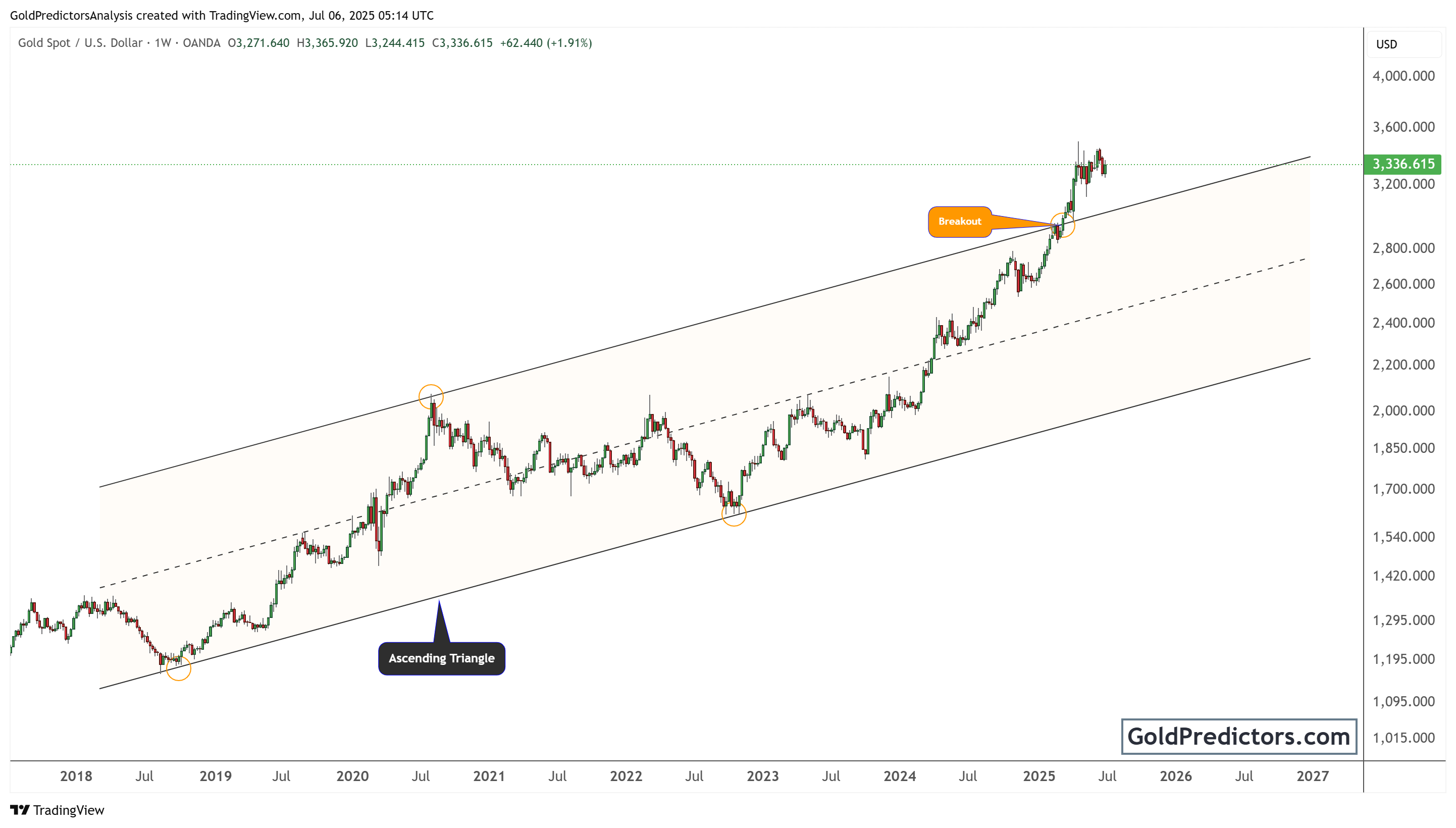
In early 2023, gold tested the lower trendline and formed a solid bottom. This laid the foundation for the current rally. After consolidating, gold broke above the midline and later crossed the upper boundary of the channel, marked clearly as a breakout on the chart. Prices jumped past $3,200 and now hold above $3,300, trading near $3,320. The recent shallow pullback suggests buying interest remains strong. As long as gold remains above the previous resistance level, which has now become support, the bullish technical perspective remains intact.
Conclusion
The gold price retains a positive bias as traders digest clues from the Fed's policy and escalating trade tensions. Reduced bets on a Fed rate cut and a strong US Dollar present headwinds, but safe-haven flows driven by Trump's tariffs provide near-term support. The long-term technical structure remains bullish with a confirmed breakout above the multi-year channel. However, limited follow-through requires caution. Upcoming US economic data and Fed commentary are likely to determine gold’s next direction.
Unlock exclusive gold and silver trading signals and updates that most investors don’t see. Join our free newsletter now!
Unlock exclusive gold and silver trading signals and updates that most investors don’t see. Join our free newsletter now!
Author
Muhammad Umair, PhD
Gold Predictors
Muhammad Umair is a financial markets analyst and investor who focuses on the forex and precious metals markets.