|

Gold hits $1300 as dollar slumps

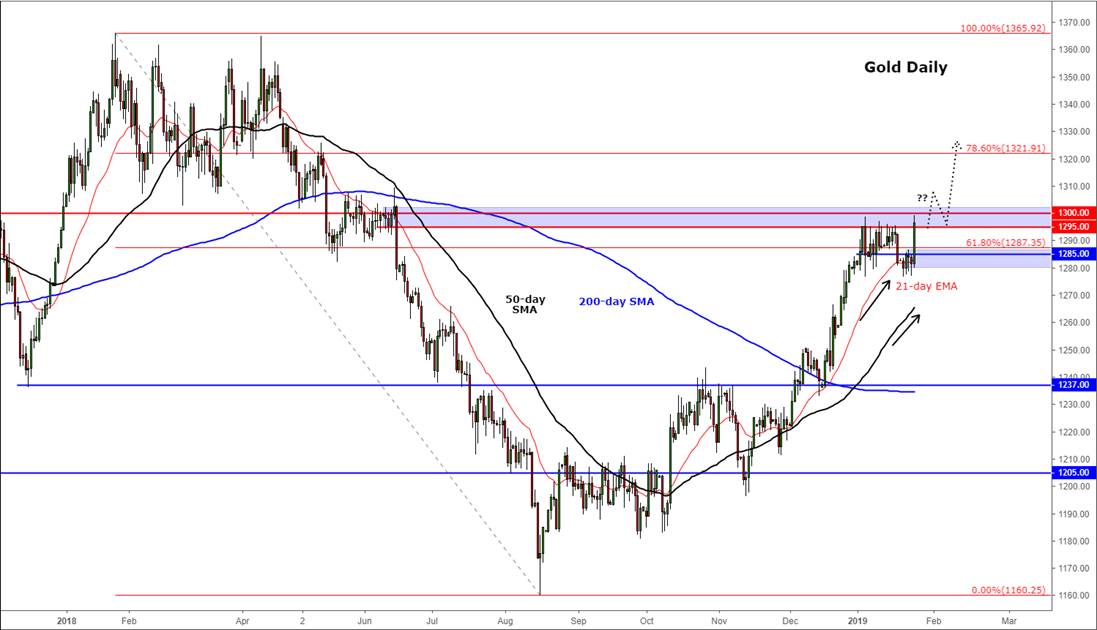
There are a number of factors supporting gold prices at the moment, most notably a big drop for the US dollar. The US dollar has weakened sharply ahead of next week’s FOMC meeting amid growing expectations that the Fed will re-iterate the need to pause its hiking cycle. We have been growing negative towards the buck for a while now and this dollar sell-off does not surprise us at all. The sell-off has been blamed on a Wall Street Journal report, which suggests that the Fed could be taking a more cautious approach towards the shrinking its huge balance sheet. Among the dollar pairs, EUR/USD has surged back to 1.14 after briefly breaking the 1.13 handle in the aftermath of the ECB policy decision yesterday.  As we mentioned previously, a dovish ECB was already expected but Mario Draghi was not exactly too dovish after all. So, the euro’s recovery makes sense as previously sentiment towards it was very negative. In addition to a weaker dollar boosting buck-denominated gold, you have the Chinese yuan being on the rise on hopes over a resolution in US-China trade dispute. With a stronger renminbi, Chinese consumers can buy more gold than was the case previously. The fact that gold has so far refused to go down meaningfully from around the $1295-$1300 resistance area suggests that the selling pressure has not been strong as some would have expected from around this key hurdle. So, as things stand, gold looks poised for a potential breakout above $1300, which could then lead to further technical follow-up buying pressure in early next week.

Figure 1:
Gold

Author

Fawad Razaqzada

Fawad Razaqzada

TradingCandles.com

Experience Fawad is an experienced analyst and economist having been involved in the financial markets since 2010 working for leading global FX, CFD and Spread Betting brokerages, most recently at FOREX.com and City Index.


More from Fawad Razaqzada
Share:

Editor's Picks

GBP/USD stays defensive below 1.3300 amid pre-Fed market caution

GBP/USD stays defensive near fresh July lows in the 1.3270 region on Tuesday. The pair struggles as the US Dollar (USD) sits at monthly highs amid market caution ahead of the two-day US Federal Reserve monetary policy meeting, while a sell-off in stocks fuels demand for the safe-haven currency.

EUR/USD hangs close to monthly lows near 1.1350 on USD strength

EUR/USD is consolidating near the monthly trough, trading near mid-1.1300s in the European morning on Tuesday, undermined by persistent US Dollar demand. Traders seem hesitant and await the outcome of a two-day FOMC policy meeting before placing aggressive directional bets.

Gold languishes near $4,000 ahead of FOMC decision

Gold (XAU/USD) maintains its offered tone through thef the European session on Tuesday and currently nears the $4,000 psychological level. This follows the previous day's failure to find acceptance above the $4,100 mark and suggests that the path of least resistance for the bullion remains to the downside amid a bullish US Dollar (USD) undertone.

Bitcoin slips below $64,000 as risk-off sentiment grips markets
Bitcoin (BTC) is extending its correction, trading below $64,000 at the time of writing on Tuesday after losses of over 2.5% the previous day. Institutional demand shows early signs of weakness, with spot Exchange Traded Funds (ETFs) recording a mild outflow on Monday, marking three consecutive days of withdrawals.
Indian Rupee outlook: Downtrend set to persist – Just at a slower pace
The Indian Rupee just endured its most brutal six-month stretch in years, battered by a perfect storm of global shocks. From United States (US)-India trade uncertainty to surging Oil prices and the significant outflow of Foreign Institutional Investment (FII) from the Indian stock market, every event brought nothing but pain for the Indian currency.
US Dollar mid-year outlook: Exceptional currency, exceptional risks?
The US Dollar enters the second half of 2026 in a markedly different position from a year ago. The King currency has recovered, reflecting persistent US inflation, changing expectations for Fed policy, geopolitical tensions and renewed demand for defensive assets.












