Gold Gains a Powerful Friend

Yesterday, gold won an influential supporter in the White House. Who is he?
The Enemy of Gold’s Enemy Is Gold’s Friend
As the ancient proverb goes, my enemy’s enemy is my friend. Although it is usually employed in foreign policy, this concept also applies to finance. Given the negative correlation between the greenback and gold, the enemies of the U.S. dollar are generally gold’s friends.
U.S. Treasury Secretary Steven Mnuchin has recently joined this elite club. On Wednesday, he welcomed the weakness in the American currency. According to Bloomberg, Mnuchin told reporters at the annual Davos summit of business and political leaders that a weaker dollar is not bad for the U.S., at least in the short term: “Obviously a weaker dollar is good for us as it relates to trade and opportunities”. He also added that the currency’s short-term value is “not a concern of ours at all.”
Is Mnuchin a Gold Bulls’ Secret Agent?
Surely, it’s not the case that Mnuchin wants the collapse in the U.S. dollar. He is the Treasury Secretary, after all. Indeed, he also winked yesterday at the dollar’s fans:
Longer term, the strength of the dollar is a reflection of the strength of the U.S. economy and the fact that it is and will continue to be the primary currency in terms of the reserve currency.
Everyone was pleased. Almost. As the chart below shows, the U.S. dollar has plunged against the euro. Actually, the greenback sank to the level not seen since late 2014.
Chart 1: EUR/USD exchange rate over the last three days.
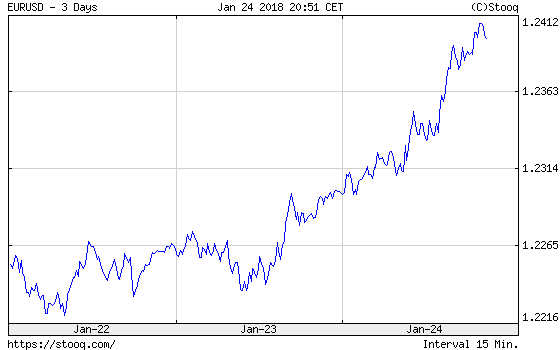
The reason behind the decline was the fact that Mnuchin’s remarks were unexpected. His comments departed from the strong rhetoric on the U.S. dollar of Treasury Secretaries before him, but were actually perfectly in line with Trump’s views that a weak greenback is positive for American exporters. As a reminder, the President said last year that the dollar was “too strong”, sending it south. So Mnuchin’s comments shouldn’t be surprising. But they were to many analysts.
Luckily not to us and our readers. We warned them in the January edition of the Market Overview that “the U.S. dollar could continue a downward trend in 2018” due to the weak U.S. economic policy. We wrote:
the decline in the U.S. dollar index might reflect weak U.S. economic policy. As a reminder, in January 2017, President Trump started to express his desire for a weaker greenback. In other words, the protectionist measures and attempts to stimulate the economy in the short-term (through fiscal stimulus) replaced policies aimed at improving productivity. The combination of protectionist schemes and deficit spending weakened the U.S. position in the global economy, so the greenback fell against the euro.
Indeed, Mnuchin’s words rekindled fears of protectionism, pushing the greenback down. The recent introduction of steep global tariffs on imported washing machines and solar panels by Donald Trump and Commerce Secretary Wilbur Ross’s comments on NAFTA and the possible action over China’s infringements of intellectual property also added some fuel to the fire.
Conclusions
Gold definitely liked Mnuchin’s comments. Let’s see the chart below, which paints the price of the yellow metal over the last twelve months.
Chart 2: Gold prices over the last twelve months.
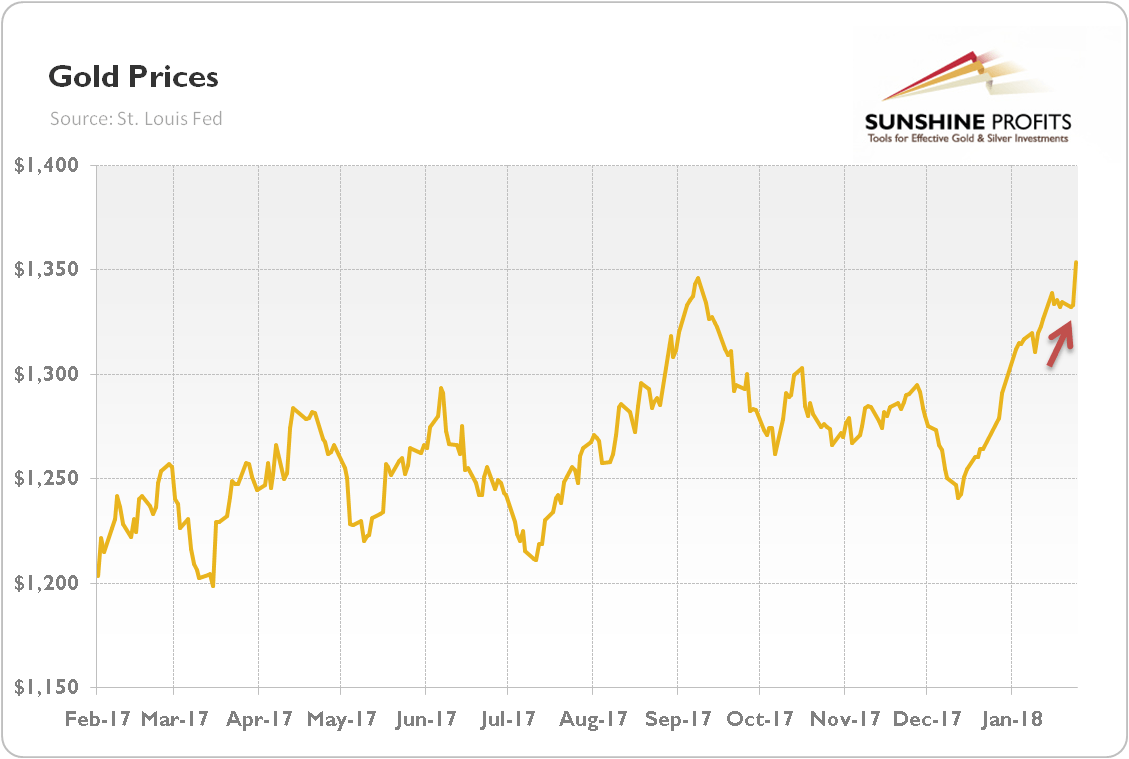
As you can see, gold has jumped above $1,350 thanks to Mnuchin’s remarks. It may be a beautiful beginning of a new friendship. Traders used to repeat “don’t fight the Fed”. But perhaps investors should replace this mantra with a new one: “don’t fight the White House which wants the weaker dollar”. So far Trump has got what he wanted. And it may be not the end, given the worries about the U.S. economic policy and the revival of the Eurozone. We will elaborate on this in the February edition of the Market Overview. Stay tuned!
Want free follow-ups to the above article and details not available to 99%+ investors? Sign up to our free newsletter today!
Author
Arkadiusz Sieroń
Sunshine Profits
Arkadiusz Sieroń received his Ph.D. in economics in 2016 (his doctoral thesis was about Cantillon effects), and has been an assistant professor at the Institute of Economic Sciences at the University of Wrocław since 2017.