Gold forecast: Will Jackson Hole spark a breakout or breakdown?

Gold prices consolidate at $3,340 ahead of the Jackson Hole Symposium. A dovish Powell could fuel a breakout toward $3,420, while a hawkish tone risks a pullback to $3,280.
- Gold consolidates near $3,340 as traders await Jackson Hole for Fed policy signals.
- Dovish Powell could spark a breakout toward $3,380–$3,420, fueled by safe-haven flows.
- Hawkish surprise risks a pullback to $3,300–$3,280, testing demand liquidity.
Why Gold’s rally has strong fundamental backing
- Conviction buyers: Central banks and long-term investors continue to underpin gold. According to Goldman Sachs, demand from institutional “conviction buyers” (e.g., central banks) has propelled prices, with every 100 tonnes purchased adding roughly 1.7% to the price. Forecasts suggest gold could reach $3,700 by end‑2025 and $4,000 by mid‑2026.
- Macro catalysts: Markets are tightly watching the Jackson Hole Symposium (Aug 21–23) for clues on Fed rate cuts. Futures pricing currently assigns an 84% probability of a 25-basis-point cut following Powell’s remarks, which could bolster non-yielding assets like gold.
- Geopolitical uncertainty & peace talks: The anticipated summit involving Trump, Zelensky, and European leaders has fueled “safe-haven” buying, especially as U.S. yields fall. A successful peace deal could curtail demand, but uncertainty continues to lean bullish for gold.
- Additional estimates: Some bullish projections span further out - InvestingHaven targets $3,500 in 2025, $3,900 in 2026, and possibly $5,155 by 2030.
Jackson Hole symposium: A pivotal catalyst for Gold
Every August, the Jackson Hole Symposium serves as a key platform for central bankers, policymakers, and economists to outline the direction of monetary policy. For gold, this annual event is especially relevant because the Federal Reserve often uses it to signal its policy stance for the months ahead.
This year’s meeting (Aug 21–23, 2025) carries heightened significance:
- Fed policy signals: Markets are currently pricing in an 84% chance of a 25-basis-point rate cut in September. If Chair Jerome Powell confirms this dovish tilt, it would lower the opportunity cost of holding gold, reinforcing bullish flows.
- Inflation & stagflation concerns: While inflation has cooled, concerns remain over stagflation - slowing growth paired with sticky prices. Any acknowledgment of this risk at Jackson Hole could further strengthen gold’s role as a hedge.
- Market sensitivity: In the past, gold has responded sharply to Powell’s tone. A dovish message could send prices higher, testing resistance at $3,380–$3,400, while a hawkish surprise could trigger a pullback toward the $3,300 demand zone.
- Broader risk sentiment: With peace talks and tariff headlines already fueling volatility, Jackson Hole adds another layer of uncertainty that keeps gold attractive as a safe-haven hedge.
In short, Jackson Hole is not just another event on the calendar - it is the policy stage that can make or break gold’s next breakout attempt.
Technical outlook: Gold holds demand FVG, eyes breakout from $3,350 range
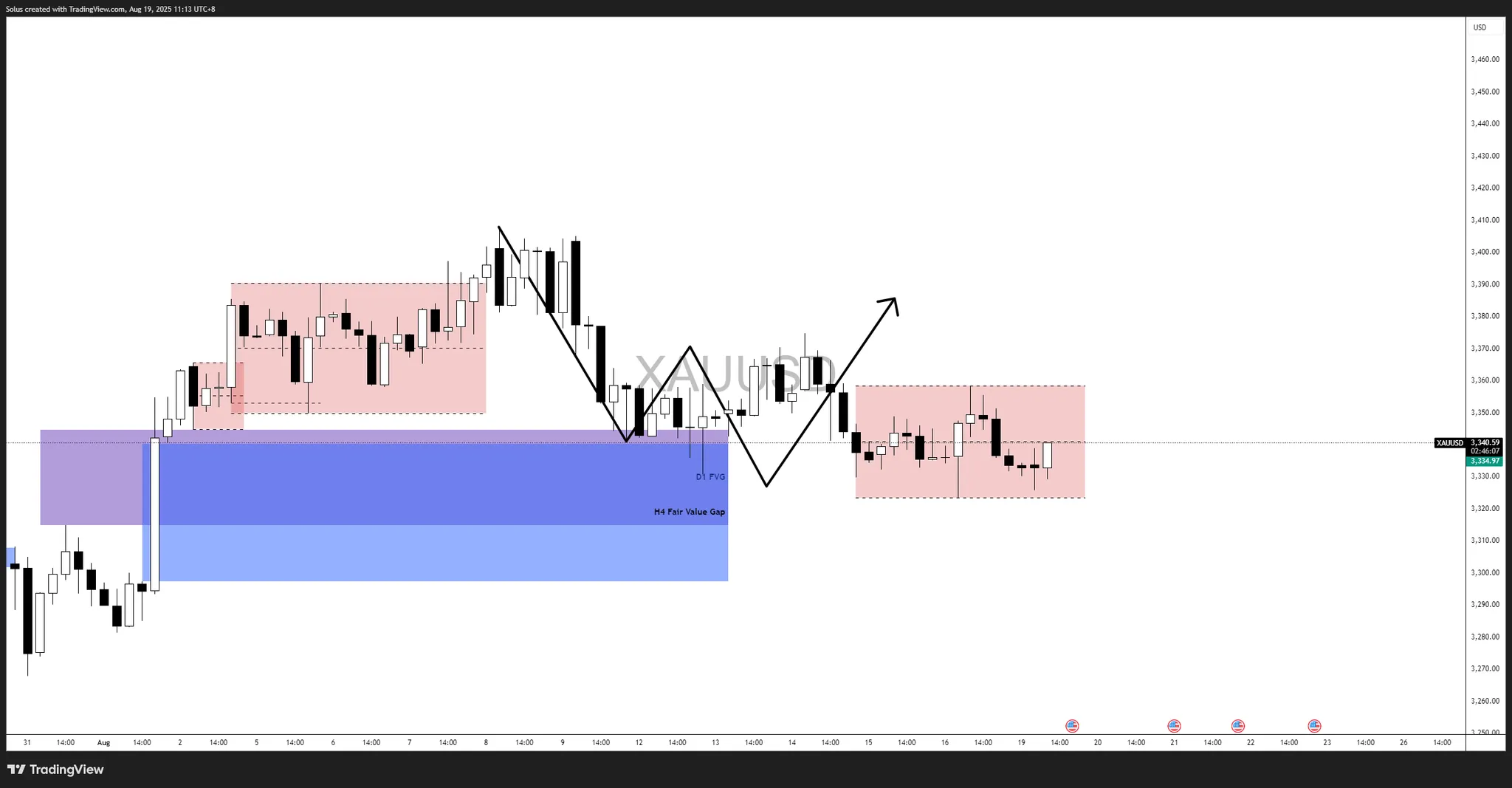
Gold has found stability after tapping into the H4 Fair Value Gap around $3,315–$3,345, confirming this zone as near-term demand. From there, the market is consolidating beneath resistance in the $3,340–$3,350 range, reflecting hesitation as traders await this week’s Jackson Hole catalyst.
Bullish scenario: Breakout above consolidation
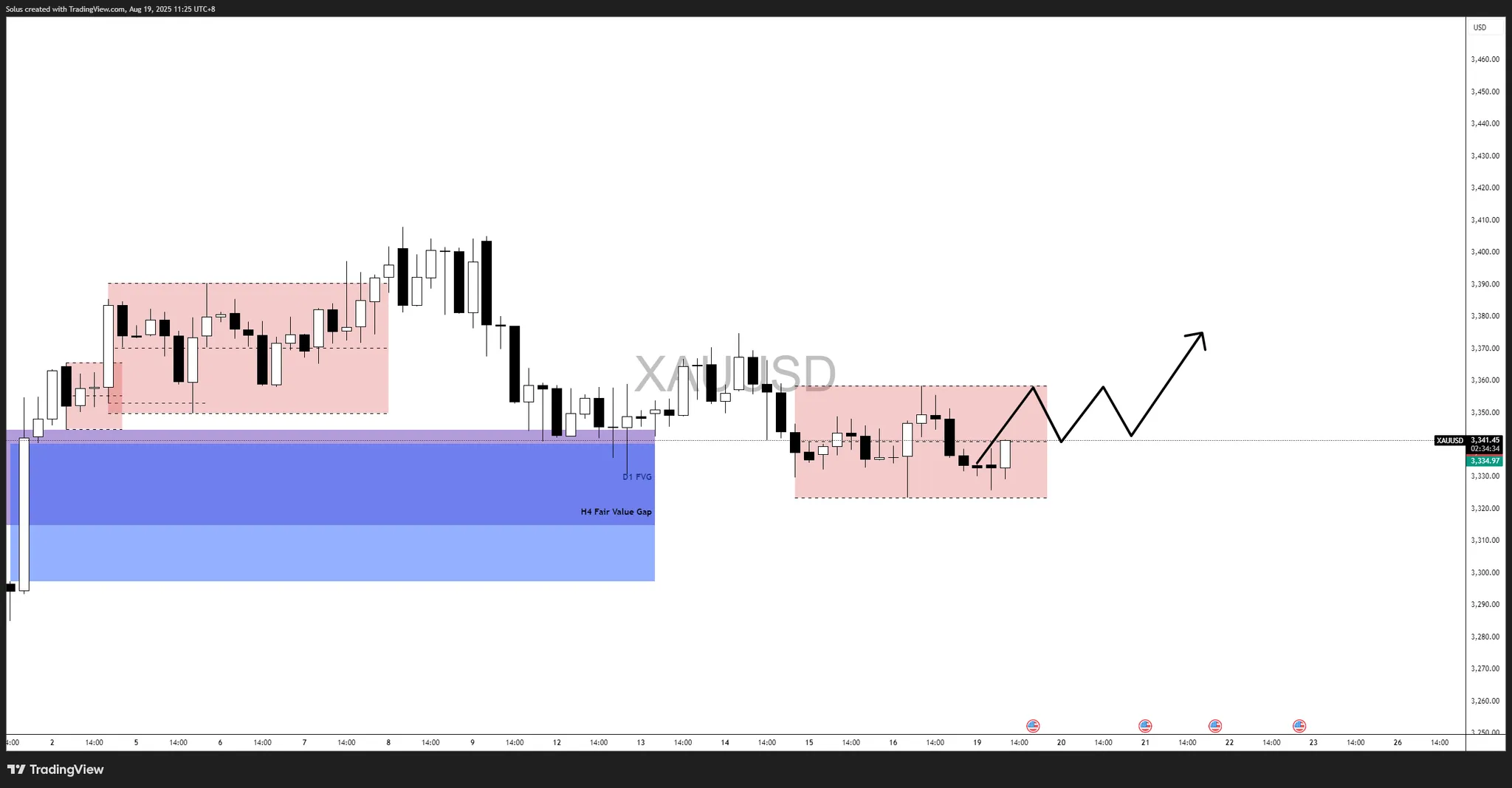
If buyers continue defending the $3,320 support level, gold could build momentum for a breakout above the $3,360 consolidation ceiling. A confirmed move higher would align with dovish Fed expectations at Jackson Hole and steady safe-haven inflows.
- Higher lows form above the $3,320 demand base.
- A clean breakout above $3,350–$3,360 validates bullish intent.
Targets:
- First upside target: $3,370, marking the top of near-term resistance.
- Second target: $3,380–$3,390, reclaiming the upper boundary of recent ranges.
- Extended target: $3,400–$3,420, if bullish momentum accelerates.
Bearish scenario: Failure at resistance, breakdown lower
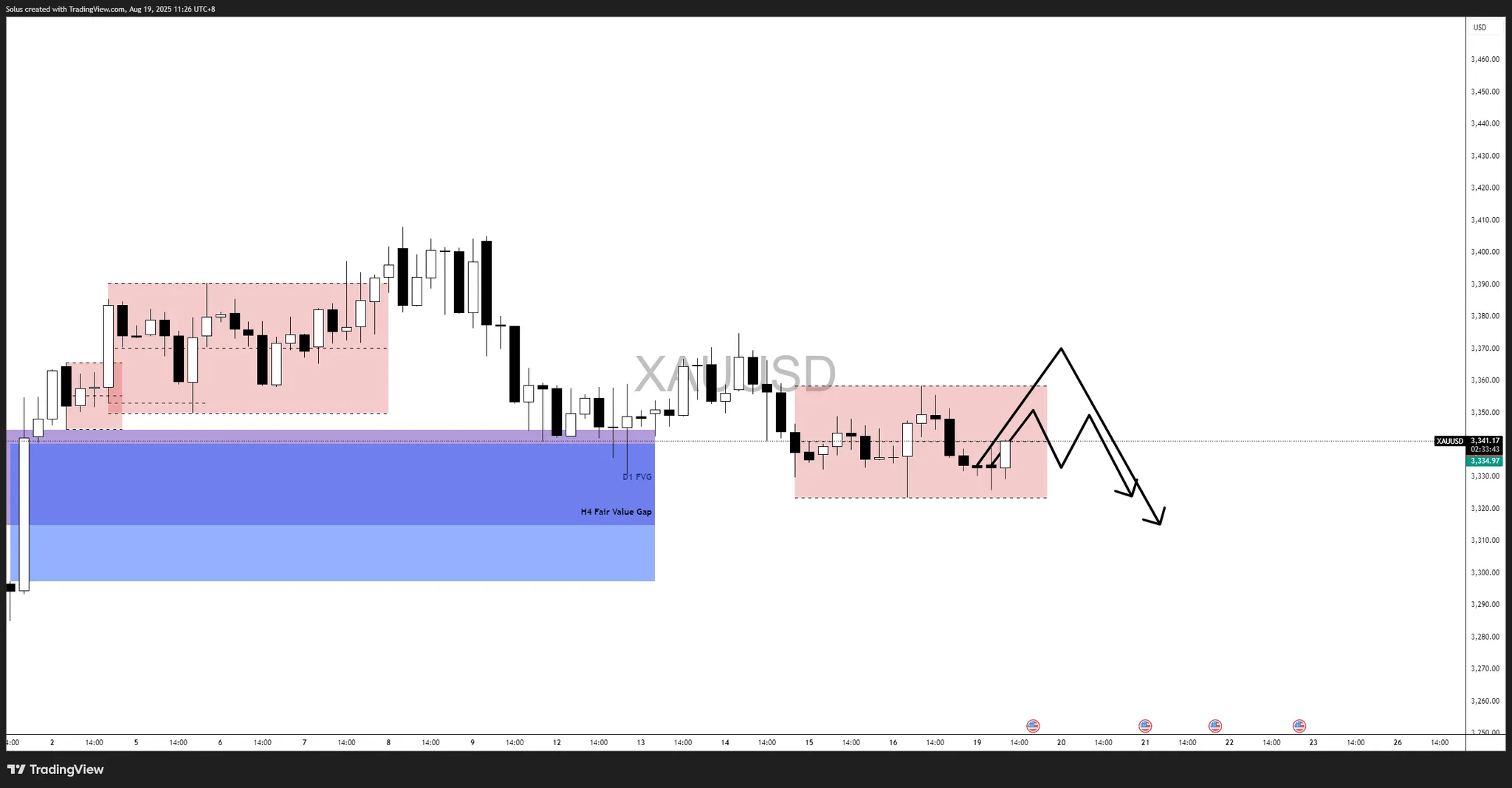
If gold fails to clear $3,350–$3,360 resistance, bears may take control and downside move may continue. A rejection from this level followed by a break below the $3,340-$3,315 Daily Fair Value Gap would expose downside liquidity zones. This scenario could be fueled by hawkish Fed messaging or easing geopolitical risks.
- Rejection occurs at $3,350–$3,360 resistance.
- Breakdown through $3,330–$3,320 invalidates bullish setups.
- First downside target: $3,300, the psychological round number.
- Second target: $3,280, aligning with prior liquidity pools.
- Extended target: $3,250, a deeper demand level where buyers may re-engage.
All eyes on Jackson Hole
Gold’s next decisive move is likely to be shaped by the Jackson Hole Symposium, where Fed Chair Jerome Powell’s message could either validate market expectations for a September rate cut or deliver a hawkish surprise. With gold consolidating around $3,340, the balance between buyers and sellers is finely poised.
A dovish Powell could fuel a breakout toward $3,380–$3,400, reinforcing gold’s role as a hedge against policy easing and stagflation risks. Conversely, a hawkish tone could pressure prices back into the $3,300–$3,280 demand zone, exposing deeper liquidity levels.
In short, Jackson Hole is not just a policy gathering - it’s the fulcrum that could determine whether gold resumes its march toward fresh highs or undergoes a corrective pullback before the next leg higher.
Author

Jasper Osita
Independent Analyst
Jasper has been in the markets since 2019 trading currencies, indices and commodities like Gold. His approach in the market is heavily accompanied by technical analysis, trading Smart Money Concepts (SMC) with fundamentals in mind.