Gold Forecast 2017: Déjà vu all over again, but at the mercy of Trumponomics, Fed

2016 - A year of surprises
The year 2016 was indeed a year of two halves and a volatile one as well for gold, dominated by plenty of historic and uncertain global events, the outcomes of which are expected to have a lasting impact on the gold price trends going forward.
Gold kicked-off the year on a firmer footing and climbed 25% in the first half of the year, marking the best H1 in four decades, in wake of heightened global financial markets uncertainty. The rebound in gold was underscored by the Chinese equities turmoil, surprisingly dovish global central banks’ (Fed and BOJ) stance and finally the Brexit-vote.
The bullion almost reached $ 1300 mark by April, having staged a solid $ 250 recovery from the lowest levels in almost six years of $ 1046.10 reached last December. By July, the yellow metal had soared to more-than-two-year highs at $ 1,375.17, following the shocking Brexit decision in June. Since then, gold has been on a downward spiral and has eroded almost 17% in H2 so far, as an unexpected Trump victory in the US elections and a second Fed rate hike in almost ten years drowned the yellow metal to ten-month troughs of $ 1122.61.
Looking behind, 2016 didn’t turn out to be a good year for gold, as expected at the start of the year given all the uncertainty and concerns over Brexit, US election and global headwinds. In fact, gold’s appeal as a safe-haven was heavily dented on a surprise Trump win, as markets bought into the renewed optimism over Trump’s plans to step up fiscal spending that would bolster the US economic growth. While an unexpectedly hawkish Fed accentuated the up move in the US dollar and treasury yields, which further collaborated to the downbeat sentiment around gold. The Fed in its December meeting hiked rates by 25bps, as widely expected, and announced three rates hikes next year compared to the two hikes forecast seen in September.
2017 - A year of modest recovery?
Heading into 2017, gold markets have been roiled by Trump’s presidency-led optimism, as investors are riding higher on expectations that the potential reforms/policies (so-called Trumponomics) to be implemented by Trump would yield positive results, spurring US economic growth and higher inflation expectations.
Further, markets have largely ignored the negatives if Trumponomics disappoint the expectations, which would spark a fresh spell of uncertainty across the financial markets and lift the demand for gold as an ultimate safe-haven. This would be a Deja Vu all over again, a replica of what we witnessed in H1 2016, the return of gold demand in times of uncertainty and market unrest.
While Trumponomics and Fed rate hike outlook will remain the key drivers for gold next year, one cannot overlook several other factors that would affect the gold-price action way forward.
Factors to watch out in 2017
Higher inflation expectations from the US and China: According to many analysts, inflationary policies adopted by China and US are likely to boost speculative flows into electronic traded funds (ETFs) related to gold.
The 45th US president-elect Trump’s plans to cut taxes is expected to increase the Federal debt from 77% of the US GDP at year-end 2016 to 86%, or about $23 trillion, over the next decade, mainly driven by higher fiscal spending amid rising wages, which would eventually push inflation higher. Moreover, implementing Trump’s pledge to impose tariffs on Mexican and Chinese imports could trigger a trade war between the two trading partners, resulting in lower trade volumes and higher prices for US consumers.
Likewise, the ongoing fiscal stimulus and peaking housing market prices in China have significantly boosted money supply growth in the economy, with the Chinese investors now turning to risky assets such as equities and commodities in order to take the yield advantage, which would help prop up prices amid increased Chinese demand.
Markets tend to store a portion of their wealth in gold in order to hedge against inflationary pressures.
Asian demand: According to the World Gold Council (WGC), China's gold demand has dropped this year, with third quarter consumer demand at 182.5 tons, down 22% from the same period in 2015, while India's 194.8 tons is 28% lower. Markets are expecting China's gold demand to remain steady in 2017, with an increase in demand in Yuan terms, as the Chinese currency is likely to extend its weakness. In the meantime, India's gold demand would also stabilize after a considerable decline witnessed in the aftermath of the government's demonetization scheme implemented last month.
China and India are the world's biggest gold-consuming nations.
Risks of Euroland breakup: Eurozone remains exposed to the risks of disintegration as a slew of elections and referendums remain on the cards, especially after Britain’s exit from the EU membership in June and Italy’s constitutional amendment referendum. The troubled Italian banks combined with a significant increase in perceived Eurozone exit probabilities across many member countries, particularly in France and the Netherlands, could refuel the safe-haven bids for gold.
Fed rate hike outlook: Trump’s policies-induced sharp USD appreciation is expected to have disinflationary effects on the US economy. As a result, the Fed could be forced to restrict the number of rate hikes by 2 and perhaps even launch a form of QE4 in the latter half to revive the stalling economic recovery in the US.
Gold Technicals: A reversal on the cards above monthly 20-SMA
Monthly Chart
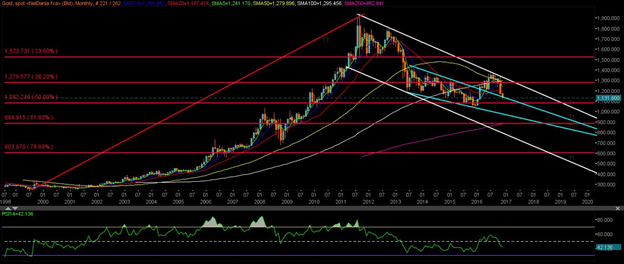
Gold prices ran into the falling channel resistance (in white) near $ 1380 levels and from there has dropped drastically, having breached the key horizontal support of monthly 20-SMA located at $ 1197.60. A fresh sell-off was triggered below a break of the last, knocking off the prices below the next support placed at the short-term falling wedge trend line resistance (in blue) at $ 1141.
Subsequently, the rate fell further to hit ten-month lows of around $ 1122 levels, having found some bids ahead of Feb 2016 lows of $ 1116.90. The yellow metal managed to move slightly away from multi-month troughs to now trade around $ 1132 levels.
Should the bullion breach Feb lows, an aggressive selling would be witnessed, which would drown gold prices to next support placed near $ 1080 levels - Fib 50% of 1999-2011 parabolic rise. Markets are expecting gold prices to bottom out at that levels and stage a minor recovery back towards the support-turned-resistance of monthly 20-SMA in H1 2017. Only a sustained break above monthly 20-SMA, would accentuate the rebound towards the confluence zone of monthly 10 & 50-SMA between $ 1262-$ 1280 levels. During the second half of 2017, the prices are expected to consolidate the recovery above $ 1200 levels, eventually averaging around $ 1250 in the final three months of 2017.
Author

Dhwani Mehta
FXStreet
Residing in Mumbai (India), Dhwani is a Senior Analyst and Manager of the Asian session at FXStreet. She has over 10 years of experience in analyzing and covering the global financial markets, with specialization in Forex and commodities markets.

















