|

Gold extends consolidation

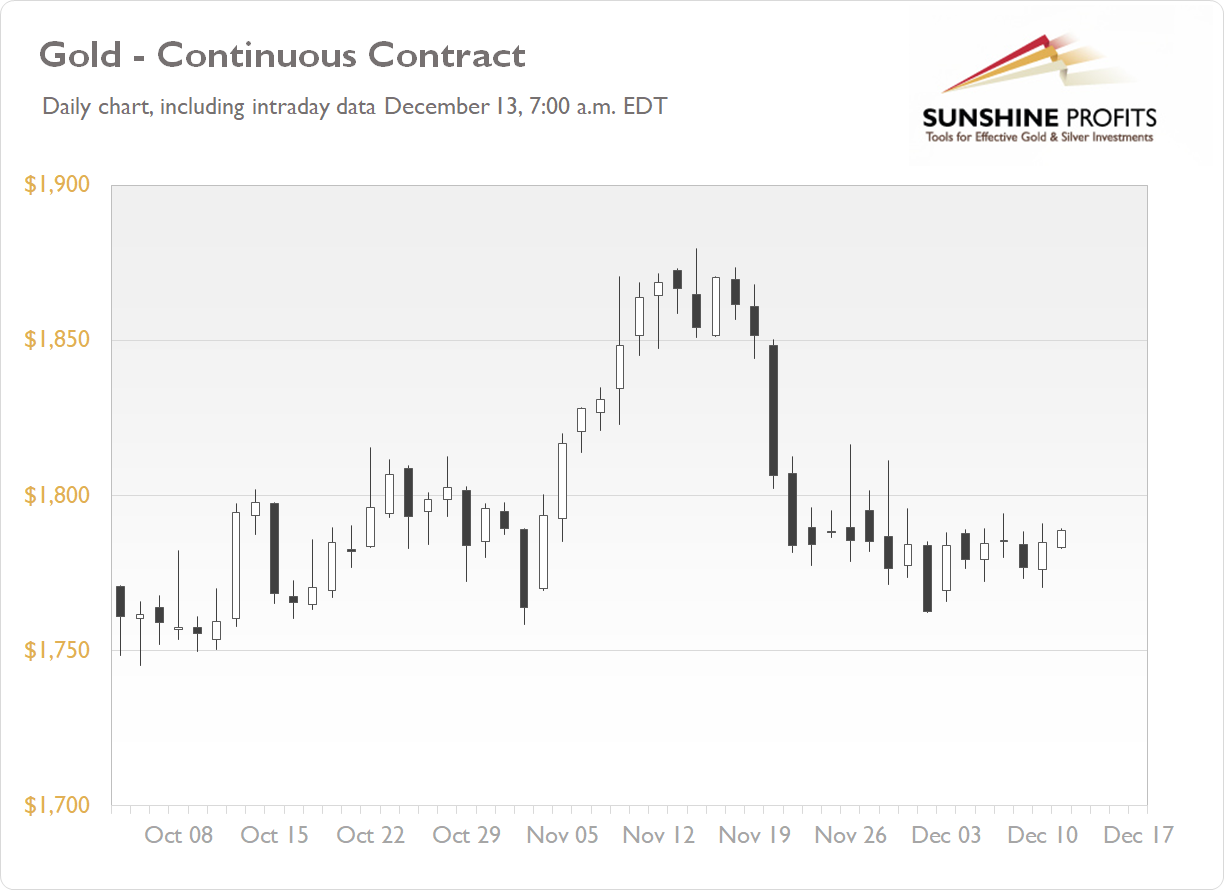
The gold futures contract gained 0.46% on Friday, as it retraced its Thursday’s loss of 0.5%. The market continues to fluctuate following the late November decline and a breakdown below the $1,800 level. It sold off in a reaction to strengthening US dollar and volatile stock prices, among other factors. This morning gold is trading slightly higher, as we can see on the daily chart (the chart includes today’s intraday data):
Gold

Gold is 0.3% higher this morning, as it gets closer to the $1,800 level again. What about the other precious metals? Silver is 0.1% higher, platinum is 0.3% lower and palladium is 0.8% lower. So precious metals’ prices are mixed this morning.

Friday’s Consumer Price Index release has been slightly higher than expected at +0.8% m/m. Today we won’t get any new important economic data announcements. The markets will be waiting for series of data releases on Tuesday and on Wednesday, including the important Wednesday’s FOMC Statement release.

Below you will find our Gold, Silver, and Mining Stocks economic news schedule for the next two trading days:

Monday, December 13

  • 12:00 p.m. U.K. - Bank Stress Test Results.

  • 12:30 p.m. U.K. - BOE Governor Bailey Speech.

  • All Day - G7 Meetings.

Tuesday, December 14

  • 6:00 a.m. U.S. - NFIB Small Business Index.

  • 8:30 a.m. U.S. - PPI m/m, Core PPI m/m.


Want free follow-ups to the above article and details not available to 99%+ investors? Sign up to our free newsletter today!


Want free follow-ups to the above article and details not available to 99%+ investors? Sign up to our free newsletter today!

Author

Paul Rejczak

Paul Rejczak

Gold Price Forecast

Paul Rejczak is a stock market strategist who has been known for the quality of his technical and fundamental analysis since the late nineties.


More from Paul Rejczak
Share:

Editor's Picks

AUD/USD sits at two-month lows near 0.6950 after Australian CPI data

AUD/USD is sitting at two-month lows near 0.6950 in the Asian session on Wednesday, as below-expectations August Australian underlying CPI data pours cold water on expectations for further RBA interest rate hikes. Chinese PMI data also fail to inspire the Australian Dollar, despite a pause in the US Dollar advance.

USD/JPY stays weak below 157.00 amid Japanese intervention risks

USD/JPY keeps losses below 157.00 in the Asian session on Wednesday, as hawkish BoJ expectations, along with intervention risks, underpin the Japanese Yen, countering dismal domestic factory output and retail sales data. Meanwhile, a broad US Dollar retreat also collaborates to the pair's downside.

Gold eyes US PCE inflation data for next move

Gold is consolidating the previous rebound from an eight-week low of $4,110 in Asia on Wednesday, although it remains below $4,200 ahead of the US ADP jobs report and core Personal Consumption Expenditures Price Index data.   


Bitcoin, Ethereum, and Ripple pause near recent highs as bullish momentum moderates

Bitcoin, Ethereum, and Ripple are showing signs of slowing bullish momentum mid-week after slight pullbacks from their recent highs. BTC faces resistance near $85,000, with ETH hovering around $2,674 and XRP holding near $1.500, as traders assess whether these top three cryptocurrencies can resume their recent rallies.

Warning: The RBI's October rate hike may be too late as oil risks mount
The Indian Rupee (INR) is one of the worst-performing Asian currencies in 2026, down about 6.5% year-to-date against the US Dollar (USD) and trading near historic lows ahead of the October 5–7 Reserve Bank of India (RBI) meeting. Economists expect the RBI to raise its repo rate by 25 basis points (bps) next month and follow up with another increase in December to counter rising retail inflation.
Silver is more volatile than Gold ahead of PCE and NFP. This chart shows the positioning gap
The market’s attention is focused on American data this week, but there’s something only those with a trained eye may be looking at: Gold and Silver positioning gap. Financial markets are moving on fears, mostly related to persistently high energy prices driven by the Middle East war. Sure, the US Dollar (USD) is strong, but at what cost?