Gold defended $1,800 bravely, but gave up

Gold fought valiantly, gold fought nobly, gold fought honorably. Despite all this sacrifice, it lost the battle. How will it handle the next clashes?
Have you ever felt trapped in the tyranny of the status quo? Have you ever felt constrained by some invisible yet powerful forces trying to thwart the fullest realization of your potential? I guess this is what gold would feel like right now – if metals could feel anything, of course.
Please take a look at the chart below. As you can see, January looked to be quite good for the yellow metal. Its price surpassed the key level of $1,800 at the end of 2021, rallying from $1,793 to $1,847 on January 25, 2022.
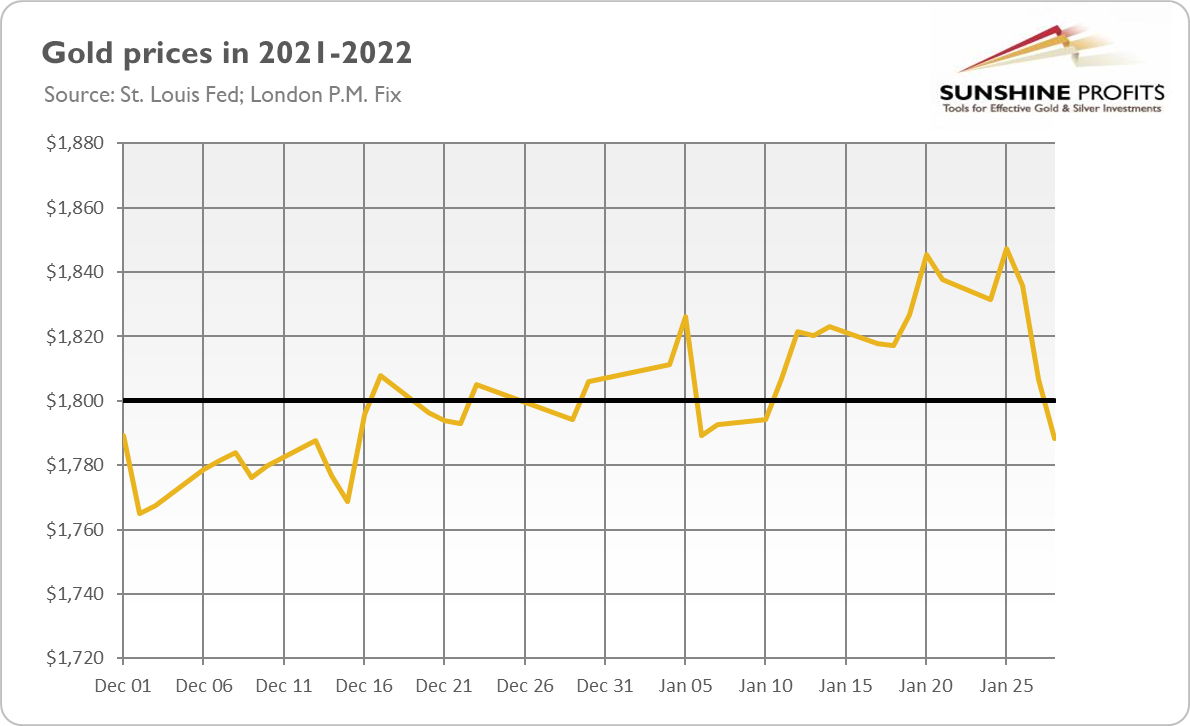
Then the evil FOMC published its hawkish statement on monetary policy. In its initial response, gold slid. That’s true, but it bravely defended its positions above $1,800 during both Wednesday and Thursday. There was still hope. However, on Friday, the metal capitulated and plunged to $1,788.
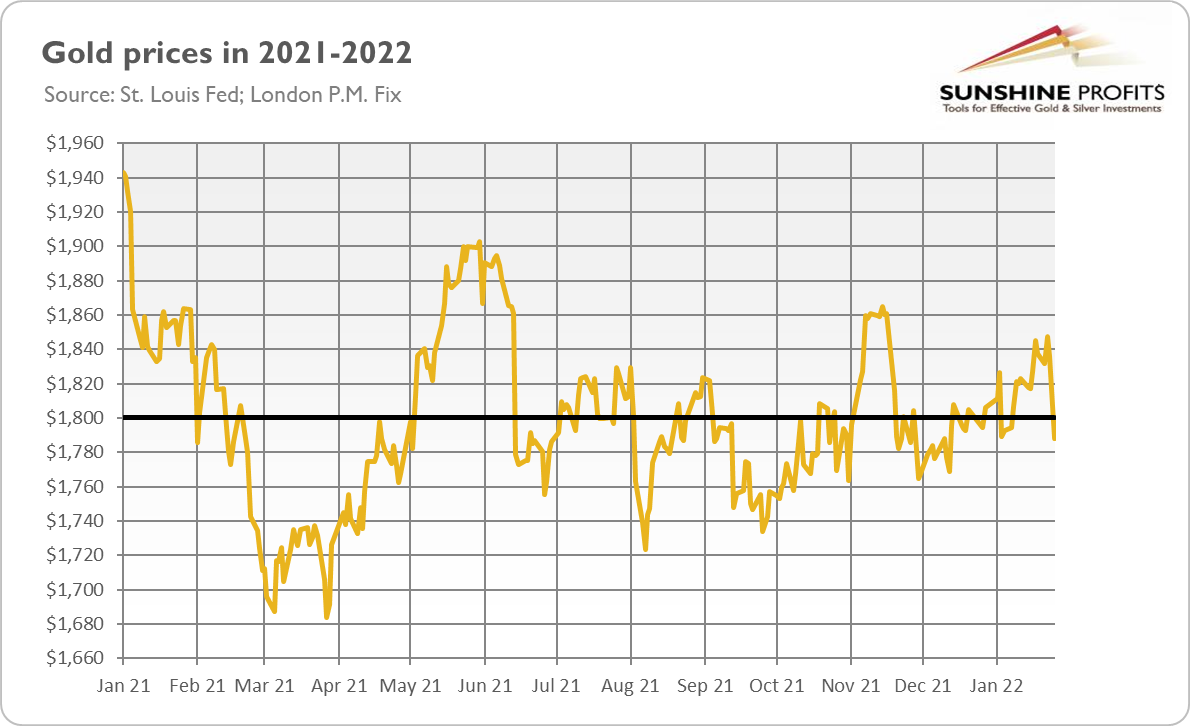
Here we are again – below the level of $1,800 that gold hasn’t been able to exceed for more than several days since mid-2021, as the chart below shows. Am I disappointed? A bit. Naughty goldie! Am I surprised? Not at all.
Although I cheered the recent rally, I was unconvinced about its sustainability in the current macroeconomic context, i.e., economic recovery with tightening of monetary policy (the surprisingly positive report on GDP in the fourth quarter of 2021 didn’t probably help gold), rising interest rates, and possibly a not-distant peak in inflation. In the previous edition of the Fundamental Gold Report, I described the Fed’s actions as “a big hawkish wave that could sink the gold bulls” and pointed out that “gold started its decline before the statement was published, which may indicate more structural weakness.” I added that it was also disturbing that “gold was hit even though the FOMC statement came largely as expected.” Last but not least, I concluded my report with a warning that “the upcoming weeks may be challenging for gold, which would have to deal with rising bond yields.”
My warning came true very quickly. Of course, we cannot exclude a relatively swift rebound. After all, gold can be quite volatile in the short-term, and this year could be particularly turbulent for the yellow metal. However, I’m afraid that the balance of risks for gold is the downside. Next month (oh boy, it’s February already!), we will see the end of quantitative easing and the first hike in the federal funds rate, followed soon by the beginning of quantitative tightening and further rate hikes.
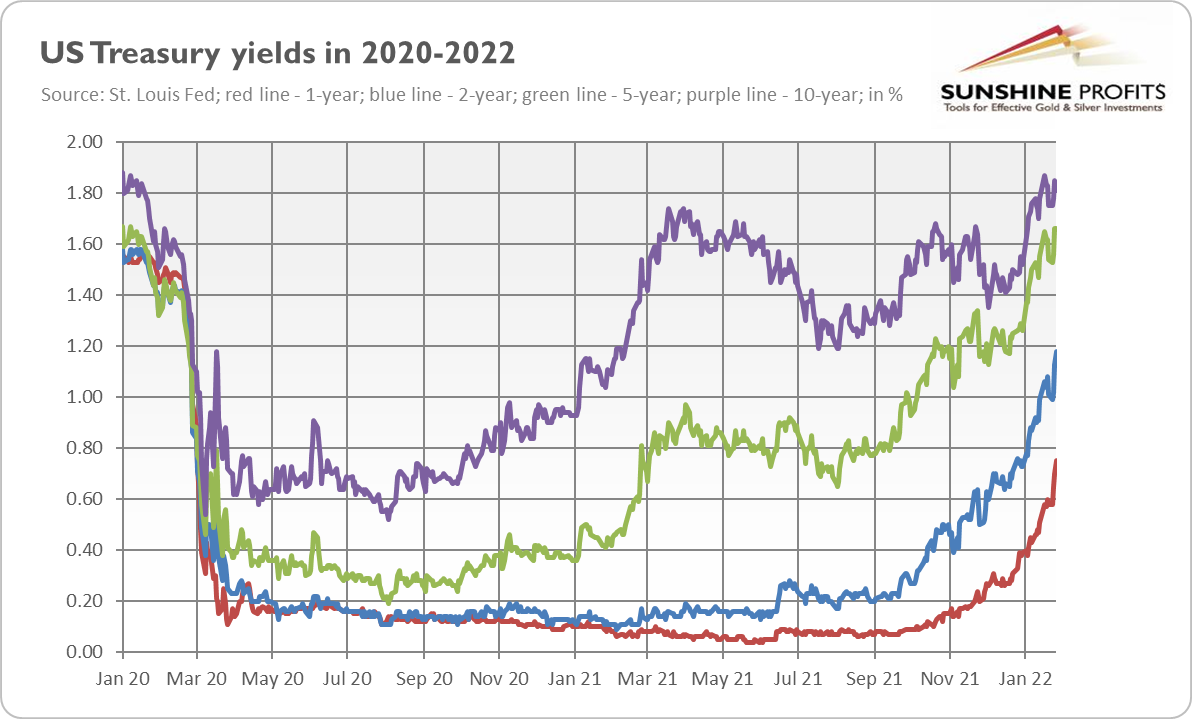
Using its secret magic, the Fed has convinced the markets that it has become a congregation of hawks, or even a cult of the Great Hawk. According to the CME Fed Tool, future traders have started to price in five 25-basis-point raises this year, while some investors believe that the Fed will lift interest rates by 50 basis points in March. All these clearly hawkish expectations led to the rise in bond yields (see the chart below), creating downward pressure on gold.
Implications for gold
What does the recent plunge in gold prices imply for investors? Well, in a sense, nothing, as short-term price movements shouldn’t affect long-term investments. Trading and investing should be kept separate. However, gold’s return below $1,800 can disappoint even the biggest optimists. The yellow metal failed again.
Not the first and not the last time, though. In my view, gold may struggle by March, as all these hawkish expectations will exert downward pressure on the yellow metal. In 2015, the first hike in the tightening cycle coincided with the bottom of the gold market. It may be similar this time, as the actual hike could ease some of the worst expectations and also push markets to think beyond their tightening horizon.
Want free follow-ups to the above article and details not available to 99%+ investors? Sign up to our free newsletter today!
Want free follow-ups to the above article and details not available to 99%+ investors? Sign up to our free newsletter today!
Author

Arkadiusz Sieroń
Gold Price Forecast
Arkadiusz Sieroń received his Ph.D. in economics in 2016 (his doctoral thesis was about Cantillon effects), and has been an assistant professor at the Institute of Economic Sciences at the University of Wrocław since 2017.