Gold declines on US Dollar surge but finds support amid geopolitical risks

Gold prices recently faced significant pressure, marking their steepest weekly decline since September 2023. The US Dollar's surge primarily drove the drop to a two-month low to a one-year high. Geopolitical tensions over the weekend provided relief as haven demand boosted the precious metal in early Asian trading. Conflicting forces of a strong dollar and heightened geopolitical uncertainty shape the market's near-term outlook.
Geopolitical developments remain a key driver for gold. US authorization of long-range missile use by Ukraine, escalating Russian aggression, and intensified military actions in the Middle East are fostering risk aversion. These tensions have sparked renewed interest in gold as a safe-haven asset. The metal's price movements are now closely tied to evolving geopolitical risks, with investor sentiment fluctuating alongside these developments.
Meanwhile, monetary policy continues to weigh on gold's trajectory. Comments from Federal Reserve officials, including Chair Jerome Powell, suggest a cautious approach to rate cuts. They cite resilient economic data and persistent inflation as key reasons for this stance. The benchmark 10-year US Treasury yield remains near multi-month highs, strengthening the US Dollar and creating headwinds for gold. These dynamics could limit the metal's upside potential even amid geopolitical uncertainty. More precise signals regarding the Fed's policy path will be necessary to drive significant gains.
Gold patterns amid geopolitical risks
The quarterly gold chart below presents a long-term bullish trend in gold prices for the past few decades. A key feature of this chart is the 44-year trendline, which has historically acted as a significant resistance point. The break above this trendline marked a pivotal shift in gold’s trajectory, signaling the potential for a sustained upward movement. This trendline, combined with a well-formed "cup" pattern, underscores the market's strong technical setup. The past consolidation phase has now given way to higher price levels. The breakout from the historical consolidation zone aligns with the broader bullish narrative in gold.
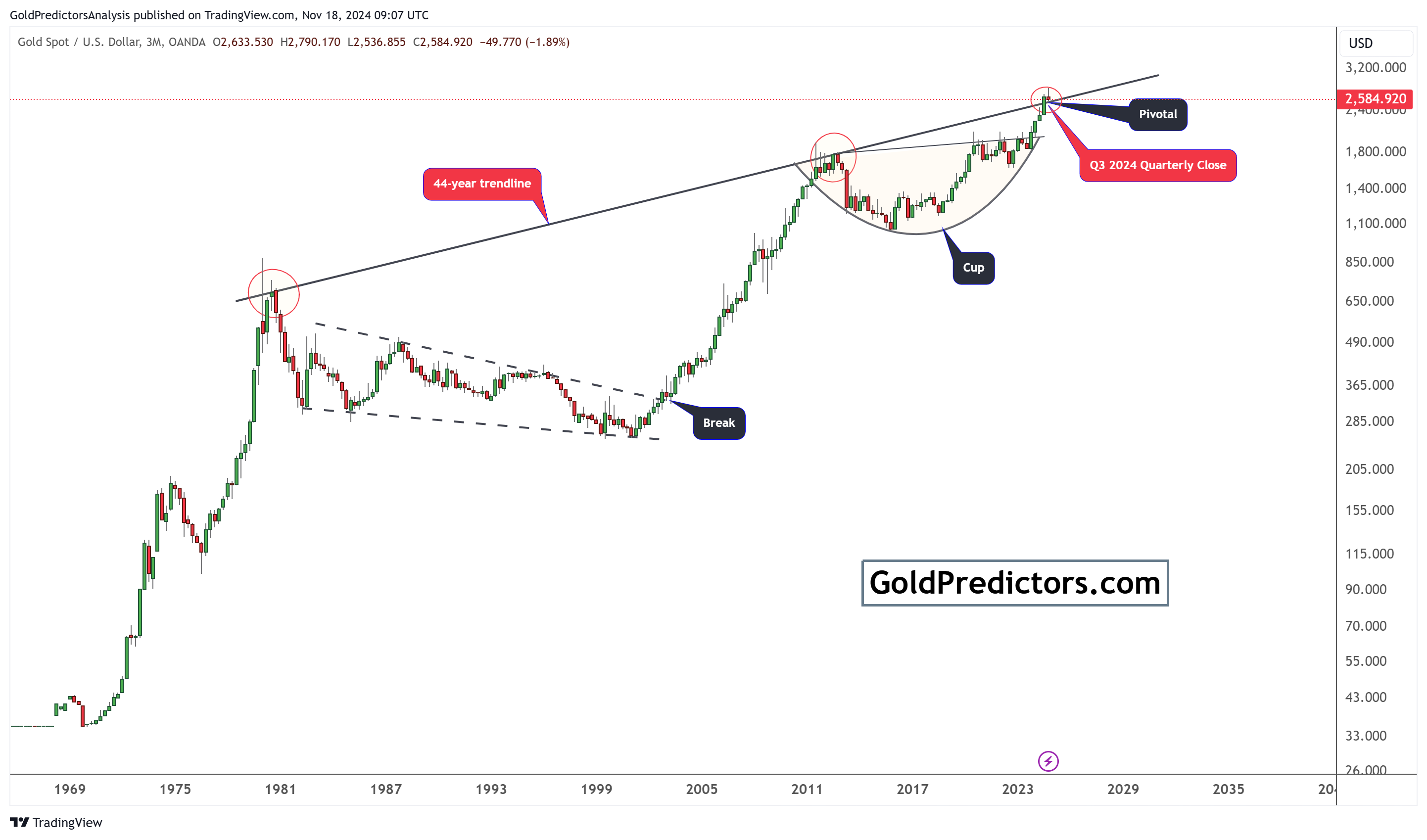
The Q3 2024 quarterly close is highlighted as pivotal, indicating a crucial confluence level for technical and market sentiment factors. The formation of the cup pattern reflects a long-term accumulation phase, which is now transitioning into a period of momentum-driven price gains. If gold sustains above this trendline and key levels, it could confirm the beginning of another major rally. Conversely, failure to hold above these critical levels could trigger a retest of previous support zones. Overall, the long-term chart indicates the gold's potential to be a haven asset amid economic uncertainty and geopolitical tensions.
Bottom line
In conclusion, gold remains at the crossroads of conflicting forces. Short-term pressures from a strong US Dollar and high Treasury yields continue to weigh on gold prices. However, these are balanced by long-term bullish momentum driven by geopolitical risks and technical patterns. The recent price dip reflects immediate challenges. However, the long-term chart highlights a sustained upward trend, with the Q3 2024 quarterly close marking a critical inflection point. The evolving geopolitical landscape and cautious Federal Reserve policies will be crucial in shaping gold’s near-term and long-term trajectory. These factors reinforce gold’s position as both a haven asset and a strategic investment opportunity during periods of uncertainty. The recent dip indicate that a buying opportunity in gold is coming soon.
Unlock exclusive gold and silver trading signals and updates that most investors don’t see. Join our free newsletter now!
Unlock exclusive gold and silver trading signals and updates that most investors don’t see. Join our free newsletter now!
Author

Muhammad Umair, PhD
Gold Predictors
Muhammad Umair is a financial markets analyst and investor who focuses on the forex and precious metals markets.