|

Gold bulls look exhausted near 2-week peak in very short-term [Video]

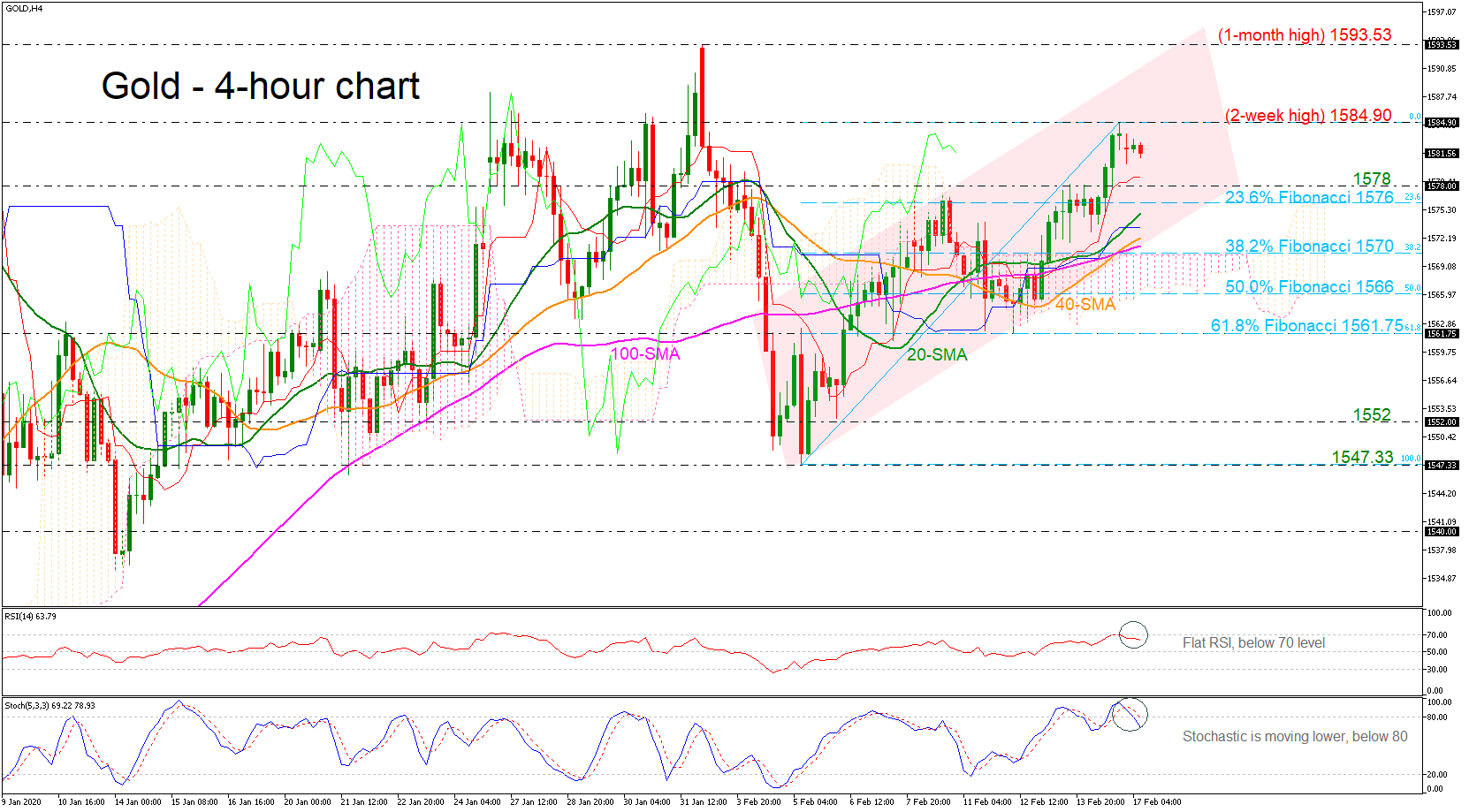
Gold stretched its upside rally to a two-week high of 1,584.90 on Friday before pulling slightly lower in a bullish sloping channel in the 4-hour chart.

Currently, in the near term, the price is losing some momentum confirmed by the technical indicators as the RSI is flattening near the 70 level, suggesting an overbought market. Also, the stochastic oscillator is turning lower as it posted a bearish crossover within its %K and %D lines above the 80 level, signaling a possible downside reversal as well. However, the market trend is holding far above its moving averages and the Ichimoku cloud.

Should the bears take control and the price extend lower, support to downside movements could be initially detected within the 1,578 – 1,576 area, which includes the 23.6% Fibonacci retracement level of the up leg from 1,547.33 to 1,584.90. Clearing that zone, the next stop could be around the 38.2% Fibo of 1,570, which overlaps with the upper surface of the Ichimoku cloud, but first it needs to slip below the 20-, 40-, and 100-period simple moving averages (SMAs). Below that, the 50.0% Fibo of 1,566 is coming into focus.

Alternatively, a jump above the two-week high of 1,584.90 could open the door for more gains towards the one-month high of 1,593.53, reached on February 3. Moreover, the almost seven-year high of 1,611 could serve as strong resistance too, continuing the long-term bullish tendency.

In the very short-term picture, the sentiment is neutral to bearish as the price is flattening below the two-week high. Despite the latest move, the price has been developing within an upward channel since February 5, adding optimism for a brighter outlook.
Gold

Author

Melina Deltas, CFTe

Melina joined Trading Point in December 2017 as a Market Analyst. She can clearly communicate market action, particularly technical and chart pattern setups.


More from Melina Deltas, CFTe
Share:

Editor's Picks

GBP/USD flirts with weekly highs in the Fed's aftermath

GBP/USD reversed early losses following the Federal Reserve decision to keep rates on hold and neared the 1.3360 level before shedding some ground. Focus shifts to Governor Kevin Warsh's speech, while the Bank of England will announce its monetary policy decision on Thursday.

EUR/USD extends rally pass 1.1450 on Fed's Warsh

EUR/USD trades at fresh weekly highs above 1.1450, following the Federal Reserve monetary policy decision to keep interest rates on hold. The statement showed policymakers remain confident in economic progress while blaming inflation on energy prices. The divided vote among officials put in doubt a September hike, leading to sharp US Dollar losses.

Gold  hovers around $4,100 as Fed decision hits the USD

Gold surged following the Federal Reserve's decision to keep the benchmark interest rate unchanged at 3.50%-3.75%. Policymakers noted that inflation remains elevated and that economic activity is expanding at a solid pace despite elevated uncertainty, spurring doubts about a rate hike in September. XAU/USD peaked above $4,100, now battling to retain the level.

Bitcoin slips below support, Ethereum and XRP flash bearish signals

Bitcoin, Ethereum and Ripple remain under pressure on Wednesday after a mild correction earlier this week. BTC slips below a key support zone, and ETH is testing a key resistance zone. Meanwhile, XRP is drifting toward the psychologically important $1.00 support level.

How the CLARITY Act unlocks Wall Street’s tokenization pipeline
The United States (US) Digital Asset Market Clarity Act (CLARITY Act), awaiting a full Senate floor vote, promises to unlock Wall Street’s potential to tokenize financial assets, including equities, US Treasuries, private credit, real estate and commodities at a scale that could supercharge the real-world asset (RWA) market from the current $17 billion level to $5.5 trillion by 2030, according to
US Dollar mid-year outlook: Exceptional currency, exceptional risks?
The US Dollar enters the second half of 2026 in a markedly different position from a year ago. The King currency has recovered, reflecting persistent US inflation, changing expectations for Fed policy, geopolitical tensions and renewed demand for defensive assets.