Global COVID-19 risk ranges up to $82 trillion


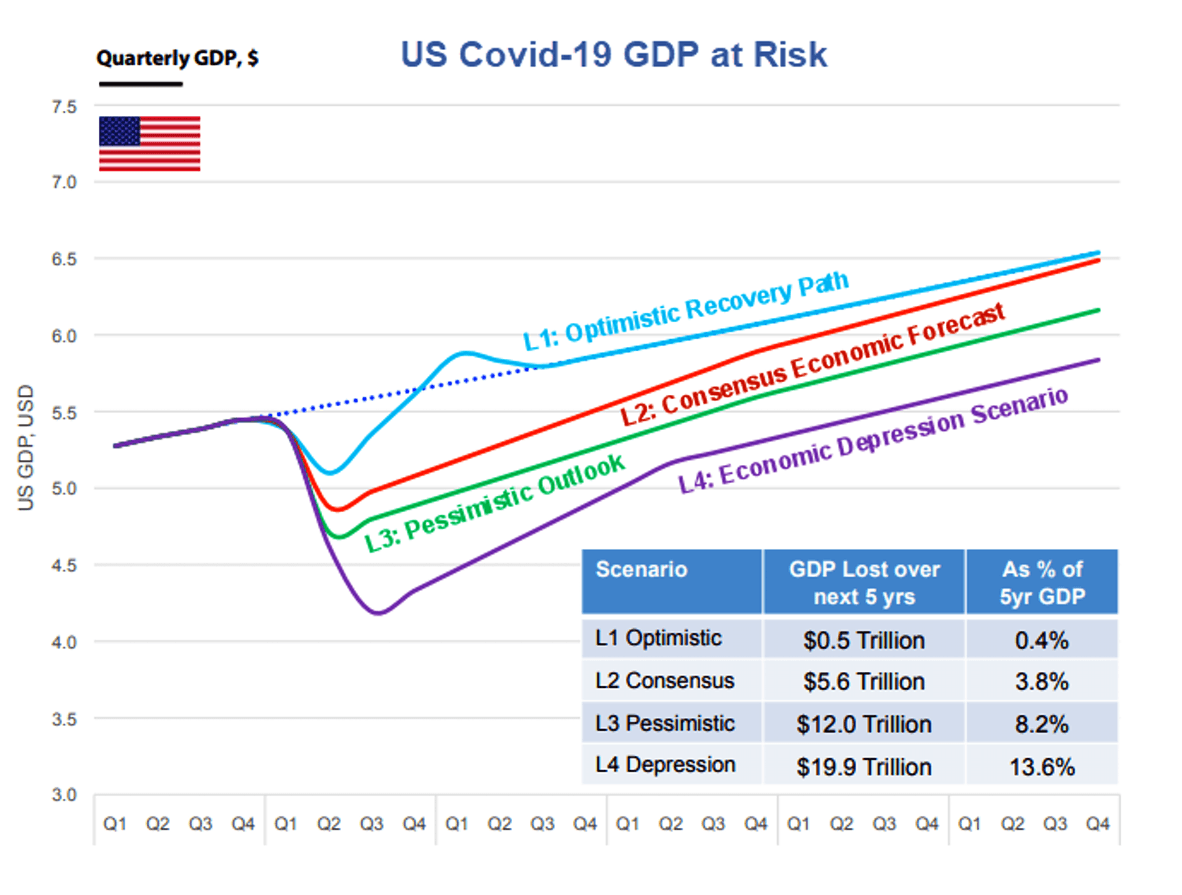
That is quite the wide range, but please consider the Centre for Risk Studies analysis of the Economic Impact of Covid-19.
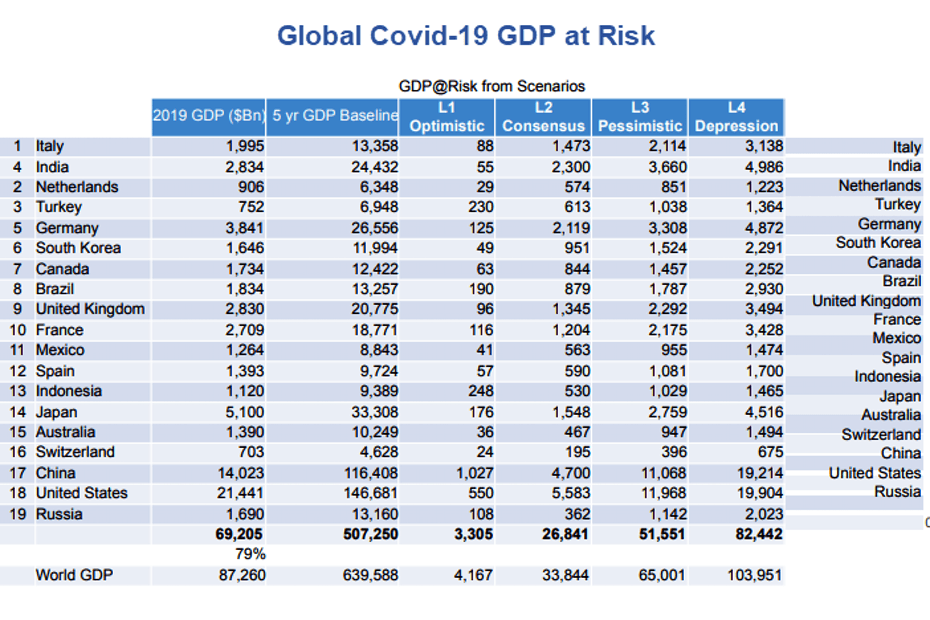
The GDP@Risk over the next five years from the coronavirus pandemic could range from an optimistic loss of $3.3 trillion (0.65 per cent of five-year GDP) under a rapid recovery scenario to $82.4 trillion (16.3 per cent) in an economic depression scenario, says the Centre for Risk Studies at the University of Cambridge Judge Business School.
Under the current mid-range consensus of economists, the GDP@Risk calculation would be $26.8 trillion or 5.3 per cent of five-year GDP, says a “COVID-19 and business risk” presentation prepared by the Centre for Risk Studies.
Under the Risk Centre’s projections, the GDP@Risk in the United States would range from $550 billion (0.4 per cent of five-year GDP) to $19.9 trillion (13.6 per cent), in the United Kingdom from $96 billion (0.46 per cent) to $3.5 trillion (16.8 per cent), and in China from $1.03 trillion (0.9 per cent) to $19.2 trillion (16.5 per cent).
The full report from the Cambridge Business Risk Hub requires a sign-in.
Four Scenarios
- L1: An Optimistic Recovery Path scenario in which pent-up demand fuels a rapid economic recovery with overshoot on the rebound, with short-term results better than currently expected
- L2: Consensus Economic Forecast – the mid-range of forecasts by economic experts, now calling for a slow recovery curve with some period of economic growth before the recovery process
- L3: Pessimistic Outlook of structural damage to the economy and a lengthy period of recession
- L4: Economic Depression Scenario of a long-term recession with the economy tipped into depression, with “worst-case” estimates by economists and negative assumptions such as severe second waves of infection or protectionist politics.
Global Covid-19 GDP at Risk
Too Early to Call
I am inclined to toss L1 and L4.
Note that that the consensus forecast of a 5.3% hit to GDP is not a V-Shaped recovery.
It is still too early. We do not know if Covid-19 will return in the fall, if a reliable vaccine is around the corner, or the results of early end of lockdowns.
There is also mutation risk that could later nullify even a successful vaccine.
Powell Warns Recovery May Stretch to the End of 2021
Meanwhile, please note Powell Warns Recovery May Stretch to the End of 2021
No Shocker
This is not a shocker although it is unusual for the Fed chair to be this blunt.
The message is warranted as the economic data has been nothing but grim.
- May 8: Over 20 Million Jobs Lost As Unemployment Rises Most In History
- May 15: Retail Sales Plunge Way More Than Expected
- May 15: Industrial Production Declines Most in 101 Years
Fed Promotes More Free Money
The Fed cannot directly give money away so that burden falls on Congress.
In additional unusual moves, Fed Chair Jerome Powell and Minneapolis Fed President Neel Kashkari both asked for Congressional Action.
This is a sign of panic. I commented on May 14, Panic Sets In: Fed Promotes More Free Money.
The Fed seldom steps in with fiscal recommendations, especially more deficit increasing measures.
Author
Mike “Mish” Shedlock's
Sitka Pacific Capital Management,Llc

















